


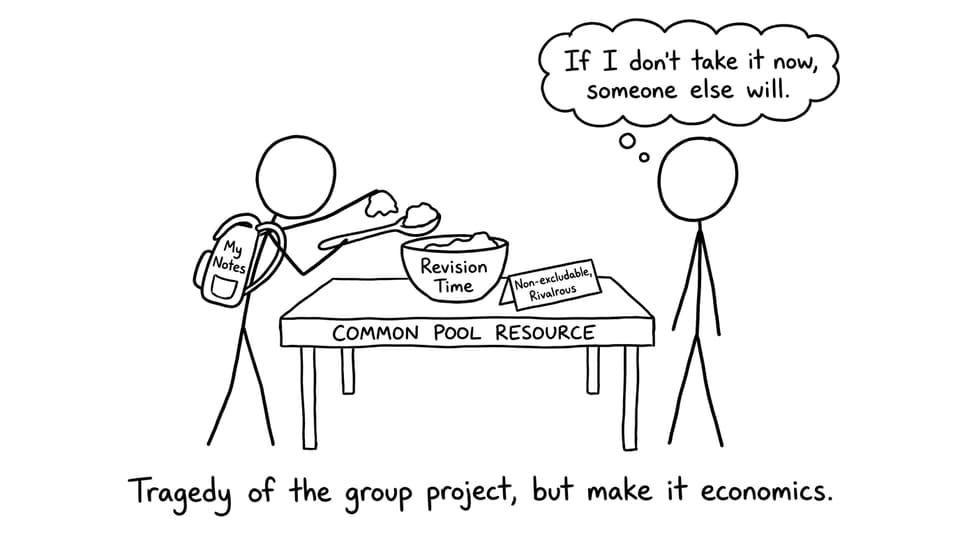
If you have ever watched a shared snack bowl disappear at a study session, you already understand the emotional core of this topic. No one plans to be selfish. But when something is open to everyone, the safest strategy can feel like taking a little more now -- before someone else does.
That instinct sits right at the centre of IB Economics when you study common pool resources and the tragedy of the commons.
The IB Economics definition you need
In IB Economics, common pool resources (also called common access resources) are:
-
Non-excludable: it is difficult to stop people from using them.
-
Rivalrous: one person’s use reduces what is left for others.
Classic examples include fisheries, forests, grazing land, and clean air. If your exam answer starts with “rivalrous and non-excludable,” you are already writing like the markscheme.
For syllabus-aligned notes, see 2.8 Market failure -- externalities, common pool resources, public goods.
Why common pool resources are often overused in IB Economics
No clear ownership (and no one feels responsible)
When property rights are unclear, nobody has a strong incentive to conserve. In IB Economics, this is the key logic: users receive the private benefit of extracting the resource, but the cost of depletion is shared across everyone. The result is overconsumption relative to the socially efficient outcome.
If you want the broader framing, connect it to resource allocation and market failure notes.
Free-rider behaviour becomes “rational”
Even students who care about sustainability can slide into free-riding: “If I cut back, others will just take more, and I lose out.” In IB Economics, that mindset explains why voluntary restraint often collapses, especially in large groups where individual actions feel invisible.
This links neatly to how public goods create free-riding too -- compare with What Are Public Goods? | IB Economics Market Failure Guide.
Weak enforcement makes rules optional
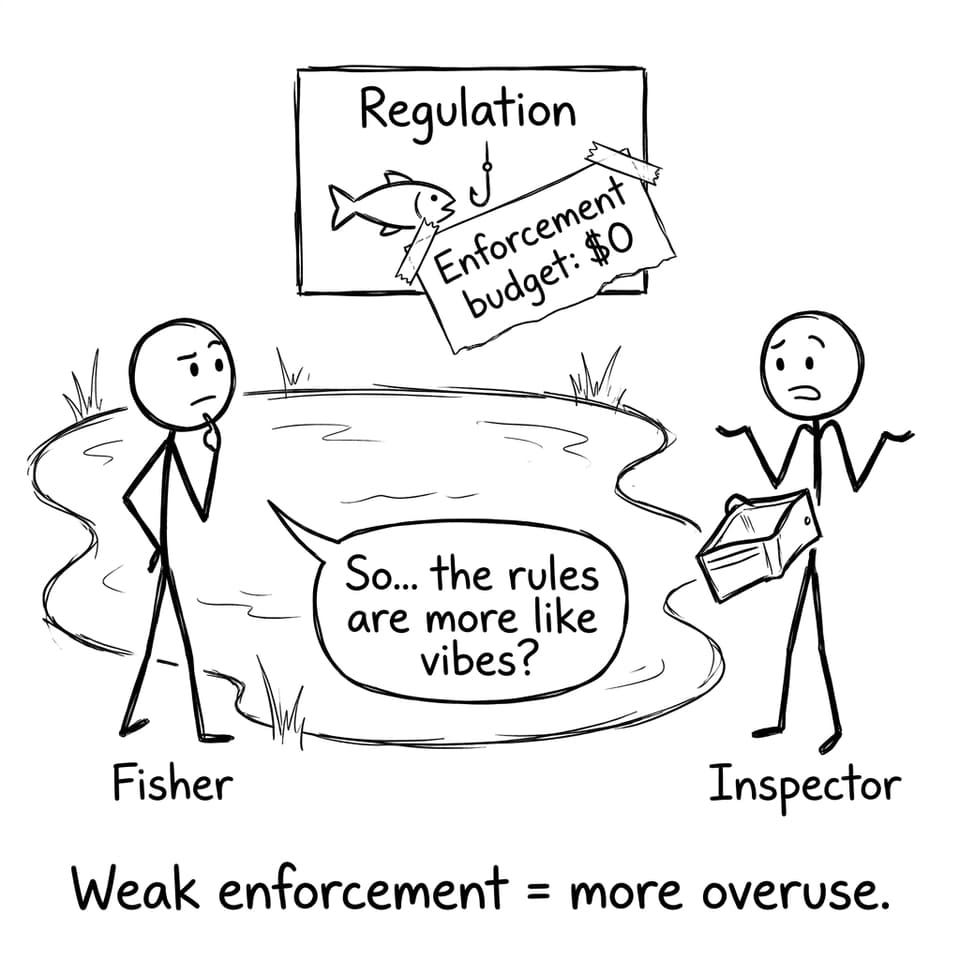
Rules without monitoring are basically wishful thinking. Remote forests, open oceans, and cross-border pollution are hard to police. In IB Economics, weak institutions and low enforcement budgets reduce the expected cost of breaking the rules, so extraction rises.
For policy responses you can evaluate in exams, browse 2.8.2 Government intervention in response to externalities and common pool resources.
Short-term incentives beat long-term thinking
A fisher might know that overfishing is destructive, but today’s income is certain while tomorrow’s fish stock is uncertain. IB Economics rewards you for stating this clearly: immediate private gain can dominate long-run social welfare, especially when competition pushes everyone to extract faster.
Imperfect information and uncertainty
Users often do not know the true regeneration rate or remaining stock. If people underestimate scarcity, they overuse. Even if they suspect depletion, uncertainty can still cause “grab it while it’s there” behaviour.
Exam-ready checklist (30 seconds)
Use this mini-structure in IB Economics responses:
-
Define common pool resources: rivalrous + non-excludable
-
Explain private incentive vs shared social cost
-
Use the phrase tragedy of the commons
-
Add 2 causes: free-riding, weak enforcement, short-term incentives, imperfect information
-
Briefly mention 1 solution (quotas, permits, regulation, property rights, international cooperation)
To practise exam-style responses, use the 2.8 Market failure Questionbank and tighten definitions with the 2.8 flashcards.
Closing: turn the theory into marks
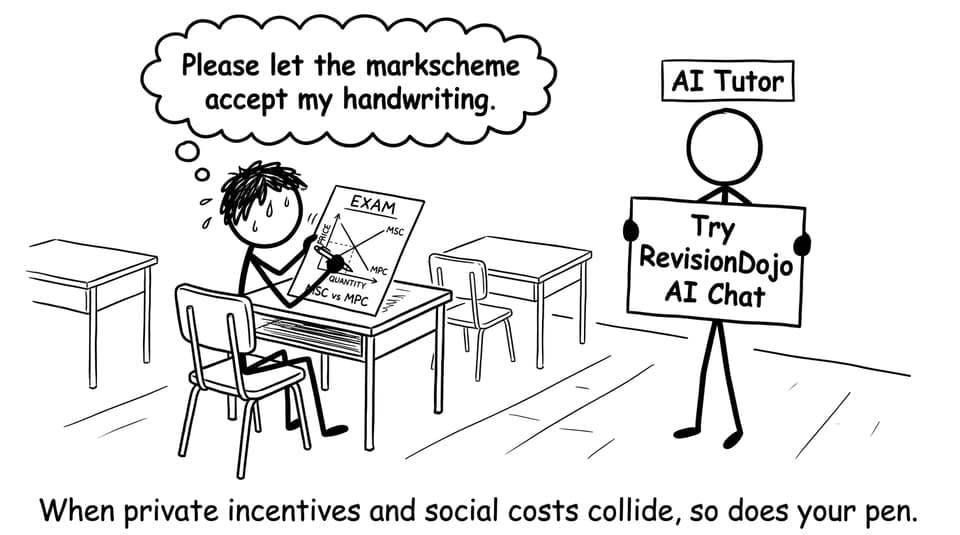
Common pool resources are often overused because the situation quietly trains people to act fast, not wisely. IB Economics is really asking you to spot that incentive mismatch -- private gain now, shared cost later -- and explain why it leads to the tragedy of the commons.
If you want to lock this in for exam day, build a tight loop: learn the definitions in RevisionDojo Study Notes, drill them with Flashcards, apply them in the Questionbank, and use AI Chat to test whether your explanation matches markscheme language. Then add Mock Exams, Predicted Papers, and Grading tools when you are ready to simulate pressure -- and use the Tutors option if you want targeted feedback on evaluation.
