


A small choice that quietly shapes society
On revision week, you feel scarcity in a very personal way: time, energy, focus. Every decision to spend 20 minutes on diagrams means 20 minutes not spent on evaluation. That trade-off is exactly why IB Economics keeps returning to one deceptively simple idea: allocative efficiency.
Allocative efficiency is when resources produce the mix of goods and services society values most. In IB Economics, you say this with the condition marginal benefit (MB) = marginal cost (MC). At that point, total welfare (social surplus) is maximised. And when you understand why that matters, a lot of exam questions suddenly stop feeling random.
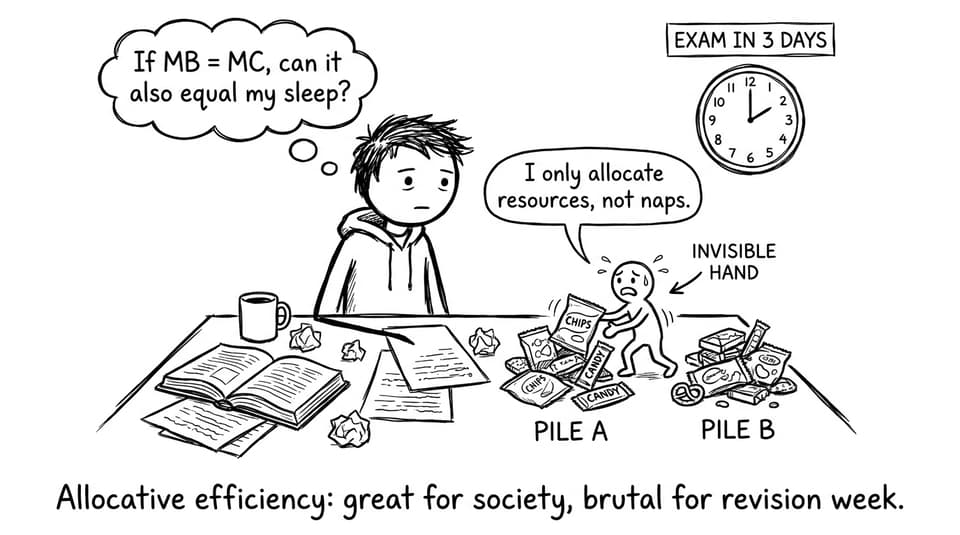
Quick exam checklist (what to write in Paper 1)
-
Define allocative efficiency: MB = MC, social surplus maximised
-
Mention scarcity: resources are limited, so allocation matters
-
Use welfare language: consumer surplus + producer surplus
-
Explain what goes wrong: market failure shifts MB/MC away from the social optimum
-
Add one policy link: tax, subsidy, regulation, competition policy
For tight definitions, keep the IB Economics Key Definitions open while you practise.
Allocative efficiency in IB Economics: the welfare story
The reason allocative efficiency matters for society is not abstract. It’s about whether limited labour, land, capital, and entrepreneurship end up creating what people actually need and value.
In IB Economics, the “sweet spot” happens when the last unit produced gives society exactly as much benefit as it costs to make. Produce less, and society misses out on net benefits (MB > MC). Produce more, and you waste resources on output people value less than it costs to produce (MC > MB). This is why the competitive equilibrium is often linked to allocative efficiency in your syllabus notes.
If you need the full syllabus framing, use 2.3.6 Allocative efficiency at the competitive market equilibrium (Notes) and then lock it in with 2.3.6 Allocative efficiency (Flashcards).
When allocative efficiency breaks: why society pays the price
The tougher (and more realistic) part of IB Economics is recognising that allocative efficiency doesn’t always happen.
-
Externalities mean private costs/benefits differ from social costs/benefits, so prices send the wrong signal.
-
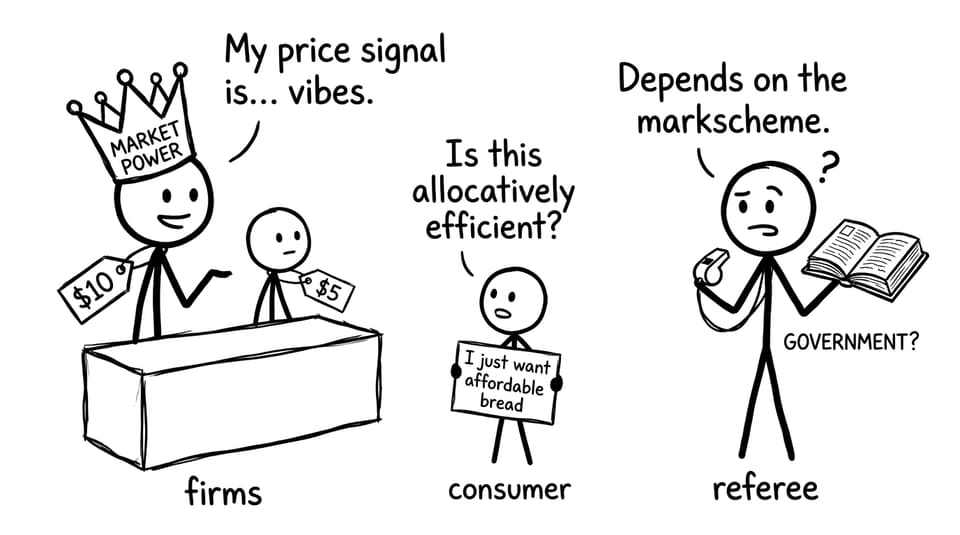
Market power (monopoly/oligopoly) can restrict output and raise price, creating under-allocation.
-
Information failure can lead consumers to choose poorly, even when markets look “competitive.”
-
Public goods may be underprovided because firms can’t profit from them.
If you want one strong “why” to use in evaluation: when the price mechanism is distorted, society gets the wrong mix of output, creating welfare loss.
To revise the policy angle, pair Why Understanding Market Failure Matters with the micro content hub at Economics - IB Resources.
How to turn this into marks (fast)
In IB Economics essays, allocative efficiency is often the “welfare backbone” of your chain analysis. A practical routine:
-
Practise one definition + one diagram explanation daily.
-
Use a real-world example, even a simple one (eg carbon tax, congestion charge).
-
Evaluate: efficiency vs equity, short run vs long run, government failure risk.
On RevisionDojo, students usually make the quickest progress by combining the Study Notes with the Questionbank and then using AI Chat to test explanation quality.
Try targeted practice from 2.3 Competitive Market Equilibrium Questionbank and broaden with the IB Economics 2. Microeconomics Questionbank.
Final thought: make efficiency feel personal
Allocative efficiency matters because society is always choosing, even when it doesn’t look like a choice. Health care, transport, education, climate policy, they all come down to whether scarce resources match what people value most.
If you want to turn that understanding into exam performance, RevisionDojo gives you the full toolkit: Questionbank practice, structured Study Notes, rapid Flashcards, AI Chat for feedback, Grading tools, Predicted Papers, Mock Exams, a Coursework Library, and Tutors when you want human guidance. Build your IB Economics explanations until MB=MC feels as natural as writing your name at the top of Paper 1.