


A quick hook: the economy is a group project
In IB Economics, aggregate demand can feel like a neat curve you memorise the night before an exam. But in real life, it behaves more like a group project: when everyone contributes at a steady pace, progress is calm and predictable. When someone suddenly does everything (or nothing), the whole system becomes unstable.
Aggregate demand (AD) matters for stability because it drives short-run changes in real output, unemployment, and inflation. If you can explain that chain clearly, you can handle a surprising number of Paper 1 and Paper 2 questions.
The AD stability checklist (exam-ready)
Use this as your quick plan when you see an AD question in IB Economics:
-
Define AD as total planned spending: C + I + G + (X-M)
-
Explain what a rise in AD tends to do: output up, unemployment down, inflation pressure up
-
Explain what a fall in AD tends to do: output down, unemployment up, disinflation/deflation risk up
-
Add evaluation: size of spare capacity, time lags, confidence, and supply-side constraints
For the syllabus version of AD, go straight to IB Economics 3.2.1 Aggregate Demand and the matching Aggregate demand (AD) notes.
Why aggregate demand matters for economic stability
When AD rises: growth feels good (until it doesn’t)
A higher aggregate demand usually means firms experience stronger sales. They respond by producing more, hiring more workers, and investing in capacity. In IB Economics, that story is your bridge from “AD shifts right” to the macro objectives: higher output and lower cyclical unemployment.
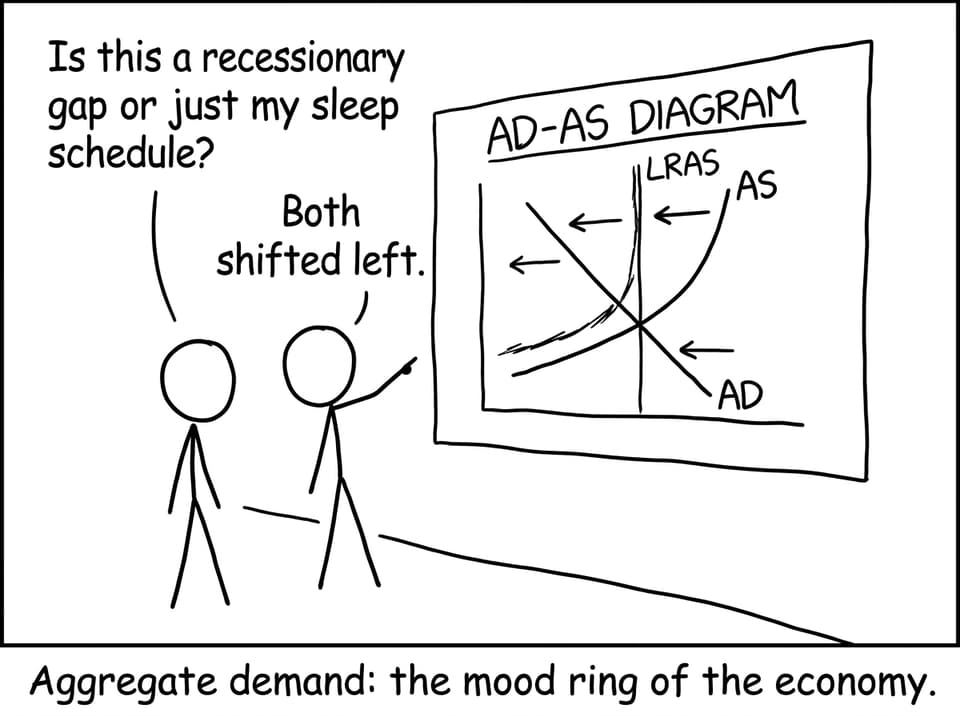
But stability is about sustainable growth. If AD rises faster than the economy’s ability to produce (productive capacity), you can get demand-pull inflation. That’s the moment where a positive boom starts to look like overheating. If you need clean inflation wording and diagrams, use Low and stable rate of inflation notes.
When AD falls: recessions are confidence spirals
A fall in aggregate demand doesn’t just reduce spending once. It can create feedback loops: firms cut output, workers lose income, consumer confidence drops, and spending falls again. In IB Economics, this is why downturns are associated with rising cyclical unemployment and a widening negative output gap.
That’s also why policymakers watch AD closely. They’re trying to stop a temporary shock turning into a longer slump.
If you want broader context for how these ideas sit inside the course, see IB Economics 3. Macroeconomics and the Macroeconomic objectives notes.
The policy angle: keeping AD near “full employment” output
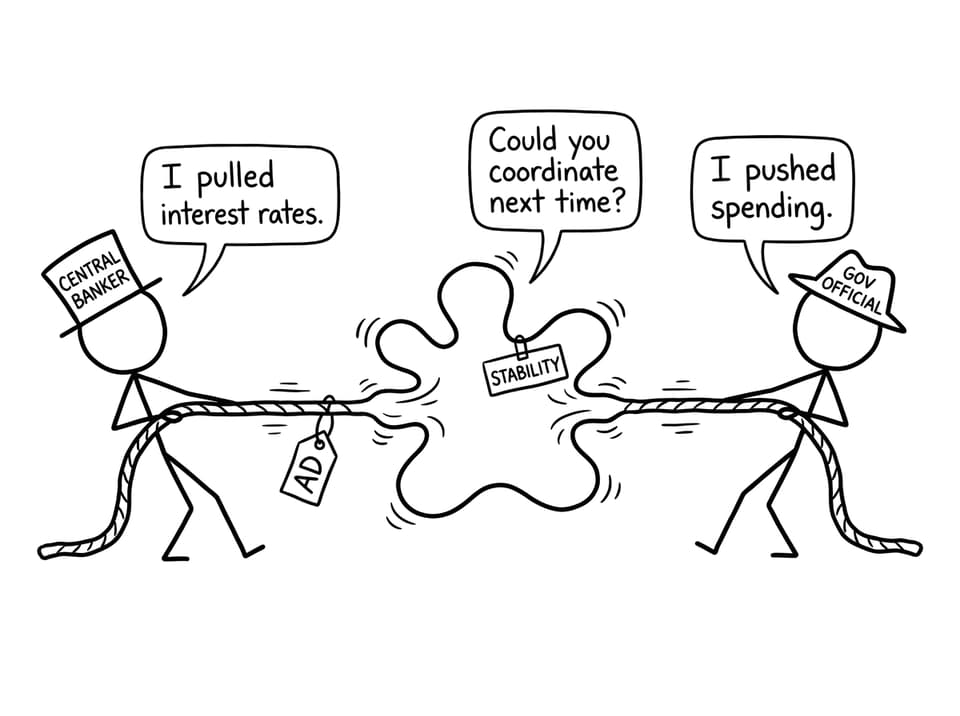
In IB Economics, demand management is basically the stabiliser toolkit:
-
Monetary policy (interest rates) influences borrowing and spending
-
Fiscal policy (taxes and government spending) directly shifts AD
The goal isn’t constant growth at any cost. The goal is fewer violent swings, because big swings make planning harder for households and firms.
For an exam-focused fiscal policy walkthrough, use Revision Tips: Fiscal Policy Guide for IB Economics and practise with the Topic 3.2 questionbank.
How to turn this into marks (without writing more than necessary)
Strong IB Economics answers often do one simple thing: they link the diagram to the real-world variables.
Try this sentence structure:
-
“An increase in AD (right shift) raises real output in the short run, reducing cyclical unemployment.”
-
“If the economy is near full capacity, the same AD increase is more likely to increase the price level, causing demand-pull inflation.”
-
“Therefore, stabilising AD supports internal balance: low unemployment and low, stable inflation.”
To drill that skill quickly, RevisionDojo helps you loop content into performance: learn it in Study Notes, lock it in with Flashcards, and test it in the Questionbank. Then use AI Chat and Grading tools to polish evaluation paragraphs.
Conclusion: learn AD once, use it everywhere
Aggregate demand matters for stability because it sits at the centre of short-run economic fluctuations: output, jobs, and inflation move with it. In IB Economics, that means AD is not just a definition to memorise, but a framework you can apply across macro objectives and policy questions.
If you want to make this topic feel automatic, build a simple routine on RevisionDojo: start with IB Economics resources, revise AD using the 3.2.1 notes, practise in the Macroeconomics Questionbank, then pressure-test with Economics Predicted Papers and Mock Exams. Add Flashcards, AI Chat, and Tutors when you need speed, feedback, and strategy.