



In IB Physics, there’s a quiet moment when a problem finally “clicks.” It usually happens when you stop treating formulas like magic spells and start seeing them as translations of something physical.
Frequency and period are one of those translations.
A speaker vibrates. A pendulum swings. A current alternates. Something repeats. And in IB Physics, repetition always comes with two equally valid questions: How often does it happen? and How long does one repeat take?
Quick checklist for IB Physics students
Before you touch your calculator, make sure you can say these out loud:
-
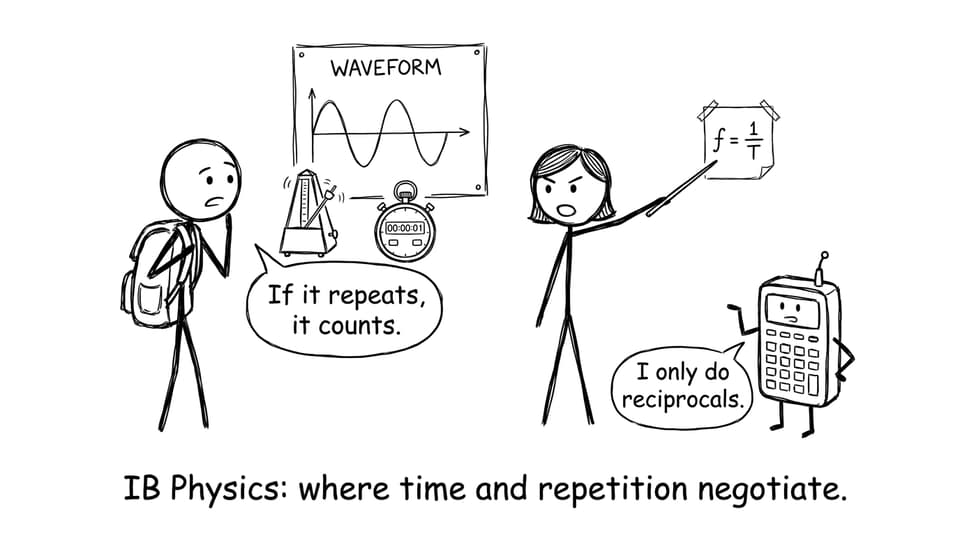
Frequency (f) = cycles per second (unit: Hz, which equals s⁻¹)
-
Period (T) = seconds per cycle (unit: s)
-
They are reciprocals: f = 1/T and T = 1/f
-
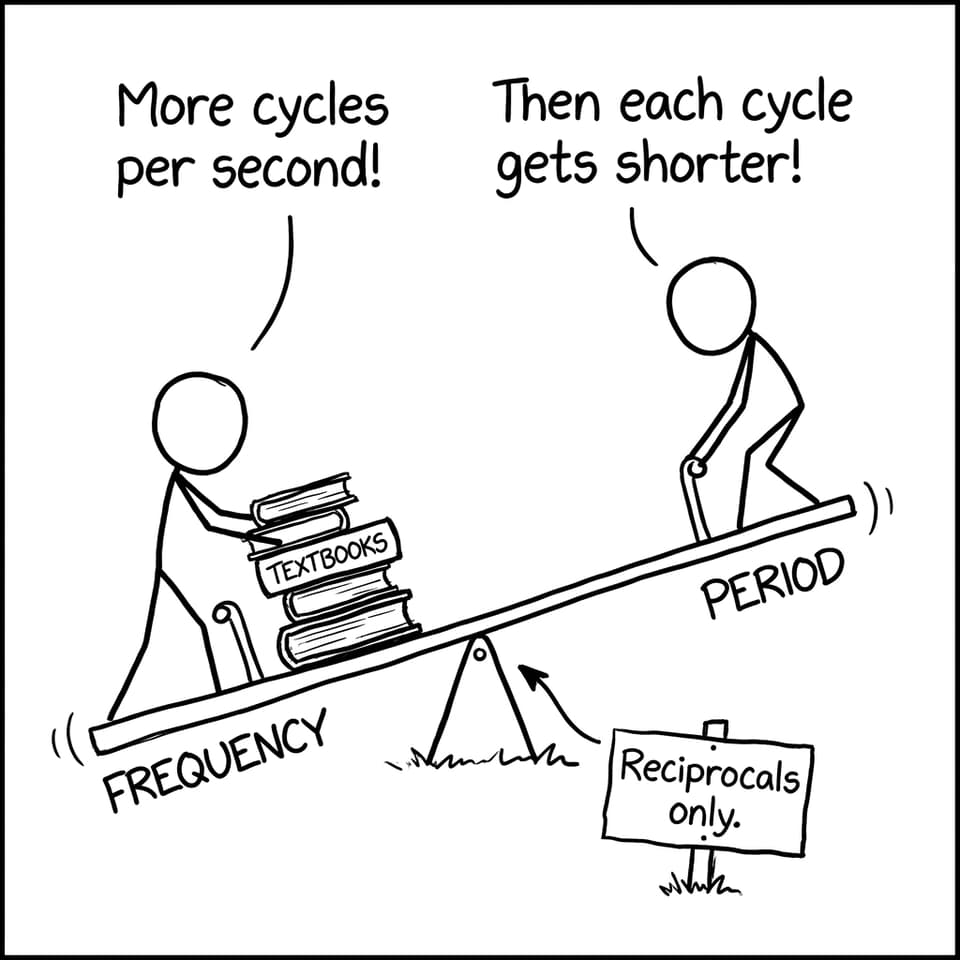
If one goes up, the other must go down (for the same motion)
If you want to see where this lives in the official equation ecosystem, keep the IB Physics Data Booklet open while you practise.
The core relationship in IB Physics: f = 1/T
The relationship between frequency and period is the kind of simple that can still cost marks if you rush.
-
Frequency = 1 / Period
f = 1/T -
Period = 1 / Frequency
T = 1/f
Why does IB Physics love this? Because it connects measurement to meaning.
If you time one full cycle, you get the period.
If you count how many cycles happen in one second, you get frequency.
You’re looking at the same repeating event from two angles.
A useful mental check: if the period is small (fast cycles), the frequency must be big. Reciprocals force that logic.
What frequency and period actually mean (with exam-friendly examples)
In IB Physics, definitions are not decoration. They’re often the shortest route to the right method.
Frequency (f)
Frequency is how many complete cycles happen per second.
Example: If a wave source produces 10 cycles every second, then:
-
f = 10 Hz
-
T = 1/f = 0.1 s
Period (T)
Period is how long one complete cycle takes.
Example: If one oscillation takes 0.25 s, then:
-
T = 0.25 s
-
f = 1/T = 4 Hz
If waves are the context, you’ll often convert quickly so you can use wave equations like those in Wave Characteristics notes.
Where this shows up across IB Physics topics
Frequency and period aren’t a “waves-only” thing. They’re a repeating pattern across the syllabus.
Waves and the wave equation
In wave questions, frequency is frequently the bridge into speed:
- v = fλ
So even if the question gives period, IB Physics expects you to switch forms confidently.
To practise the style of wave questions where this conversion is automatic, use the Oscillations and Waves Questionbank.
Oscillations and SHM
In simple harmonic motion, time-based thinking becomes everything: timing peaks, reading graphs, interpreting phase.
RevisionDojo’s Oscillations notes and Simple harmonic motion notes are ideal when you’re trying to connect the idea of “one cycle” to real motion.
If you’re focusing on how period is derived (and what it depends on), the Time period of oscillatory systems notes are especially useful.
Circular motion
Circular motion is basically “period and frequency wearing a different outfit.” The object repeats its path.
If one revolution takes time T, then the frequency is still f = 1/T. And many questions quickly shift from that into angular quantities.
See Circular motion notes for how this conversion supports later steps.
Common mistakes that lose marks (and how to avoid them)
The relationship is simple. The exam traps are not.
-
Unit confusion: milliseconds vs seconds. If T is in ms, convert to s before using IB Physics equations.
-
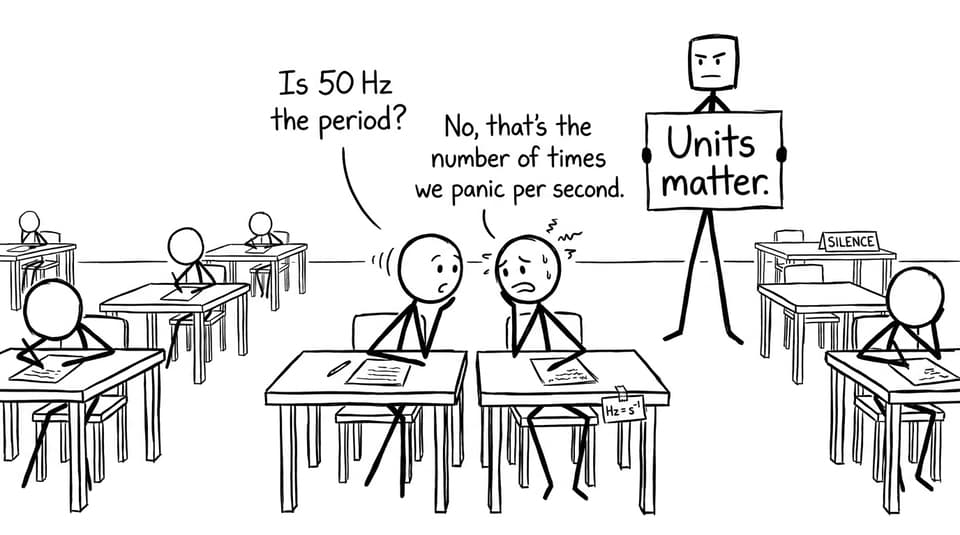
Hz misunderstandings: Hz is not a “mystery unit.” It’s s⁻¹.
-
Mixing up f and ω: angular frequency ω is related but different (ω = 2πf). Many students substitute ω where f is required.
-
Graph misreads: period comes from the time between identical points on a wave/oscillation (peak-to-peak, not peak-to-midline).
The fastest fix is deliberate practice with feedback. That’s exactly what RevisionDojo’s Questionbank and Grading tools are designed for: you practise conversions, submit steps, and learn where your method slips.
Bringing it back to your exam routine
In IB Physics, frequency and period are small ideas with long shadows. They show up in waves, SHM, circular motion, and any question where repetition matters. If you master f = 1/T early, you stop losing marks to avoidable conversions and you start reading questions faster.
To make that automatic, use RevisionDojo as your practice loop: learn the concept in the Study Notes, drill it in the Questionbank, lock it in with Flashcards, and troubleshoot with AI Chat when a step feels unclear. When exam season tightens, RevisionDojo’s Mock Exams and Predicted Papers help you practise under pressure, while Grading tools show you how to write solutions that earn method marks.
For a bigger-picture strategy on pushing your score higher in IB Physics, keep this guide nearby: The Quest for a 7 in IB Physics.