


In IB Physics, the marks you lose on uncertainty questions rarely come from “not knowing physics.” They come from something quieter: reporting a measurement as if reality is sharper than your instrument allows.
A ruler, a stopwatch, a balance: each one is a translator. It turns the messy, continuous world into a neat number. Absolute uncertainty is how you admit what got lost in translation. And in IB Physics, that honesty is not optional: it shapes your data tables, your graphs, your calculations, and often your final conclusion.
The absolute uncertainty checklist (keep it nearby)
Before you write any measurement in IB Physics, run this quick checklist:
-
Identify whether the instrument is analogue or digital.
-
Find the smallest division (analogue) or last displayed digit (digital).
-
Decide if human reaction time matters (timing experiments often need it).
-
If you repeated readings, compute the range and use range/2.
-
Report as: best estimate ± absolute uncertainty, with units.
-
Match decimal places in the value and the uncertainty.
For deeper practice, the Measurements and Uncertainties topic hub ties these ideas together the way exam questions do.
What is absolute uncertainty in IB Physics?
Absolute uncertainty is the plus-or-minus margin that tells the examiner (and your future self) how precise a measurement really is. It is written in the same units as the measurement.
Example:
- (L = 45.0 \pm 0.1,\text{cm})
Here, (\pm 0.1,\text{cm}) is the absolute uncertainty. In IB Physics, absolute uncertainty usually comes from:
-
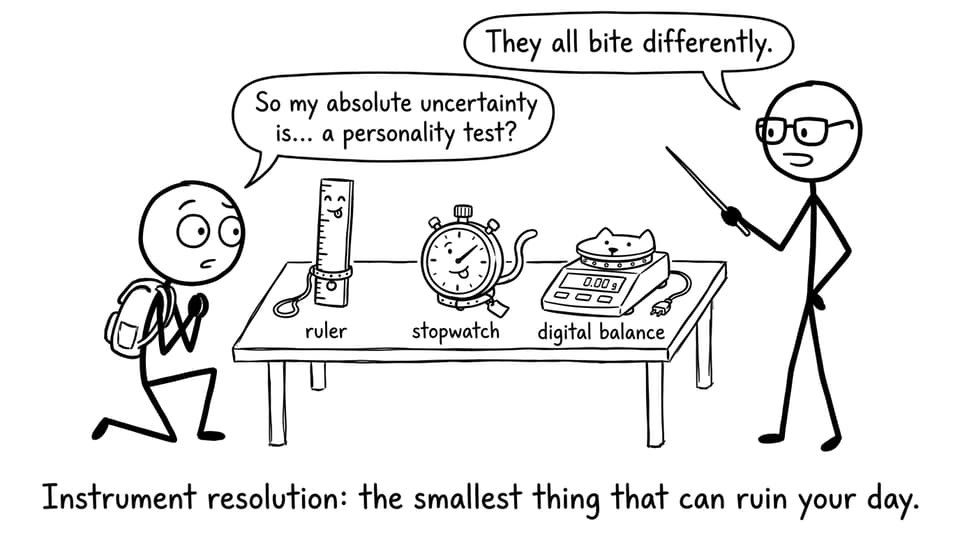
Instrument resolution (your tool cannot show anything smaller)
-
Reaction time (especially with stopwatches)
-
Random variation (repeat readings never match perfectly)
If you want a syllabus-aligned explanation with the exact language IB expects, use Notes for 1.2: Uncertainties and errors.
The formula to calculate absolute uncertainty (the one you actually use)
In IB Physics, you’ll meet two core “formulas” for absolute uncertainty depending on how the measurement is taken.
IB Physics absolute uncertainty for analogue instruments
Absolute uncertainty = ± (half the smallest scale division)
This is the standard rule for analogue tools like metre rules, protractors, and analogue ammeters.
Examples:
-
Ruler marked every 1 mm: (\Delta L = \pm 0.5,\text{mm})
-
Protractor marked every 1°: (\Delta\theta = \pm 0.5^\circ)
Why half? Because with analogue readings, you estimate between marks. Your best guess might be slightly above or below the true value by about half a division.
IB Physics absolute uncertainty for digital instruments
Absolute uncertainty = ± (smallest displayed increment)
Examples:
-
Digital balance reading to 0.01 g: (\Delta m = \pm 0.01,\text{g})
-
Digital stopwatch showing 0.01 s: (\Delta t = \pm 0.01,\text{s})
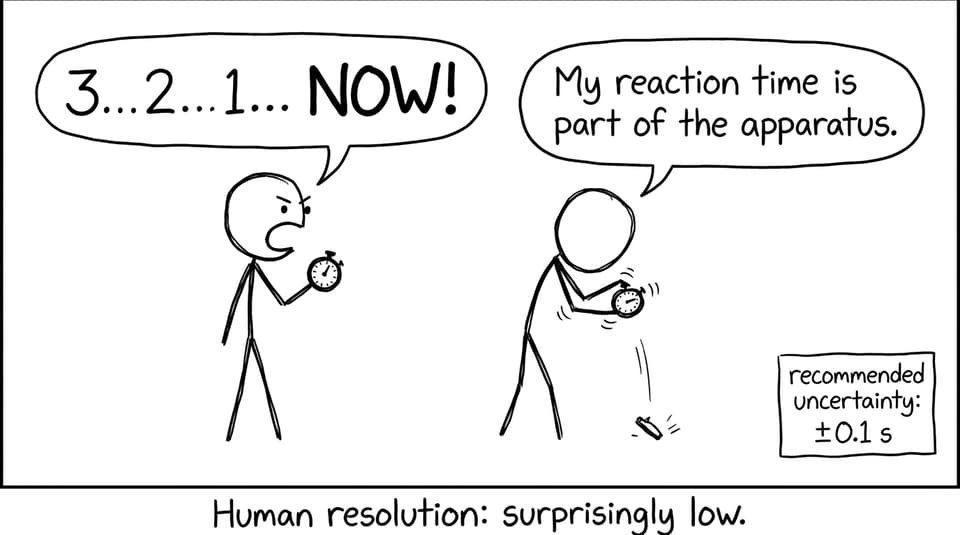
But here’s the IB Physics catch: timing is often limited more by you than by the display. Many teachers (and markschemes) accept using something like (\pm 0.1,\text{s}) to reflect reaction time when humans start/stop the clock.
Absolute uncertainty from repeated measurements (range/2)
When you take repeated measurements in IB Physics, you can estimate absolute uncertainty from the spread:
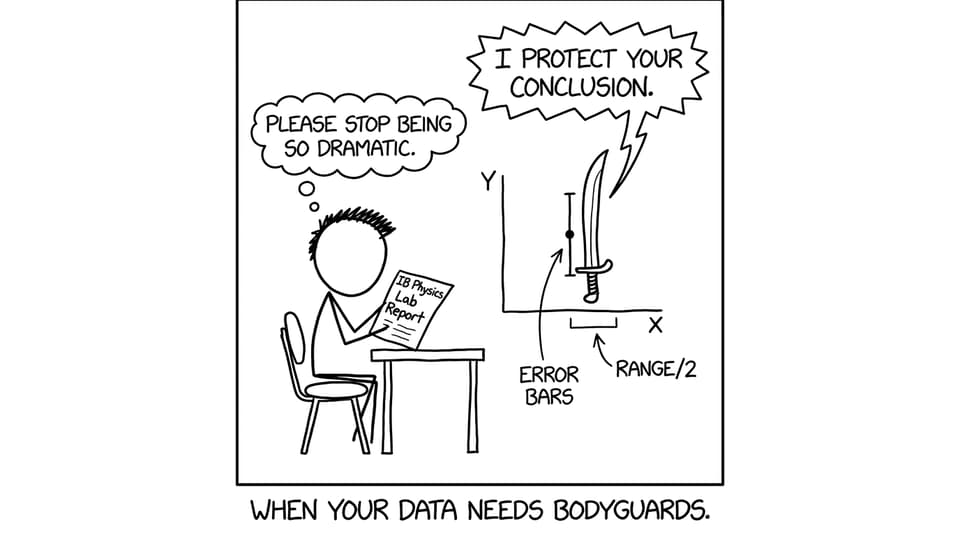
Absolute uncertainty = ± (range / 2)
Where:
- (\text{range} = \text{max value} - \text{min value})
Example: times recorded are 1.24 s, 1.28 s, 1.22 s.
-
Range = 1.28 - 1.22 = 0.06 s
-
Absolute uncertainty = ±0.03 s
This is especially useful in labs and in data-based exam questions where variation is the whole point.
To drill this with exam-style wording, use the IB Physics 1.2: Uncertainties and Errors Questionbank inside RevisionDojo’s Questionbank.
Where absolute uncertainty shows up in your IA (and why it changes your grade)
A strong IB Physics Internal Assessment doesn’t treat uncertainty like decoration. It uses it to justify choices.
You’re expected to:
-
State instrument uncertainties in raw tables
-
Keep sig figs and decimal places consistent
-
Include error bars when graphing
-
Discuss whether differences are significant compared with uncertainties
RevisionDojo’s IB Physics IA Rubric Explained is a good reality check for what earns marks in Data Analysis, and the Recording Data guide helps you format tables and uncertainties like an examiner.
If you already have a draft, the IB Physics IA Grader can highlight where your uncertainty handling stops being consistent.
Closing: treat uncertainty as part of the measurement, not an apology
The formula to calculate absolute uncertainty is simple. The habit is harder: every number you record in IB Physics should carry its truth with it, how well you could really measure it.
If you want to make uncertainty feel automatic before exams, use RevisionDojo the way top students do: learn the concept in the Study Notes, drill it in the Questionbank, lock it in with Flashcards, and use AI Chat when a markscheme step feels like a different language. Then, when it’s time to polish coursework, lean on the IA Grading tools, Coursework Library exemplars, Predicted Papers, Mock Exams, and (if you want a human eye) Tutors. IB Physics rewards students who measure carefully, write clearly, and practise deliberately, and RevisionDojo is built for exactly that.


