

The moment you realise one firm owns the whole game
There’s a particular kind of panic that hits during IB Economics revision: you understand demand and supply, you can explain elasticity, and then market structures arrive and suddenly everything feels like it has rules written in invisible ink. Monopoly is the one that tends to stick in your mind, partly because it’s simple (one dominant firm), and partly because it’s unsettling: when competition disappears, the market starts behaving differently.
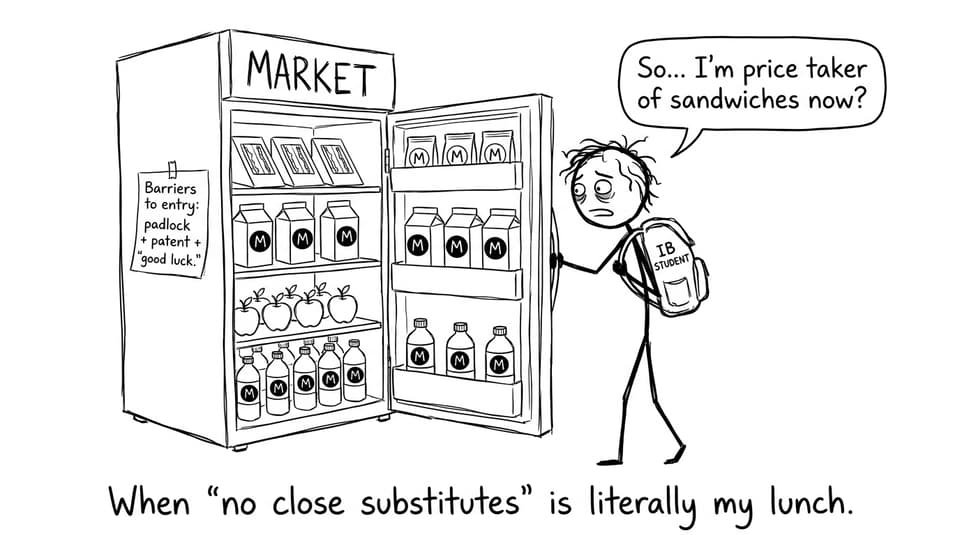
In IB Economics, a monopoly isn’t just “a big company.” It’s a market structure where one firm effectively is the market. That firm has market power: it can influence price and output because there are no close substitutes and barriers to entry stop rivals from appearing.
Monopoly in IB Economics: a quick checklist
Use this fast checklist before you write any diagram or evaluation paragraph:
-
One dominant firm supplies the market
-
The firm is a price maker (not a price taker)
-
The product has no close substitutes
-
High barriers to entry protect the firm
-
Abnormal profit can persist in the long run
If you want syllabus-aligned definitions and exam-style practice, start at Economics - IB Resources and then build from there.
Key characteristics of a monopoly (what examiners look for)
In IB Economics, marks often come from precision. A monopoly is defined by market power, which usually comes from barriers to entry such as:
-
Legal barriers (patents, licensing)
-
Control of essential resources
-
Economies of scale (especially in natural monopolies)
-
Brand loyalty and network effects (common in digital markets)
RevisionDojo’s Notes for 2.11.6 Monopoly are useful here because they phrase these characteristics the way you’ll want to phrase them in Paper 1.
Monopoly price and output in IB Economics (MR = MC)
Here’s the mental model that saves time in exams: a monopolist faces the industry demand curve, which is downward sloping. To sell more, it must lower price. That means:
-
AR (demand) is downward sloping
-
MR lies below AR (because cutting price to sell more reduces revenue on previous units)
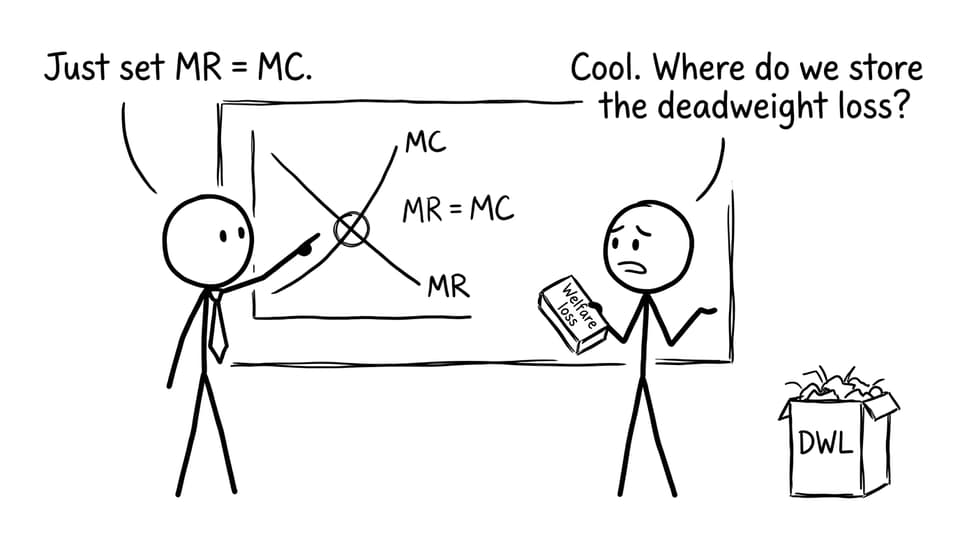
A monopolist profit-maximises where MR = MC. Then you:
-
Find the quantity at MR=MC
-
Go up to the demand (AR) curve to find price
In IB Economics, you almost always follow this with efficiency analysis: compared with perfect competition, monopoly typically leads to higher price and lower output.
To lock in the exam language, pair your diagram practice with targeted questions from the 2.11 Market failure - market power (HL only) Questionbank.
Efficiency: why monopoly can be a market failure
In IB Economics, monopoly is linked to market failure because it can cause both:
-
Allocative inefficiency: price is above marginal cost (P>MC), meaning society under-consumes the good relative to the efficient outcome.
-
Productive inefficiency: the firm may not produce at the lowest possible average cost due to weak competitive pressure.
This is where evaluative writing matters. A monopoly might still achieve lower average costs through economies of scale, especially when fixed costs are huge.
For a focused, diagram-friendly explanation, see Monopoly and efficiency.
When monopoly can be helpful (especially natural monopoly)
Not all monopoly outcomes are identical, and IB Economics rewards students who say “it depends” and then explain what it depends on.
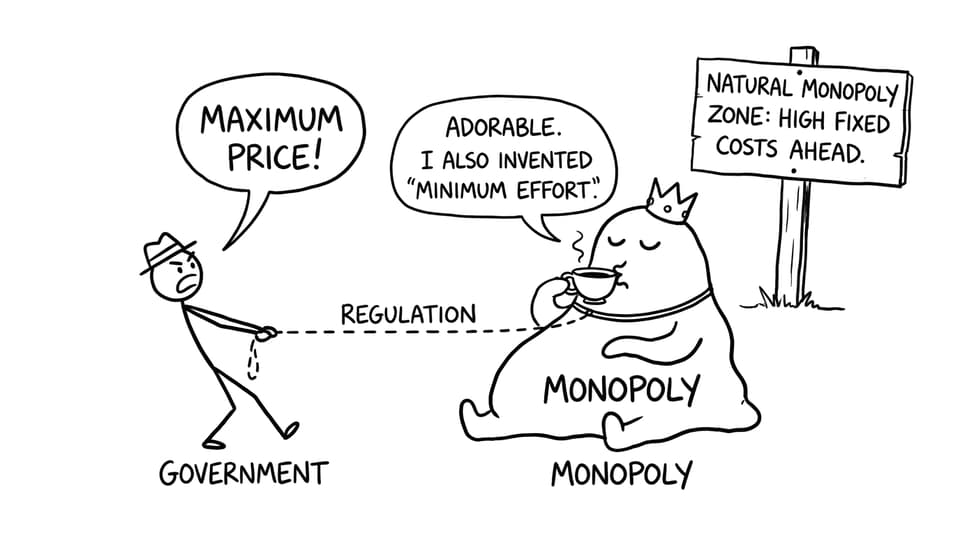
A natural monopoly occurs when one firm can supply the whole market at a lower cost than several smaller firms. Think industries with:
-
very high fixed costs
-
strong economies of scale over the relevant output range
That’s why utilities like water, electricity, and rail can be organised as legal or regulated monopolies. The exam move is to weigh lower costs and stability against potential consumer exploitation.
For comparison language you can use in evaluation, read The advantages and disadvantages of monopoly compared with perfect competition.
Government intervention: controlling monopoly power
Government responses in IB Economics usually fall into a few categories:
-
Maximum price (price cap) to protect consumers
-
Regulation and legislation to reduce abuse of market power
-
Competition policy (blocking mergers, breaking up firms)
-
Public ownership in essential services
The key is to evaluate: regulation can reduce monopoly harm, but it can also reduce incentives to innovate or invest.
For strong policy paragraphs, use the structure in 2.11.11 Government intervention in response to abuse of significant market power.
Bringing it all together (and where RevisionDojo fits)
Monopoly is one of those IB Economics topics that looks straightforward until you’re under exam pressure and the evaluation feels slippery. If you can remember the core logic (market power from barriers to entry; MR=MC; efficiency trade-offs), you’ll have something stable to write from.
To turn that stability into marks, RevisionDojo helps you practise the exact skills examiners reward: targeted Questionbank drills, clear Study Notes, fast Flashcards, and AI Chat for instant feedback when your explanation feels “almost right.” When exams get close, RevisionDojo’s Predicted Papers, Mock Exams, and Grading tools help you refine structure, diagrams, and evaluation. And if you’re working on written application, the Coursework Library and Tutors can guide you from decent answers to consistent high-scoring ones.
If monopoly is the market where one firm sets the terms, your revision shouldn’t feel the same. Make your preparation competitive -- with IB Economics resources built for the way exams actually mark.