


A quick story about an economy that “ran out of room”
In IB Economics, the idea of “potential output” is quietly powerful. It’s the economy’s sustainable speed limit: the level of real output it can produce when resources are fully employed and inflation stays stable.
Now picture an economy like a school week before exams. People push harder, sleep less, and try to do more with the same limited energy. For a day or two it works. Then something breaks: mistakes rise, tempers flare, and progress becomes expensive.
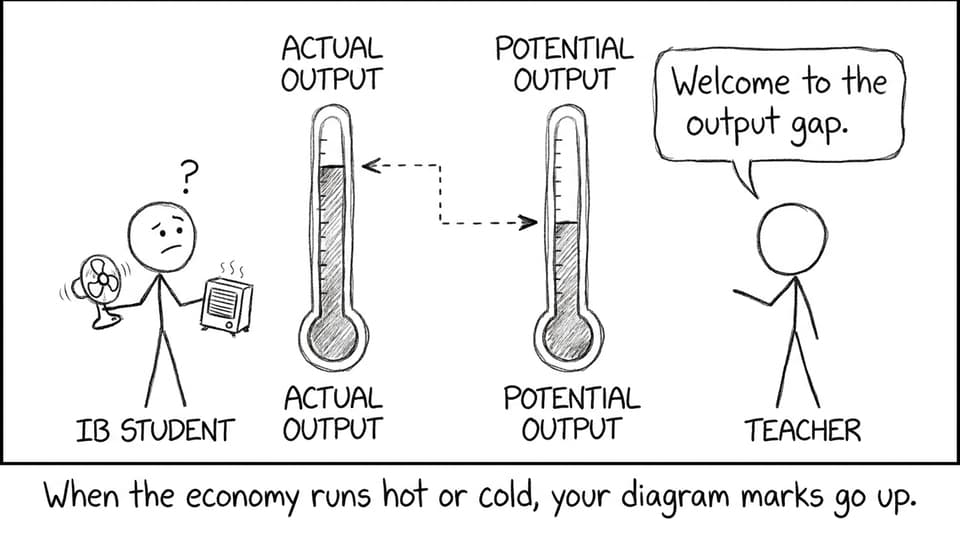
That’s what happens when actual output deviates from potential output. The gap between them is called the output gap, and it sits at the centre of macroeconomic instability in IB Economics.
Output gap checklist (what examiners want)
When you see “output gap” in IB Economics, make sure you can:
-
Define potential output (full employment level of output) and actual output (current real GDP).
-
Identify a positive output gap vs a negative output gap.
-
Link each gap to inflation, unemployment, and the AD/AS model.
-
Recommend a policy response (monetary, fiscal, supply-side) with clear evaluation.
Helpful RevisionDojo refreshers:
Positive output gap (actual output above potential)
In IB Economics, a positive output gap means real GDP is temporarily above the full-employment level. This often happens when aggregate demand (AD) rises quickly (strong consumption, investment, government spending, or net exports).
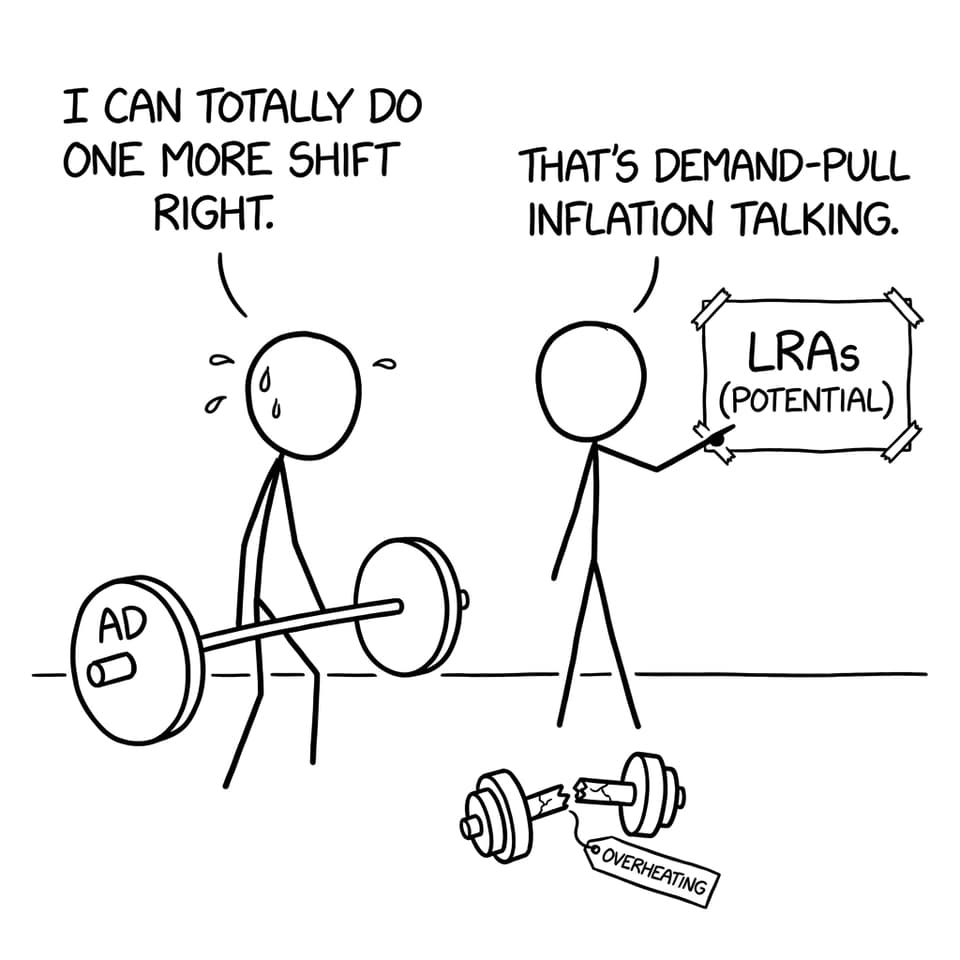
The short-run story looks cheerful: firms produce more, hire more, and profits rise. But the long-run story is less friendly. As labour and capital become scarce, costs climb. Firms compete for workers, wages increase, and prices rise. That’s why a positive output gap is strongly linked to demand-pull inflation.
In exam terms: AD shifts right, the economy moves beyond potential output, and inflation accelerates. To explore the model language, use:
Typical policy response in IB Economics
A central bank may raise interest rates (tightening monetary policy) to reduce spending. A government may use contractionary fiscal policy to cool demand. For clean policy diagrams and terminology, review:
Negative output gap (actual output below potential)
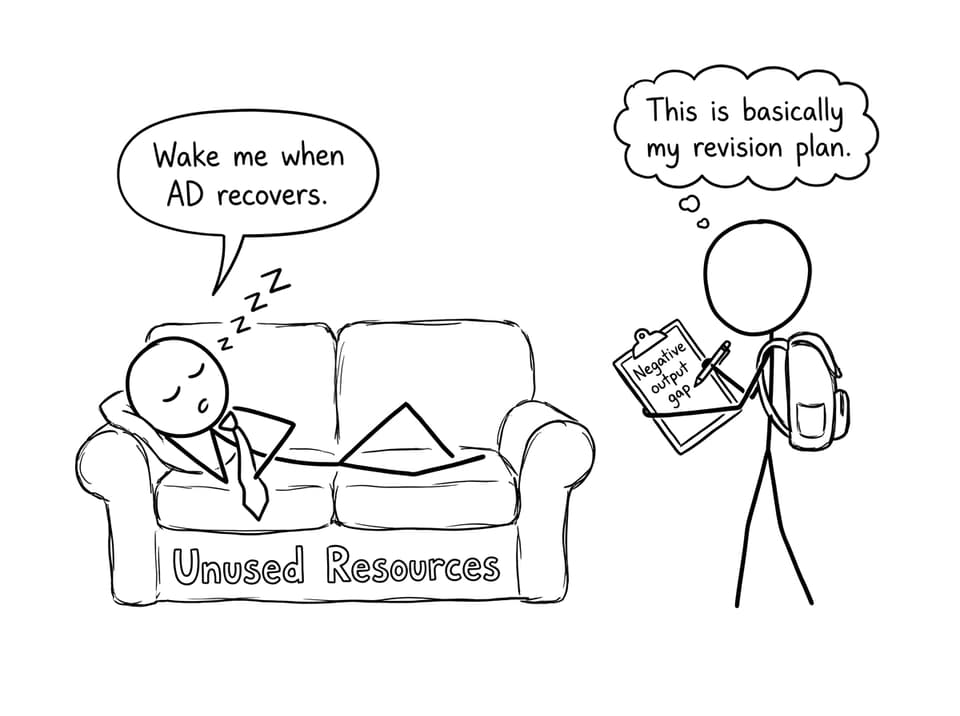
A negative output gap means the economy is producing below capacity. This usually appears in recessions or periods of weak AD. Firms cut output, unemployment rises, and machines and workers sit idle.
In IB Economics, the key consequence is underused resources and lower living standards. Price pressure often weakens too: if demand is low, firms struggle to raise prices, so you can see disinflation or even deflationary pressure.
To connect the output gap to unemployment and stability trade-offs, see:
Typical policy response in IB Economics
Policymakers often try to shift AD right again (lower interest rates, higher government spending, tax cuts). But strong answers also mention supply-side policies that raise potential output over time, linking short-run stabilisation to long-run growth.
For growth language that pairs well with output gap essays, use:
How to write this in an exam (fast and high scoring)
In IB Economics, you score marks by being calm and structured:
-
Define potential output and output gap.
-
State whether it’s positive or negative.
-
Explain the mechanism via AD/AS (AD shift, SRAS limits, LRAS/potential).
-
Link to inflation and unemployment.
-
Recommend a policy and evaluate (time lags, side effects, distributional impacts).
If you want targeted practice, RevisionDojo’s Questionbank for AD/AS topics helps you train the exact phrasing examiners reward:
Bringing it home (and using RevisionDojo to lock it in)
The output gap is one of those IB Economics concepts that looks simple until you try to write it under time pressure. But once you see it as a story about an economy running too hot or too cold relative to potential output, your diagrams, chains of reasoning, and policy evaluation become much easier.
To practise it the way the exam demands, use RevisionDojo’s Study Notes, Flashcards, AI Chat, and Grading tools to tighten definitions and evaluation. Then test yourself with the Questionbank, and polish timing with Mock Exams and Predicted Papers. When you can explain why output deviates from potential output in one clear paragraph, you’re no longer revising macroeconomics -- you’re thinking like an economist.