


A market is talking to you
You know that moment before an exam when you think you understand supply and demand, and then a question asks, “Explain what happens when a shortage occurs” and your mind goes blank? In IB Economics, shortages and surpluses are basically the market sending a clear message: the price is not doing its job yet.
A market shortage or market surplus happens when the actual price sits away from the equilibrium price. That small gap creates big consequences: queues, unsold inventory, pressure on firms, and eventually a pull back toward equilibrium.
If you want to refresh the core diagram language first, start with Define Supply and Demand in IB Economics.
Quick exam checklist (use this in Paper 1)
-
State the equilibrium rule: Qd = Qs at equilibrium
-
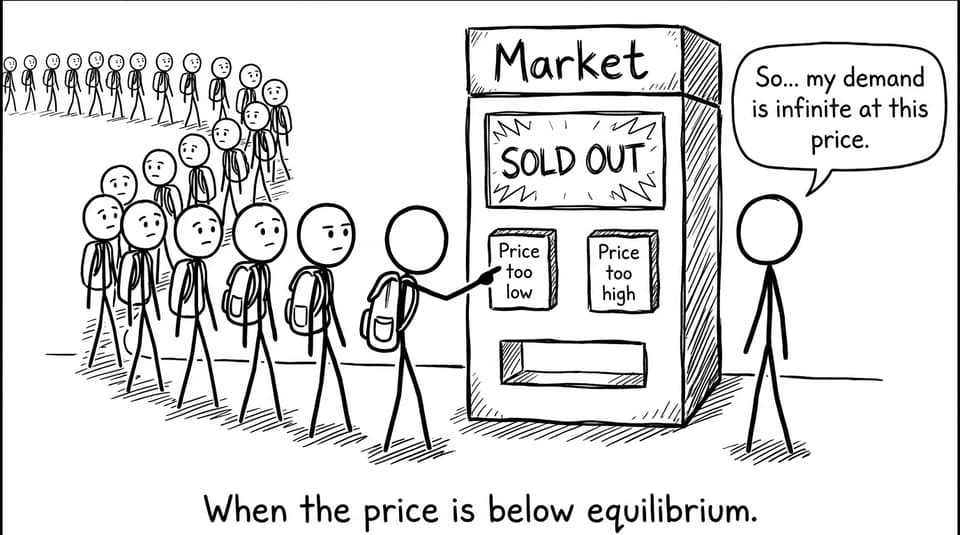
If price is below equilibrium: shortage (excess demand)
-
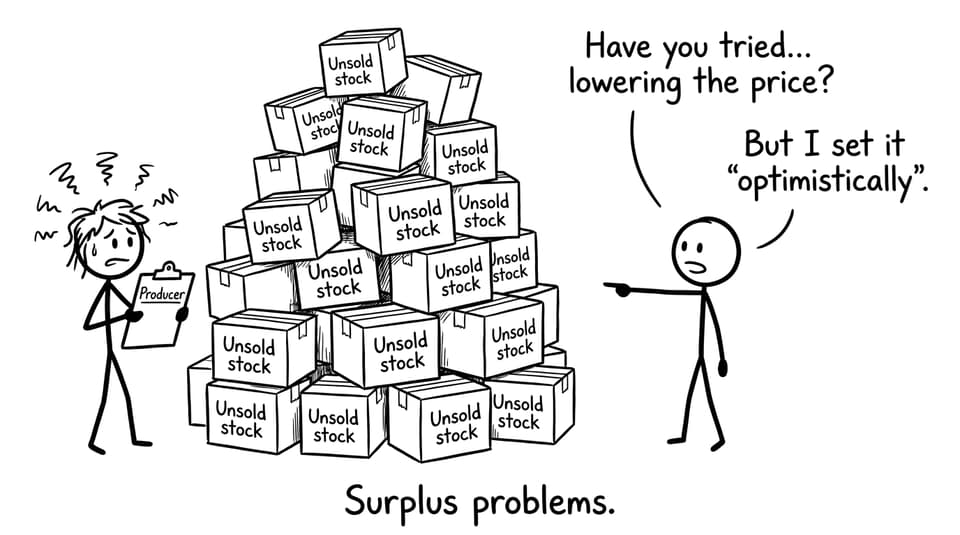
If price is above equilibrium: surplus (excess supply)
-
Explain the price mechanism: shortages push prices up; surpluses push prices down
-
Add one sentence on incentives: firms respond to profits; consumers respond to affordability
For a clean equilibrium explanation, see How Supply and Demand Create Equilibrium and What Is Market Equilibrium?.
What happens in a shortage (excess demand)
In IB Economics, a shortage occurs when quantity demanded is greater than quantity supplied at the current price. The usual reason is simple: the price is too low relative to equilibrium.
At that low price, more consumers are willing and able to buy, while producers supply less (lower profitability). Because not everyone can get the good, buyers compete. That competition pushes the price up in several ways: some consumers offer more, sellers ration to higher-paying customers, and firms notice the opportunity to raise prices.
As price rises, two things happen along the curves:
-
Quantity demanded falls (movement along demand)
-
Quantity supplied rises (movement along supply)
Eventually, the shortage shrinks until the market returns to equilibrium.
To connect this to your broader micro toolkit, Microeconomics for Better Decisions shows how incentives and constraints drive these adjustments.
What happens in a surplus (excess supply)
A surplus in IB Economics is when quantity supplied is greater than quantity demanded at the current price. Most of the time, the price is too high.
At a high price, firms supply more because profits look attractive. Consumers buy less because the good feels expensive. Inventories build up: unsold stock, discounts, and pressure to clear shelves. Firms respond by cutting prices, offering deals, or reducing output.
As price falls:
-
Quantity demanded increases
-
Quantity supplied decreases
The surplus gradually disappears and the market returns to equilibrium.
When shortages and surpluses don’t disappear: price controls
In the real world and in exam evaluation, you often add one twist: sometimes the price cannot adjust.
-
A price ceiling (maximum price) set below equilibrium can create a persistent shortage.
-
A price floor (minimum price) set above equilibrium can create a persistent surplus.
That’s why exam questions love asking you to show the diagram and then explain the unintended consequences. For deeper review, use Why Price Ceilings and Price Floors Create Unintended Consequences and the syllabus-aligned Price Ceilings Notes.
Bring it back to exam performance
Shortages and surpluses are not random chaos. In IB Economics, they’re the market’s feedback loop: a shortage says “raise price or increase supply,” and a surplus says “lower price or cut output.”
To make this automatic before exams, practice diagram questions and explanations with RevisionDojo’s IB Economics Notes, drill exam-style prompts in the Competitive Market Equilibrium Questionbank, and lock in definitions with the Microeconomics Flashcards. When you can explain shortages and surpluses cleanly, a huge chunk of microeconomics marks start feeling predictable.