


If you walked out of an exam thinking, I just failed that, you’re not alone. In IB Sciences, that feeling is almost a rite of passage: a shaky calculation, a data question that suddenly looks like a foreign language, a long-response that runs out of time.
But the story your brain tells you in the first five minutes after a bad paper is rarely the true story. The IB doesn’t grade your future based on one moment. It grades a profile of performance. And in most cases, failing one IB science paper does not automatically mean you fail the subject, or the diploma.
Below is what actually happens in IB Sciences, what to do next, and how to recover with a plan that’s calm, specific, and realistic.
Quick checklist: what to do if you think you failed
Use this as your quick reset for IB Sciences:
-
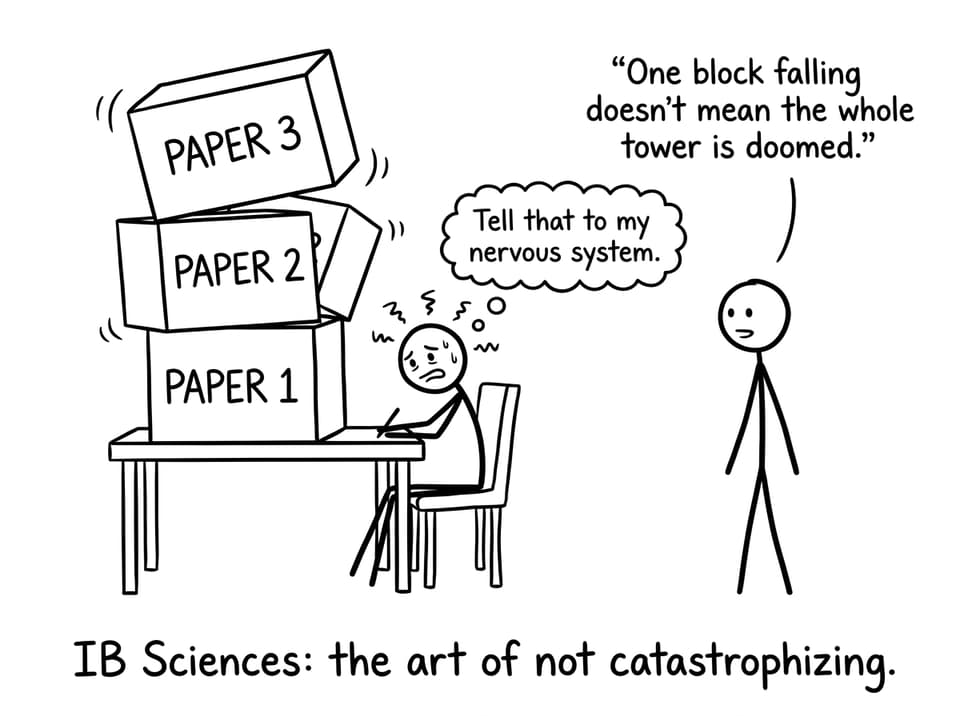
Don’t guess your final grade from feelings. One paper is one component.
-
Separate “failed a paper” from “failed the subject.” They’re not the same thing.
-
Check what else carries marks (other papers, Internal Assessment).
-
Protect the next exam. One bad sitting becomes two when you spiral.
-
Plan a recovery loop: targeted practice, feedback, and timed sets.
If you want a simple system for that loop, RevisionDojo’s Questionbank is built for exactly this moment: you stop guessing and start collecting evidence.
What “failing” means in IB Sciences (and what it doesn’t)
In IB Sciences, your subject grade is awarded on a 1 to 7 scale. In most schools, 4 is treated as a pass and 3 or below is treated as failing.
Here’s the key distinction: you don’t receive a separate “pass/fail” stamp for Paper 1, Paper 2, or Paper 3. You receive a final subject grade based on your combined performance across components.
That’s why doing badly on one exam paper can be painful, but not automatically fatal.
Science assessment typically includes:
-
Paper 1
-
Paper 2
-
Paper 3 (in some course structures)
-
Internal Assessment (IA)
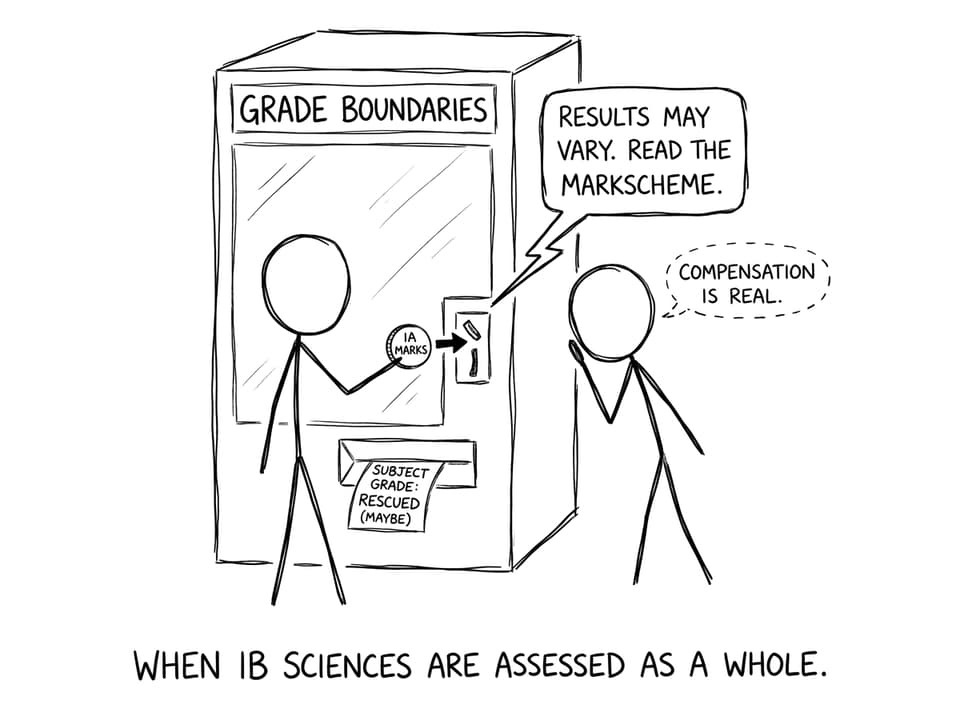
So in IB Sciences, a weak Paper 2 can be partly offset by a strong IA or stronger performance on other papers. It’s not “fair” in an emotional sense, but it is fair in a statistical sense: the grade reflects more than one day.
If you’re revising Biology, Chemistry, or Physics, use the RevisionDojo subject hubs as your map: IB Biology Resources, IB Chemistry Resources, and IB Physics Resources.
Can you still earn the diploma if you fail one IB science paper?
Usually, yes.
The IB Diploma is awarded based on overall requirements, not perfection inside one component. In IB Sciences, you could underperform on one paper and still meet the diploma requirements if your overall results remain strong enough.
The commonly cited diploma conditions include:
-
At least 24 total points
-
At least 12 points across your three Higher Level subjects
-
No grade 1 in any subject
-
No more than one grade 2 overall
-
No E in TOK or EE
-
CAS completed
So the diploma decision is more like a dashboard than a single warning light. One problem matters, but it’s judged alongside everything else.
If you want a reality check on where you stand, the IB Grade Calculator can help you estimate outcomes from your component marks and see what “damage control” actually needs to look like.
The quiet math of compensation: how one paper can be balanced out
Students often underestimate how much the IA and other papers can matter in IB Sciences, especially when the panic is loud.
A simple way to think about it:
-
One paper going badly is a hit, not a verdict.
-
Your goal becomes: stop the bleed on the next component.
-
Then: raise the floor with targeted practice.
This is where structured tools matter. When you use a platform that connects Study Notes, Flashcards, practice questions, and grading feedback, you can respond precisely instead of emotionally.
RevisionDojo is designed to do that in one place: Study Notes to patch concepts fast, Flashcards to keep daily recall alive, AI Chat when you’re stuck, Grading tools to learn how marks are actually awarded, and Mock Exams plus Predicted Papers to rehearse under time pressure.
What this means for university offers (especially conditional ones)
Here’s the uncomfortable truth: even if the diploma is still possible, university conditions might be tighter.
In conditional systems (especially common in the UK), offers often specify a minimum overall score and minimum grades in certain HL subjects. If your final IB Sciences subject grade drops below that required number, the offer may be at risk.
Possible outcomes if you miss conditions include:
-
Being reconsidered for a different course
-
A request to retake or provide updated results
-
Post-results pathways (like clearing-style processes)
-
Acceptance based on subject certificates rather than the full diploma
The most practical move is early communication. Universities tend to respond better to clear timelines and a plan than vague reassurance.
Remark or retake: how recovery works in IB Sciences
If results come back and you’re right on a boundary, there are two standard recovery routes.
Enquiry Upon Results (remark)
A remark is requested through your IB coordinator. A senior examiner re-marks the work.
In IB Sciences, a remark is usually best when:
-
You are very close to a grade boundary
-
Your component marks suggest something unusual happened
-
A one-mark change would materially affect your final grade
Remember: grades can go up, stay the same, or go down. The point is not hope. The point is probability.
Retakes
The IB allows retakes in future sessions. A retake can be the cleanest way to meet a university condition or rebuild a subject grade.
Retakes are often effective because they give you something panic never gives you: time to train properly.
To train properly, you need repetition plus feedback. Use timed sets from IB Predicted Papers by IB Examiners (Free), then drill weak areas with the Questionbank. If you want the broader method, Custom IB Mock Exams: Build Practice Tests by Topic lays out a simple workflow.
A calm recovery plan for IB Sciences (48 hours after a bad paper)
This is a plan you can actually follow, even when you feel behind.
-
Step 1 (same day): Write down the 3 question types that hurt you most (data analysis, calculations, explanations, evaluation).
-
Step 2 (next day): Use RevisionDojo’s app workflow to patch one weakness: Study Notes 20 minutes, then 15 questions.
-
Step 3 (48 hours): Retake a short timed set on the same weakness.
-
Step 4 (weekend): Sit one timed paper section to rebuild stamina.
For subject-specific help:
-
Biology students often benefit from a clear structure like How to Pass IB Biology SL Exams: Proven Study Strategy.
-
Chemistry students can tighten understanding fast with focused resources like IB Chemistry Revision Notes (SL/HL) or a concept reset such as IB Chemistry: Dynamic Equilibrium, Finally Clear.
-
Anyone who needs a condensed overview can use examiner-designed Cheatsheets like Biology Cheatsheets.
Closing: one bad paper is a data point, not a destiny
In IB Sciences, the hardest part of failing one paper is rarely the grade itself. It’s the story you tell yourself about what the grade means.
One paper can hurt. But it doesn’t get to decide everything unless you let it cascade into the next one.
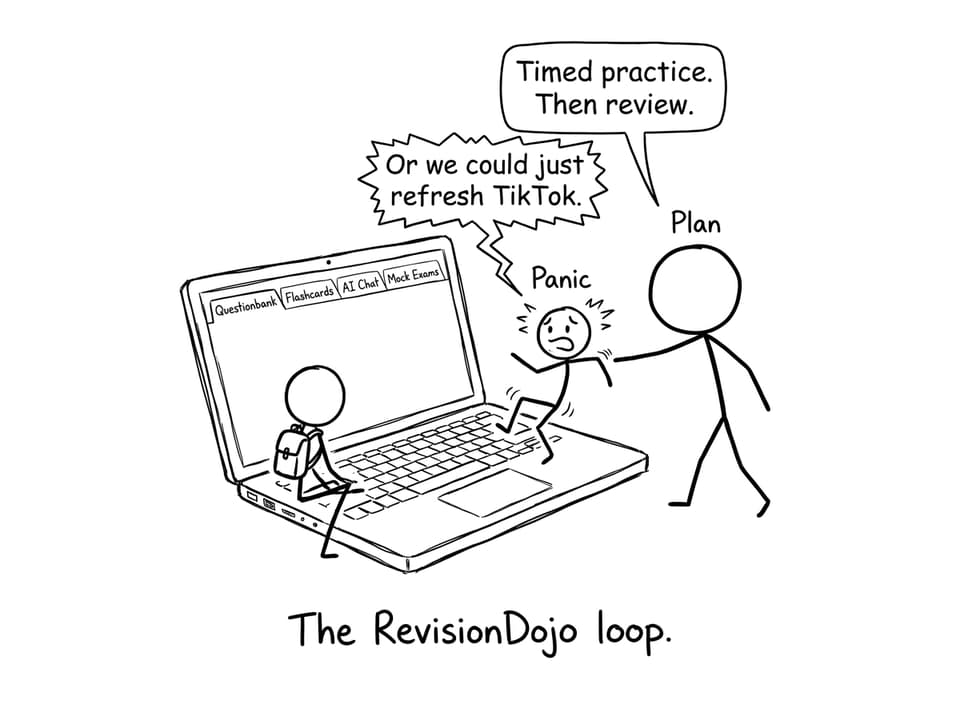
If you want a calmer, more controlled way to prepare (or recover), build your system inside RevisionDojo: drill with the Questionbank, lock in recall with Flashcards, clarify fast using AI Chat, practice under pressure with Mock Exams and Predicted Papers, and use Grading tools to understand how marks are earned. When your preparation becomes a loop, not a mood, IB Sciences becomes manageable again.