



When you picture IB Sciences, you probably picture a lab bench: goggles, timers, and someone shouting “don’t touch that.” Then real life happens. The lab is booked. The equipment is missing. Your investigation needs two weeks of data, not two periods.
So the question feels almost rebellious: can you do IB Sciences labs at home, and what experiments are allowed?
The calm answer: yes, home-based practical work can be acceptable. The serious answer: it only stays acceptable when you treat it like science, not like a shortcut. In IB Sciences, the room matters less than the method.
The IB rule of thumb: process over location
The IB isn’t looking for stainless steel benches. It’s looking for credible investigation.
For IB Sciences, the practical work still needs to be:
-
Safe (risk assessed, appropriate materials)
-
Authentic (your own work, no mystery data)
-
Supervised/verified (a qualified adult can confirm what happened)
-
Well-documented (so someone else could repeat it)
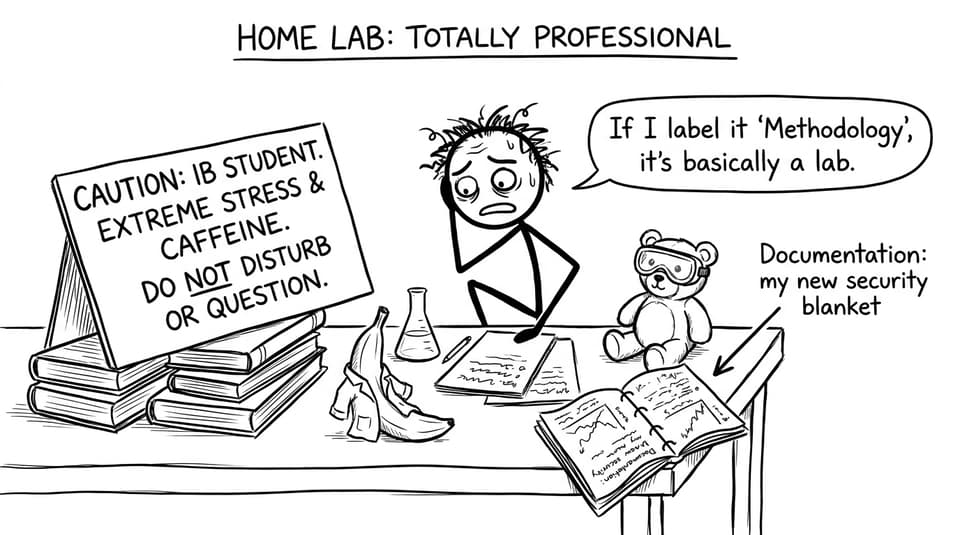
If you want a more detailed view of how practical work is expected to look on paper, keep a lab notebook structure like this in mind while planning.
Quick checklist: is your home experiment likely to be allowed?
Before you lift a beaker (or a measuring jug), use this quick filter for IB Sciences:
-
Have you asked your teacher for approval before collecting data?
-
Can you explain your method so clearly that a stranger could replicate it?
-
Are the risks low and the materials household-level (or properly controlled)?
-
Can a teacher/technician/approved adult supervise or verify the work?
-
Can you collect enough trials for reliability?
If you’re unsure about feasibility, this guide on choosing a manageable IA experiment is a good reality check.
Supervision: the most misunderstood requirement
A home lab doesn’t mean an unsupervised lab.
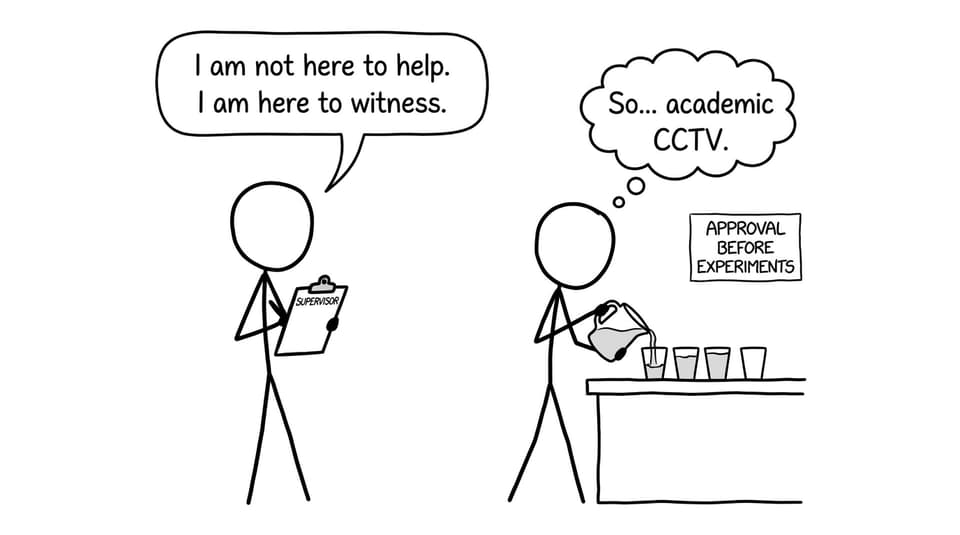
For IB Sciences, supervision is about credibility and safety. Your supervisor (often your science teacher, sometimes a lab technician or other approved adult) doesn’t need to coach you through the experiment. They do need to confirm that the work was carried out appropriately.
A useful mindset: think of supervision as verification, not help.
If you’re planning the investigation for your IA, start from the expectations in the IA Guides hub so your design choices match what examiners actually reward.
Documentation: your home “lab bench” on paper
In a school lab, the environment signals structure. At home, your writing has to do that job.
Strong home-lab documentation in IB Sciences usually includes:
-
A dated, step-by-step methodology (including units and uncertainties)
-
Raw data recorded at the time (not re-created later)
-
Photos/screenshots only as support, not as a substitute for data
-
Clear processing (tables, graphs, sample calculations)
-
Evaluation that treats limitations like evidence
If you want your investigation to feel examiner-proof, pair the write-up with planning habits from designing effective experiments for a Science IA.
What kinds of IB Sciences experiments work well at home?
The best home experiments for IB Sciences share three traits: low risk, simple equipment, and high control.
Good home-friendly categories include:
Biology-style home labs
-
Enzyme activity using safe substrates
-
Osmosis investigations with food-safe solutions
-
Plant growth and controlled environment studies
-
Reaction time and physiology measurements (ethics and privacy matter)
If you’re comparing what “counts” as practical across subjects, see IB Sciences: Biology vs Physics lab work explained.
Chemistry-style home labs (keep it simple)
-
Rate of reaction with safe reactants (teacher-approved)
-
Indicators with food dyes
-
Water quality tests using approved kits
Avoid anything that pushes into hazardous chemicals, fumes, or uncontrolled heat sources. If it sounds like it belongs in a hazard video, it belongs back at school.
Physics-style home labs
-
Motion and kinematics using phone sensors
-
Circuits with low-voltage components
-
Energy transfer with careful measurement and repeat trials
How to connect home labs to exam prep (without losing time)
Here’s the hidden win: when you run a careful home experiment, you’re also training the thinking that shows up in exams across IB Sciences: variables, uncertainty, graph interpretation, evaluation.
This is where RevisionDojo becomes more than “revision.” You can:
-
Drill the topic behind your lab using the Questionbank
-
Build memory for definitions and processes with Flashcards and Study Notes
-
Stress-test your explanations by asking AI Chat to challenge your assumptions
-
Use Grading tools to tighten your IA-style evaluation language
-
Build confidence with Mock Exams and Predicted Papers once your concepts are stable
-
Pull exemplars and structure ideas from the Coursework Library
-
Get targeted help from Tutors if your method or analysis is wobbling
If motivation drops mid-project (it often does), use a practical system like these IB Sciences motivation strategies to keep momentum.
FAQ
Are IB Sciences experiments at home actually allowed?
Yes, IB Sciences experiments can be conducted outside of school in many cases, but “allowed” depends on how you meet the expectations. The IB cares about authenticity, safety, supervision/verification, and documentation more than the physical location. If you can show that the work is real and repeatable, the setting becomes secondary. The risk profile matters a lot: home-friendly investigations are typically low hazard and easy to control. The safest approach is to get approval before collecting data, then keep a record that reads like a professional lab notebook. If you treat it like casual tinkering, it becomes hard to defend.
What experiments are usually a bad idea for IB Sciences at home?
Anything with significant risk, unclear control, or questionable ethics is a bad bet. In IB Sciences, experiments involving strong acids/bases, open flames, pressurized containers, toxic fumes, or biological materials that require specialist handling can quickly cross the line. Even if you personally feel confident, the issue is whether the setup is defensible under school safety expectations. Another common problem is equipment that can’t measure reliably, which creates messy data and weak evaluation. Finally, experiments that can’t be supervised or verified are risky even if they’re “safe,” because authenticity becomes harder to prove. When in doubt, simplify the design until the data quality improves.
How do I prove my home lab work is legitimate?
In IB Sciences, legitimacy is built through traceable process, not dramatic results. Start by documenting approval and supervision clearly, including dates and what was agreed. Then write a method detailed enough that another student could replicate it without guessing quantities, timing, or conditions. Record raw data as you collect it, keep units consistent, and note anomalies honestly instead of hiding them. Photographs can support your timeline, but they can’t replace tables of measurements and repeats. Finally, your evaluation should acknowledge limitations specific to home setups and propose realistic improvements. Strong documentation doesn’t just protect you; it often raises your mark because it shows scientific thinking.
Closing: the kitchen table is not the problem
A home setup can be perfectly valid for IB Sciences. The real danger is rushing: skipping approval, underestimating safety, or writing the report as if the details don’t matter.
If you plan early, keep supervision clear, and document like a scientist, your home experiment can become a strength, not a compromise. And when it’s time to turn that practical understanding into exam performance, RevisionDojo helps you tighten every part of the loop: Study Notes for clarity, Flashcards for recall, Questionbank for exam technique, AI Chat for fast feedback, plus Mock Exams, Predicted Papers, and Tutors when you need the final push in IB Sciences.