



If you have medicine in the back of your mind, your subject choices stop feeling like “school admin” and start feeling like a small, quiet bet on your future.
You can almost picture it: one version of you in a lab coat, another version of you staring at a timetable thinking, I just need to pick the right IB Sciences and not regret it later.
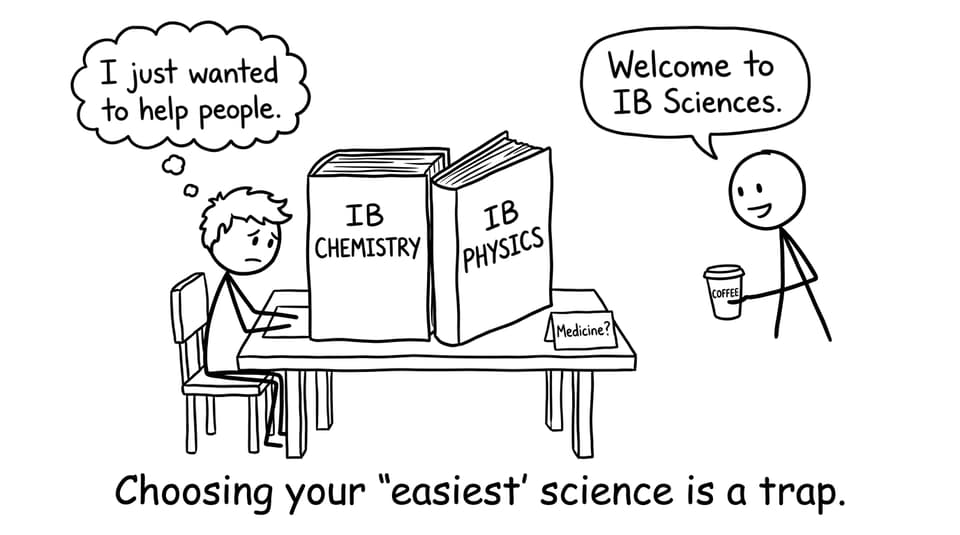
The debate usually lands in one place: Should you choose IB Chemistry or IB Physics for medicine? This isn’t about which is “cooler.” It’s about prerequisites, workload, your strengths under exam pressure, and what keeps the widest number of medical pathways open.
A quick checklist before you decide (save this)
Use this as your five-minute filter before you overthink the choice:
-
Check your target universities’ subject requirements (not rumours, not Reddit summaries).
-
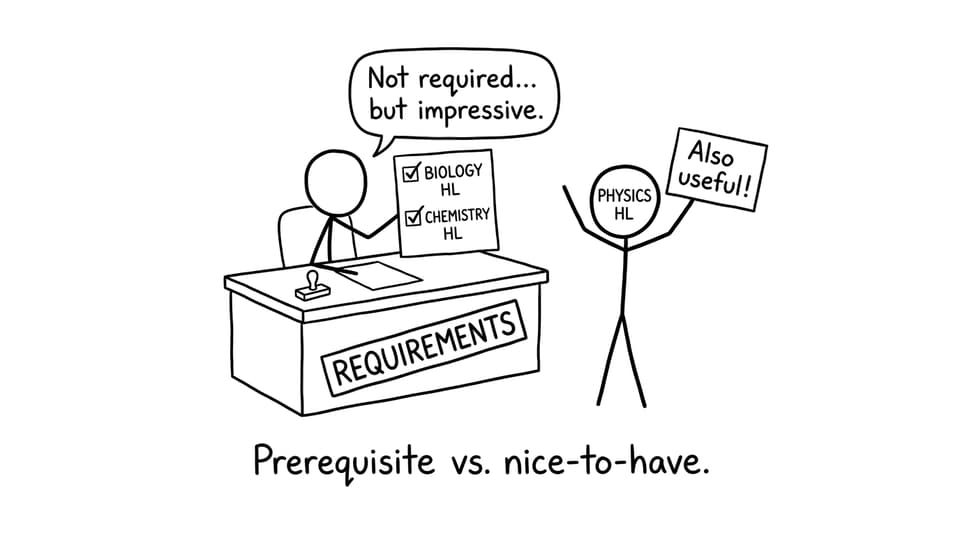
Assume Biology HL is expected for most medicine routes.
-
If you want maximum flexibility, prioritise Chemistry HL alongside Biology.
-
Choose Physics HL if you’re leaning toward imaging, biomedical engineering, or you’re strongest in maths-based modelling.
-
Pick the subject you can realistically score high in, because medicine is competitive and scores matter.
If you’re revising right now and want a clean hub for each subject, start with the RevisionDojo resource pages for IB Chemistry resources and IB Physics resources.
What universities usually expect from IB Sciences for medicine
Across many medical pathways, the pattern is consistent: admissions teams want proof that you can handle the early content of medical school. That content is heavy on biochemistry, physiology, and the chemistry of systems in the body.
So in practice:
-
Biology is often the backbone.
-
Chemistry is frequently required or strongly preferred.
-
Physics is less commonly a formal requirement, even though it can still be valuable.
This is why, in the world of IB Sciences, Chemistry is often treated as the “safe” option for medicine. Not because it’s easy (it isn’t), but because it aligns more directly with what medical courses assume you already understand.
Why IB Chemistry maps so naturally onto medicine
Medicine is full of chemistry that doesn’t announce itself as chemistry.
It shows up as drug interactions that depend on polarity and bonding. It shows up as enzyme pathways you can’t fully explain without kinetics. It shows up as buffers in blood and equilibrium that suddenly becomes very real, very fast.
Choosing Chemistry in your IB Sciences package tends to build:
-
Strong comfort with mechanisms and multi-step reasoning
-
Better intuition for data handling and experimental design
-
Precision habits that exams reward (units, sig figs, controlled variables)
If you’re aiming for a top grade, it helps to revise Chemistry like a skill, not a reading project. RevisionDojo supports that loop with Study Notes, Flashcards, and a high-volume Questionbank with feedback. Useful starting points include the strategy-focused post IB Chemistry HL: Complete Guide for Success and the reflection (and reality check) in Will Wishing Get You a 7 in IB Chemistry?.
Where IB Physics helps future doctors (even when it isn’t required)
Physics is the subject that teaches you to stay calm when a problem looks unfamiliar.
In medicine, you will meet unfamiliar systems constantly. Physics trains a specific kind of discipline: define the model, isolate variables, and let the maths tell the truth.
Physics becomes especially relevant if you’re curious about:
-
Medical imaging later on (thinking in waves, fields, and signals)
-
Bioengineering or medical technology pathways
-
Building strong quantitative confidence for uni-level science
In RevisionDojo, you can sharpen physics thinking with targeted practice from the Mechanics topic hub or drill common exam patterns through the Forces and Momentum notes and questions.
Chemistry HL vs Physics HL: the real difference in difficulty
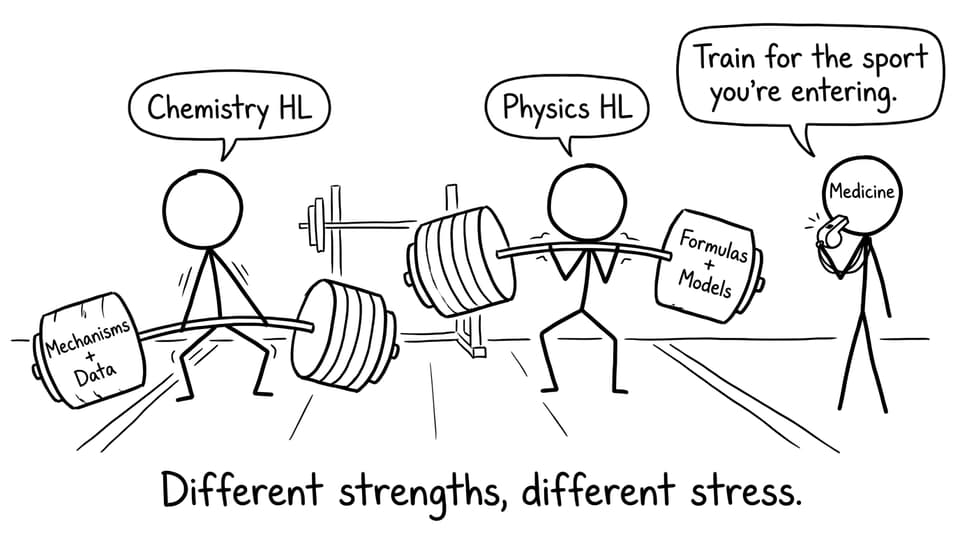
Students often ask which is harder. The honest answer: they are hard in different ways, and your stress will come from different places.
Chemistry HL often feels heavy because:
-
There’s a lot of content density
-
Explanations matter (not just final answers)
-
Labs and evaluation skills can quietly boost or hurt performance
Physics HL often feels hard because:
-
Modelling and algebra stack quickly
-
You can “understand” a concept but still lose marks through setup errors
-
Exam questions reward method clarity and consistency
So the best IB Sciences choice for medicine is usually the one where you can become reliably correct under timed conditions.
How to decide: two student stories (and what they got right)
The “keep doors open” student
They want medicine, but they’re not committed to one country or one shortlist of universities. They choose Biology HL + Chemistry HL, then add a third science only if it doesn’t damage their total score.
This is the classic safest combination in IB Sciences because it matches the most common expectations and keeps options broad.
The “physics brain” student
They love calculus, patterns, and clean logic. Physics HL feels like home. They can still apply to some medicine routes, but they do it strategically: they check requirements early, choose universities that accept their combination, and make sure the rest of their profile is strong.
If this is you, treat Physics as a strength to showcase, not a risk to hide. And use a serious practice loop: timed sets, diagnostics, then re-testing.
A practical way to build that loop is RevisionDojo’s Questionbank (high-volume practice with feedback) plus Mock Exams style rehearsal using Predicted Papers. Start here: Questionbank feature page and the workflow breakdown in RevisionDojo App: The Smarter Way to Prep for IB Exams.
How to revise whichever IB Sciences you choose (without burning out)
A calm revision plan beats a heroic one.
-
Learn concepts quickly using Study Notes.
-
Lock them in with Flashcards (short, daily, active recall).
-
Convert knowledge into marks using the Questionbank.
-
Fix patterns with AI Chat when you’re stuck (fast clarification prevents slow confusion).
-
Rehearse performance with Predicted Papers and Mock Exams.
If you want a broader revision philosophy that stops you trying to “do everything perfectly,” read Do You Need to Study Every Topic for IB?.
Conclusion: the IB Sciences choice that keeps your future calm
If medicine is your goal and you want the widest range of university options, Chemistry (especially at HL) usually fits more cleanly than Physics. It aligns with what medical courses assume, and it reduces the risk of discovering a prerequisite problem too late.
But Physics is not “useless.” It’s powerful when it matches your strengths and your plan. The right choice in IB Sciences is the one that keeps doors open and gives you the best chance of a strong score.
When you’re ready to stop guessing and start training, use RevisionDojo to build a simple loop: learn with Study Notes, retain with Flashcards, practise with the Questionbank, get unstuck with AI Chat, and rehearse with Predicted Papers and Mock Exams. That’s how you make your choice pay off on exam day.