
You can feel it before you can explain it.
A headline says “confidence drops.” A friend’s parents pause a house purchase. A government announces a stimulus package. Suddenly, the whole economy seems to lean forward or sit back. In IB Economics, that lean is often a shift in aggregate demand (AD), and it’s one of the fastest ways to earn clear, diagram-backed marks in exams.
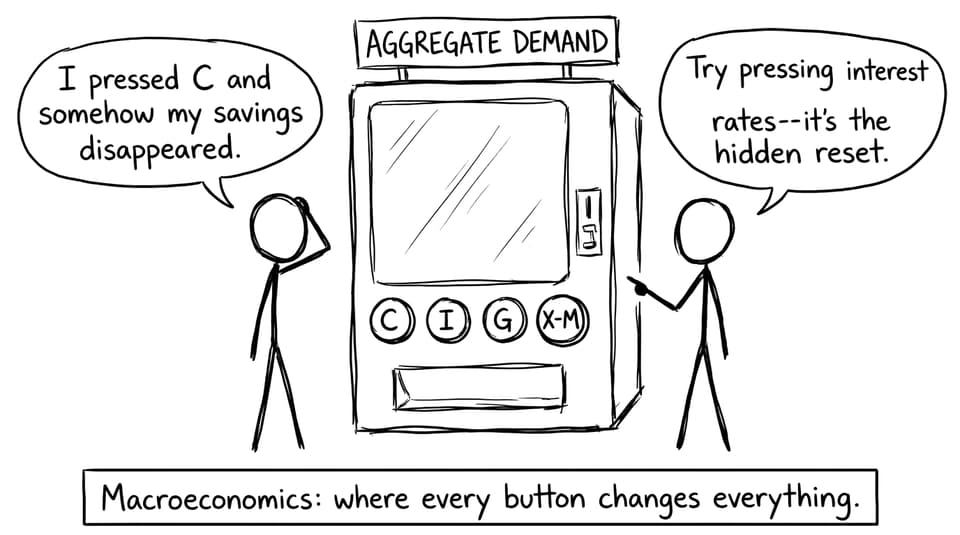
Aggregate demand is total planned spending on a country’s goods and services at different price levels. In IB Economics, we write it as:
AD = C + I + G + (X - M)
When any of these components changes for reasons other than the price level, the AD curve shifts.
Quick exam checklist for AD shifts (IB Economics)
Before you write anything, run this checklist:
-
Did C, I, G, or (X-M) change?
-
Is it a shift (non-price determinant) rather than a movement along AD (price level change)?
-
Is the shift right (higher real output demanded) or left?
-
Can you name two determinants and connect them to real GDP and price level?
For clean definitions and the syllabus framing, keep IB Economics 3.2.1 Aggregate Demand open while you revise.
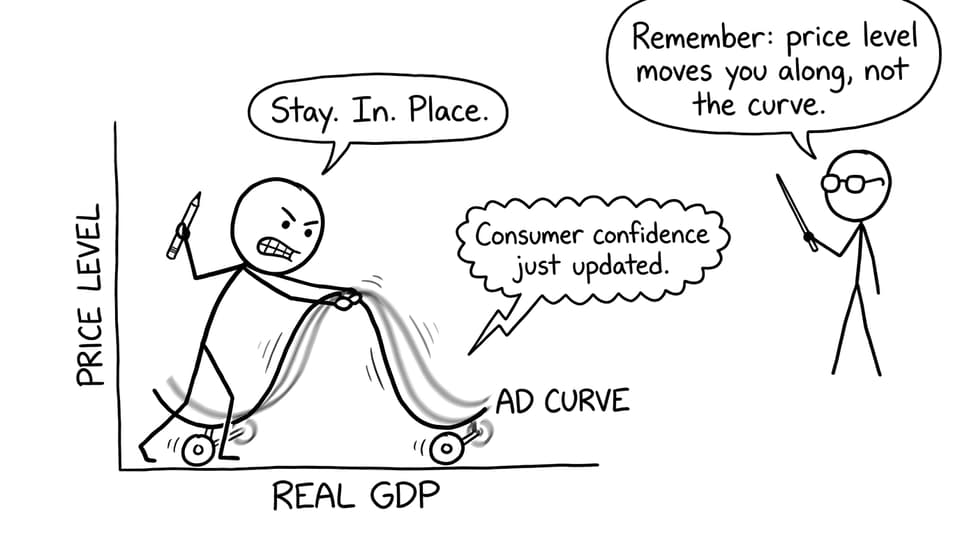
Changes in consumption (C): confidence, income, wealth
Consumption is the biggest AD component in most economies, so it’s often the easiest story to tell in IB Economics.
AD shifts right when households spend more because:
-
Consumer confidence rises (people feel safe buying now)
-
Disposable income rises (tax cuts, higher wages, more employment)
-
Wealth increases (housing or stock prices rise)
AD shifts left when the opposite happens: uncertainty spikes, debt feels heavy, and saving looks smarter than spending.
If you want the examiner-friendly determinants list, use 3.2.3 Determinants of AD Components Notes alongside 3.2.2 Components of AD Notes.
Changes in investment (I): interest rates and expectations
Investment is volatile because it depends on what firms think the future looks like.
In IB Economics, investment tends to rise when:
-
Interest rates fall (borrowing is cheaper, projects become viable)
-
Business confidence improves (expected profits rise)
-
Credit is easier to access (banks are willing to lend)
When rates rise or expectations sour, planned investment drops and AD shifts left.
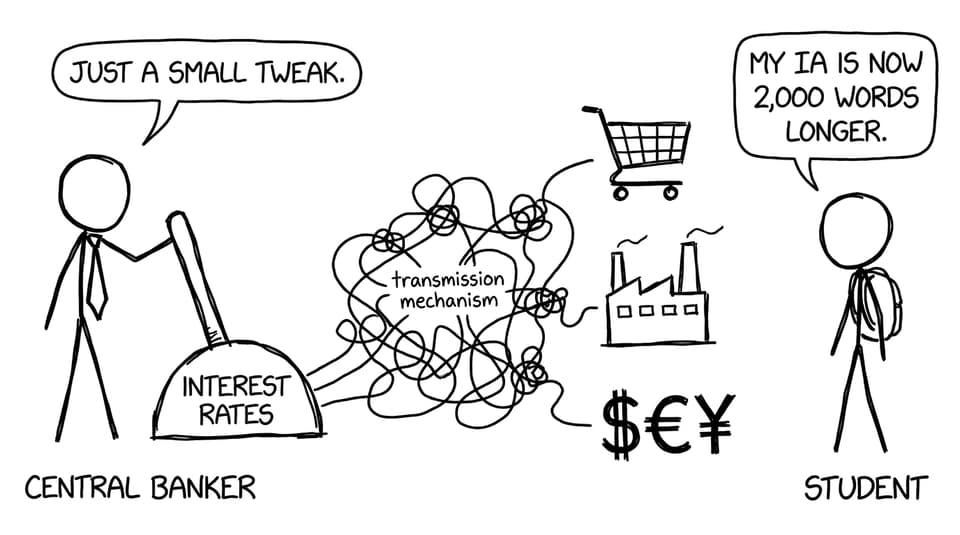
To practise writing this as a tight chain of reasoning (rate change → I change → AD shift → macro outcomes), try exam-style prompts in the Aggregate Demand Questionbank and the wider 3.2 Variations in Economic Activity Questionbank.
Changes in government spending (G): fiscal choices
Government spending directly enters AD, so it shifts the curve without needing a complicated detour.
-
Higher government spending (infrastructure, healthcare, public services) → AD shifts right
-
Spending cuts (austerity) → AD shifts left
In IB Economics, you’ll often score extra evaluation by noting the trade-offs: time lags, debt sustainability, and possible crowding out.
For a focused revision path, use Revision Tips: Fiscal Policy Guide for IB Economics and connect it back to shifts in AD.
Changes in net exports (X - M): exchange rates and global demand
Net exports change when the world changes.
AD shifts right if:
-
The currency depreciates (exports cheaper, imports more expensive)
-
Foreign incomes rise (more demand for domestic exports)
-
Trade conditions improve (competitiveness rises)
AD shifts left when global growth slows, the currency appreciates, or imports surge.
To strengthen your global-economy links in essays, revise alongside IB Economics 4. the Global Economy.
How RevisionDojo helps you lock in AD shifts (fast)
In IB Economics, marks come from clarity: definition, determinant, direction of shift, and a diagram explanation.
RevisionDojo is built for that workflow: use the Study Notes and IB Economics Revision Notes (SL/HL) to learn the language, then drill it with the Questionbank and Mock Exams. Tighten definitions with Aggregate Demand Flashcards. If your explanation feels shaky, ask AI Chat to challenge your chain of reasoning, and use Grading tools to see what an examiner would reward. When you’re ready to simulate the pressure, use Predicted Papers, and if you need personal feedback on your diagrams and evaluation, tap into Tutors.
Closing: learn the story behind the shift (IB Economics)
AD shifts aren’t random. In IB Economics, every shift is a story about planned spending changing in C, I, G, or (X - M). If you can tell that story clearly, and attach it to a clean AD/AS diagram; you’re already writing the kind of answer examiners trust.
Build that skill systematically with RevisionDojo: start with the notes, test yourself with the Questionbank, sharpen definitions with flashcards, and use AI Chat and grading feedback until your AD shift explanations feel inevitable.