


A small light that exposes a big idea
You’ve probably never paid a “subscription fee” to use a streetlight. You just walk under it, read your notes, and keep going. That quiet convenience is exactly why IB Economics treats public goods as a classic market failure: some goods are so easy to consume that they’re hard to sell.
In exams, public goods questions reward students who can do more than define terms. You need to show why the free market underprovides them, connect it to market failure, and evaluate why government provision helps (and what can go wrong).
Public goods in IB Economics: the exam definition
In IB Economics, a public good has two core characteristics:
-
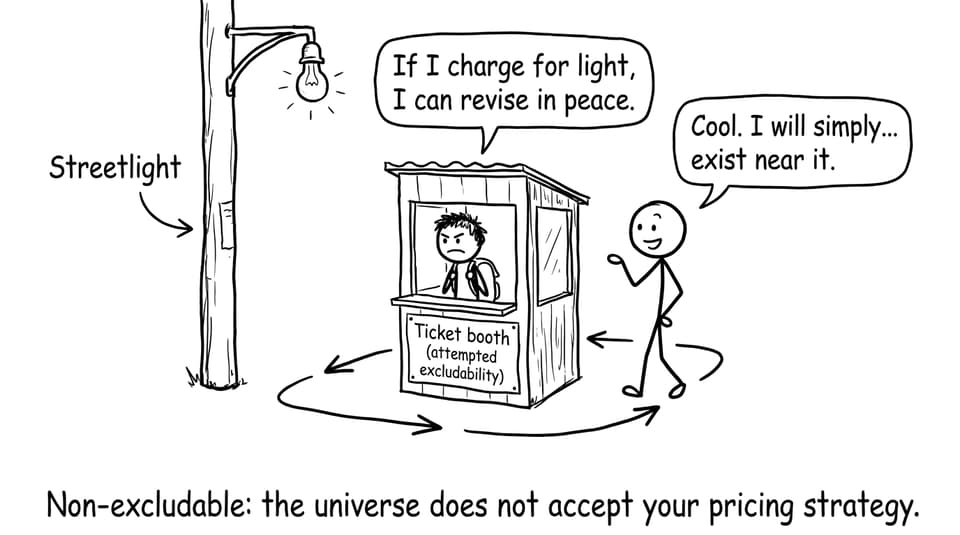
Non-excludable: it’s not feasible (or too costly) to stop non-payers from consuming it.
-
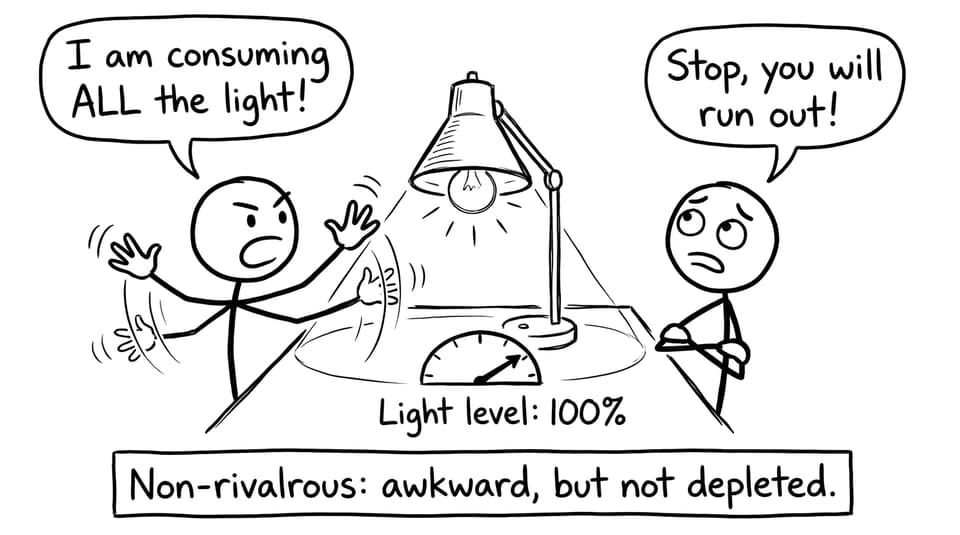
Non-rivalrous: one person consuming it does not reduce how much is available for others.
Classic examples you can use safely in responses include street lighting and national defense.
For syllabus-aligned coverage, anchor your revision with IB Economics Topic 2.9: Market Failure, Public Goods and the wider unit page Market Failure: Externalities, Common Pool Resources, Public Goods, Asymmetric Information.
Non-excludability: why charging is awkward
Non-excludability creates the “why should I pay?” moment. Once a public good exists, it’s difficult to stop people benefiting from it.
-
A streetlight shines on everyone nearby.
-
Flood barriers protect everyone behind them.
-
A public warning system alerts everyone within range.
In IB Economics, this matters because it breaks the normal link between payment and consumption, which private markets depend on.
Non-rivalry: why your use doesn’t reduce mine
Non-rivalry is simpler: your consumption doesn’t meaningfully reduce mine.
If one student walks under a streetlight, there isn’t “less light left” for the next student. In exam language, marginal cost of an additional consumer can be close to zero once the good is provided.
The free-rider problem (and why markets underprovide)
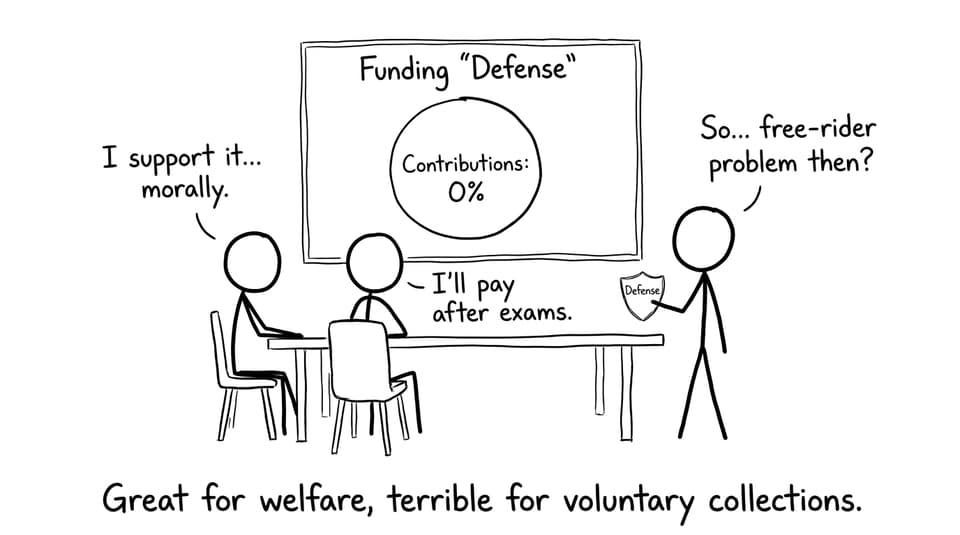
Put non-excludability and non-rivalry together and you get the headline mechanism: the free-rider problem.
In IB Economics, free-riding happens when individuals can enjoy a benefit without paying, so they have an incentive to hold back and let others fund it. If too many people do that, a private firm cannot reliably collect revenue, so the good becomes underprovided or not provided at all.
If you want a quick, exam-friendly explanation with extra examples, review Why Do Public Goods Create Free-Rider Problems?.
Public goods vs other goods: a fast sorting tool
Examiners often test whether you can classify goods accurately. Use this quick sorting grid in your head:
-
Private goods: excludable + rivalrous (food, clothing)
-
Public goods: non-excludable + non-rivalrous (street lighting, national defense)
-
Quasi-public goods: partly excludable or partly rivalrous (toll roads)
-
Common access resources: non-excludable but rivalrous (fisheries)
To practise classification and explanation under time pressure, use the Public Goods Questionbank and the broader Market Failure Questionbank.
Government provision: the standard policy response
Because private provision is difficult, governments often provide public goods directly and fund them through taxation. In IB Economics, your reasoning should be: the social benefits of public goods are high, but private incentives to supply them are weak.
For policy framing across the whole unit, connect this topic to Why Do Governments Sometimes Intervene in Otherwise Free Markets and the bigger-picture explanation in Why Understanding Market Failure Matters.
Evaluation points examiners love
Even when government provision is justified, evaluation earns marks:
-
Opportunity cost: money spent on street lighting cannot be spent elsewhere.
-
Risk of government failure: inefficient allocation, bureaucracy, weak incentives.
-
Equity concerns: who pays the tax burden, and who benefits most?
Quick checklist for Paper 1 and short responses
Use this mini-plan whenever you see a public goods prompt in IB Economics:
-
Define public goods: non-excludable + non-rivalrous
-
Explain the free-rider problem
-
Link to underprovision and market failure
-
Give one clear example (street lighting or national defense)
-
Propose government provision/tax funding
-
Evaluate with opportunity cost + inefficiency risk
If you want this laid out lesson-by-lesson, study with Lessons for Market Failure: Public Goods and consolidate with Videos for Market Failure: Public Goods.
Closing: make the definition do work
Public goods look simple on flashcards, but they’re powerful in exams because they explain a whole chain: non-excludability and non-rivalry lead to free-riding, which leads to underprovision, which justifies government action (with trade-offs).
To turn that chain into marks, revise public goods in IB Economics with RevisionDojo’s syllabus-aligned Study Notes, drill real exam-style prompts in the Questionbank, and tighten your evaluation using Flashcards and AI Chat when your explanations feel fuzzy. When you’re ready to simulate exam pressure, use Mock Exams, Predicted Papers, and Grading tools to sharpen structure and timing, and explore the Tutors and Coursework Library if you want feedback that moves your writing from “correct” to “high-scoring.”