


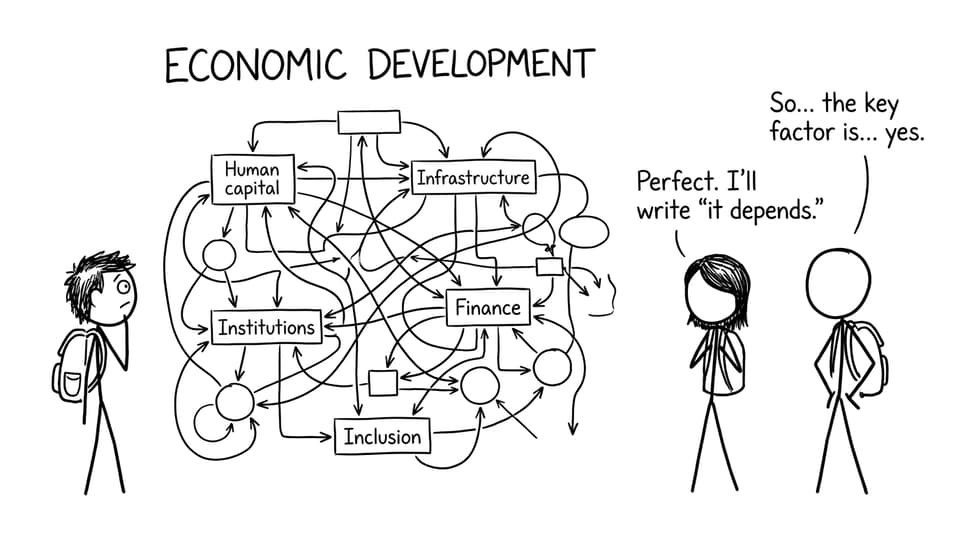
If you have ever tried to explain why one country seems to “take off” while another stays stuck, you have already met the real heart of IB Economics. Development is not a single lever you pull. It is a long chain of small advantages that compound quietly, until until they show up as longer lives, better schools, safer streets, and more choices.
In IB Economics, this topic can feel deceptively simple: list the factors, define them, add an example. But examiners reward something subtler: clear cause-and-effect, links to indicators (like HDI), and a balanced awareness that policies have trade-offs.
A quick exam checklist (what to include)
When you answer a development question in IB Economics, try to hit this sequence:
-
Define economic development (living standards + well-being, not just output)
-
Use at least one development indicator (HDI, poverty rates, literacy, life expectancy)
-
Explain 3-5 drivers with clear transmission mechanisms
-
Add one evaluation point (time lags, inequality, corruption, opportunity cost)
-
End with a judgment (which factor matters most depends on context)
If you need a structured syllabus anchor, start with IB Economics resources.
Human capital: the quiet engine of productivity
Human capital (education, skills, and health) is often the “first domino” in development. A healthier workforce increases labour productivity and reduces absenteeism. Better education improves occupational mobility and makes it easier for an economy to adopt new technology.
In IB Economics, the strongest answers show how this translates into development: higher productivity can raise incomes, which can raise tax revenue, which can fund merit goods like schools and clinics, creating creating a reinforcing cycle.
For exam revision, pair theory with practice using the IB Economics Topic 4.10 hub and then test yourself under pressure with the Questionbank.
Infrastructure: lowering costs, widening access
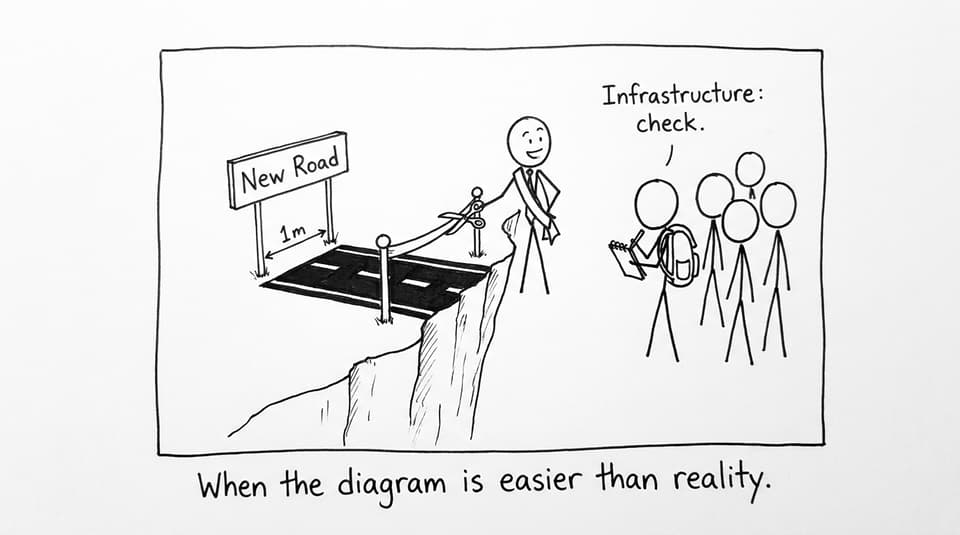
Infrastructure is not just “roads.” It is electricity grids, ports, clean water, broadband, and reliable transport networks. These reduce transaction costs, connect rural regions to markets, and make private investment more attractive.
In IB Economics, link infrastructure to both firms and households: businesses can produce at lower average costs, while households gain access to education and healthcare. That is development, not just growth.
To strengthen your explanation and evaluation, review Economic growth notes and then connect back to development outcomes.
Institutions: why rules beat luck
Strong institutions are the “invisible infrastructure” of development: secure property rights, contract enforcement, low corruption, political stability, and predictable regulation.
When institutions are weak, investment becomes riskier, government spending can be inefficient, and growth gains may not translate into better living standards. In IB Economics, this is where you can add evaluation: anti-corruption policies take time, and reforms may face political resistance.
For common obstacles and how to write them, use Barriers to growth and development lessons.
Access to finance: turning ideas into capital
Development needs savings to become investment. When households can save safely and firms can borrow at reasonable rates, economies become more dynamic. Financial inclusion also helps families smooth income during shocks (illness, unemployment, crop failure), preventing poverty from becoming permanent.
In IB Economics, go beyond “banks give loans.” Explain that access to credit supports entrepreneurship, capital formation, and sometimes export diversification.

For strategy language that scores well, revise Strategies to promote growth and development (notes).
Social inclusion: development that actually spreads
Economic development is not only about averages. Gender equality, social mobility, and inclusive access to education and healthcare determine whether progress is broad-based.
This is an exam-friendly place to mention inequality: growth can rise while poverty remains stubborn if benefits concentrate. A strong IB Economics response might mention progressive taxation, targeted transfers, or investment in merit goods, then then evaluate risks like budget constraints or administrative capacity.
To connect development to measurement, revisit 4.8 Measuring Development and the discussion of indicators.
Bringing it home: revise like development is built
Economic development is compounding in real life, and your IB Economics understanding works the same way. Small daily improvements: one clearer definition, one better chain of reasoning, one stronger evaluation, add up.
If you want a single place to run that loop, RevisionDojo is built for it: Study Notes for clean explanations, Flashcards for fast recall, the Questionbank for exam-style practice, AI Chat to fix confusion quickly, Grading tools to tighten technique, Predicted Papers and Mock Exams for realism, plus a Coursework Library and Tutors when you need human-level guidance. Start with IB Economics resources and make economic development a topic you can explain calmly, under time pressure, every time.