Join 650k+ students breezing through the IBReady to breeze through the IB?
Infrared spectroscopy is one of those IB Chemistry topics that feels like you’re supposed to “just see it.” A jagged line, a few dips, and suddenly you’re expected to announce: alcohol!carbonyl!carboxylic acid!
But IR isn’t magic. It’s closer to listening than looking: molecules absorb infrared light when their bonds vibrate at matching frequencies. Once you learn a small set of signals, IB Chemistry IR questions become predictable, even calming.
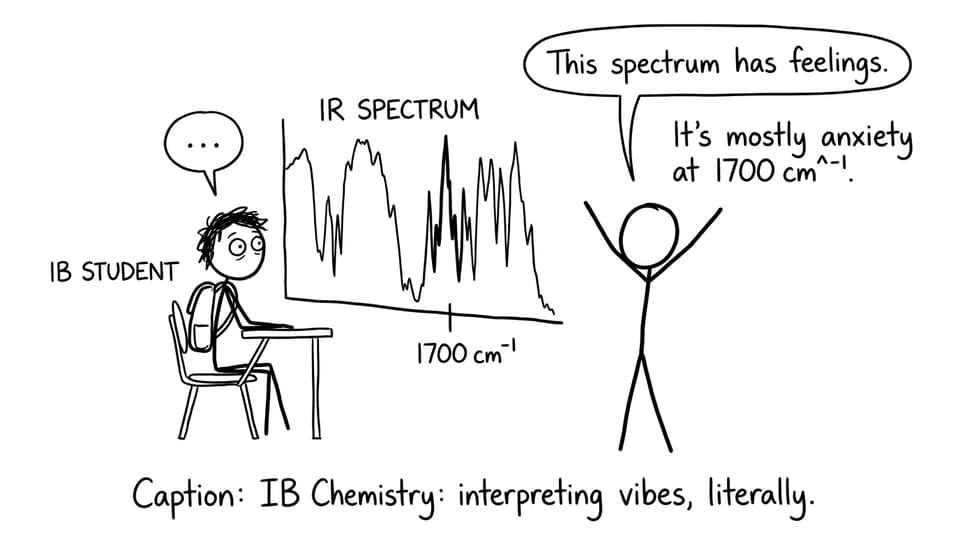
Student staring at an IR spectrum mountain range
What infrared spectroscopy actually measures (IB Chemistry)
In IB Chemistry, infrared spectroscopy (IR) is an analytical technique that measures which wavenumbers (cm⁻¹) a molecule absorbs. Those absorptions correspond to bond vibrations.
Think of covalent bonds like springs. When IR radiation hits a molecule:
Bonds stretch (change bond length)
Bonds bend (change bond angle)
Different bonds absorb different frequencies
The instrument plots an IR spectrum as % transmittance (y-axis) vs wavenumber (x-axis). A downward “peak” (dip) means absorption.
Most IB Chemistry exam interpretation follows the same rhythm: scan the functional group region, then use the fingerprint region only for confirmation.
Functional group region (4000-1500 cm⁻¹)
This is where the “big identity clues” live: O-H, N-H, C=O, C=C, C-H.
Fingerprint region (<1500 cm⁻¹)
This region is messy but unique. You typically don’t assign every peak. Instead, you use it to compare against a known sample or check if your product “matches.”
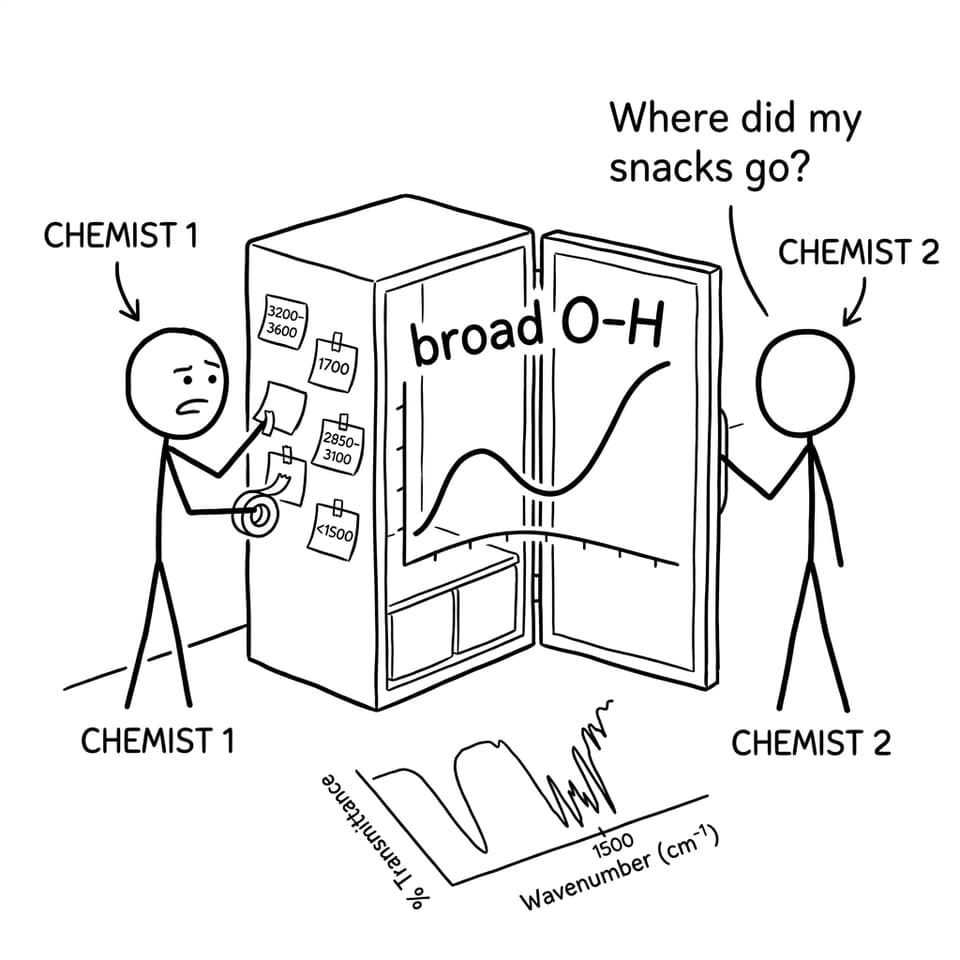
Fridge full of wavenumber sticky notes
A quick checklist to interpret an IR spectrum (exam-ready)
Use this fast checklist in IB Chemistry Paper 2 style questions:
Look for a broad O-H (alcohol vs carboxylic acid)
Look for a strong C=O near ~1700 cm⁻¹
Check for C=C if unsaturation is relevant
Use C-H stretches to support your story
Mention fingerprint region only as a “confirm identity” tool
Can IR spectroscopy distinguish aldehydes and ketones in IB Chemistry?
Not reliably by the carbonyl peak alone, because both aldehydes and ketones show a strong C=O absorption around the ~1700 cm⁻¹ region. In an IB Chemistry exam, you should say that IR is excellent for confirming “a carbonyl is present,” but weaker for telling which carbonyl it is. Sometimes additional clues exist (like small aldehyde C-H features near ~2720-2820 cm⁻¹), but those details are not always clear in simplified exam spectra. The safest approach is to combine IR evidence with reaction context and other data provided in the question. If the prompt includes multiple spectra or additional information, use IR to narrow functional groups, then finish the identification logically. In RevisionDojo’s Questionbank, explanations train you to write that reasoning in markscheme language.
Can IR spectroscopy show isomers for IB Chemistry?
IR can sometimes distinguish functional group isomers because they contain different key bonds (for example, an alcohol vs an ether). In that case, the functional group region gives different headline peaks, and the answer is straightforward. However, IR usually cannot reliably distinguish stereoisomers, because they share the same set of functional groups. Even structural isomers with the same functional groups may look similar in the functional group region, which is why the fingerprint region becomes important for comparison. In IB Chemistry, you should state that the fingerprint region is unique and can help confirm identity against a reference. But you typically won’t “decode” the fingerprint region peak-by-peak under time pressure. Use IR as one piece of the puzzle rather than the whole solution.
Does IR spectroscopy work on all compounds in IB Chemistry?
IR works best for covalent molecules where vibrations produce a measurable change in dipole moment. Many organic compounds fit this perfectly, which is why IB Chemistry uses IR heavily in organic identification. Some substances may produce spectra that are harder to interpret, especially if peaks overlap or if strong hydrogen bonding broadens signals. Ionic compounds often don’t give the kind of functional-group information students expect from IR in the organic context. In exam questions, you’re usually dealing with an organic unknown, so IR is appropriate and informative. The bigger limitation is not “whether it works,” but what it can and cannot conclude: functional groups, yes; complete structure, no. That’s why RevisionDojo pairs IR with structural analysis practice and exam-style marking.
Conclusion: treat IR like a small vocabulary, not a giant picture
Infrared spectroscopy in IB Chemistry is less about artistic interpretation and more about recognising a handful of high-value patterns: broad O-H, strong C=O, signs of C=C, and the idea that the fingerprint region confirms identity. Learn those signals, practise them in exam conditions, and your confidence rises quickly.
If you want the fastest path, use RevisionDojo to cycle between Study Notes, Flashcards, and the Questionbank, then test yourself with Mock Exams and Predicted Papers. That repetition is what turns an IR spectrum from a scary squiggle into a straightforward mark-collector for IB Chemistry.