RevisionDojo was developed independently of the IBO and as such is not endorsed by it in any way.
The week you finally feel on top of your HLs is often the week the IB Core taps you on the shoulder.
Not loudly. Just enough to remind you it exists in every reflection, every draft, and every “quick CAS evidence upload” you swear you’ll do later. For IB students preparing for exams, an in-depth review of the Diploma Programme isn’t complete without understanding how the IB Core quietly shapes your score, your workload, and your stress levels.
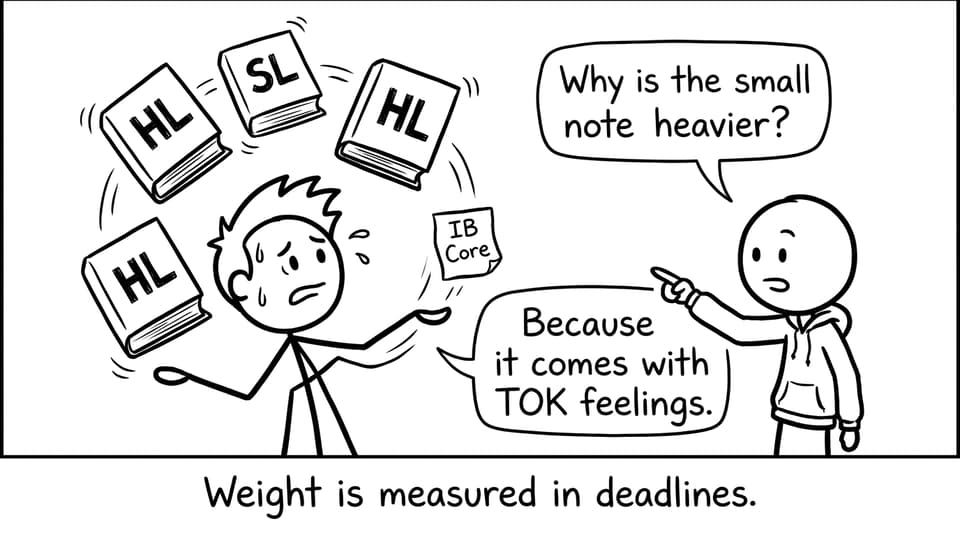
A tiny sticky note labeled IB Core somehow outweighs six books
IB Core at a glance (exam-season checklist)
Before the details, keep this simple IB Core checklist in your head:
TOK (Theory of Knowledge): graded A to E
EE (Extended Essay): graded A to E, max 4,000 words
CAS: assessed complete/incomplete
Weak performance can create real risk: TOK/EE = E or CAS incomplete can block the diploma
Strengths of the IB Diploma Programme (and why the IB Core matters)
The Diploma is globally recognised, but what universities often value most is the training beneath the grades: research habits, reflection, and independent thinking. That’s the IB Core doing its job.
TOK teaches you to question evidence and assumptions. The EE forces you to sustain an argument when motivation fades. CAS builds the muscle of showing up consistently. Those skills spill into every subject when exams get close and your time gets tight.
To anchor your subject revision while the IB Core runs in the background, use RevisionDojo for IB, then patch gaps quickly with Study Notes and IB Notes.
Challenges and limitations (the honest IB Core trade-offs)
The biggest drawback isn’t that the IB Core is “hard.” It’s that it’s easy to postpone until it becomes loud.
Workload is the obvious issue: six subjects plus TOK, EE, CAS, and internal deadlines. Burnout usually shows up as small unfinished tasks that multiply. The curriculum can also feel rigid if you want early specialisation. And your experience depends on school support; somesome students have strong guidance, others improvise.
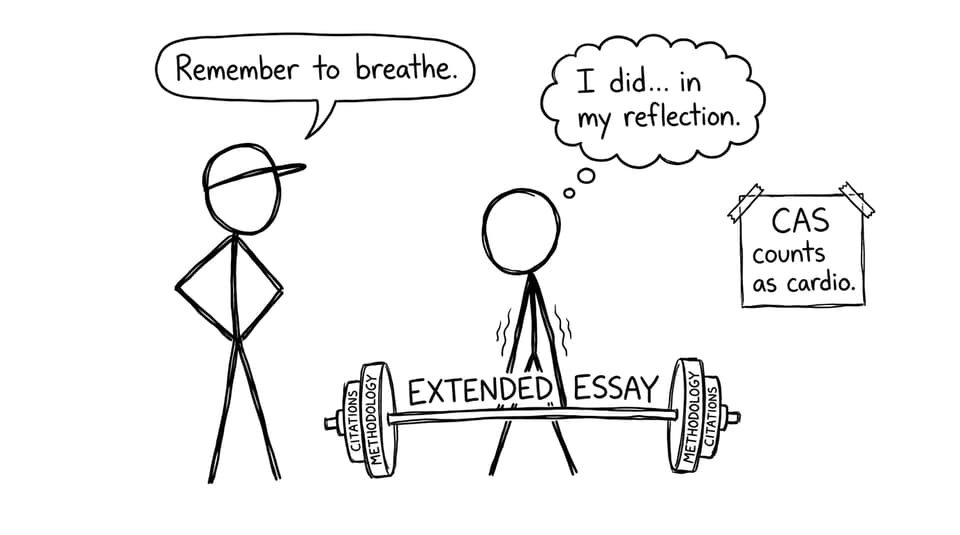
A barbell labeled Extended Essay at the “stress gym”
One exam-season fix is to turn “core work” into a weekly system: small drafting blocks, quick reflection prompts, and evidence uploads that take minutes, not hours. RevisionDojo supports that loop with AI Chat, Grading tools, and the Coursework Library, alongside exam features like Questionbank, Flashcards, Mock Exams, and Predicted Papers.
How to use RevisionDojo to keep the IB Core from derailing exams
The calm approach is integration: let the IB Core support your exam prep instead of competing with it.
Use the Questionbank to expose weaknesses fast, then write one TOK-style reflection question about your mistakes.
Convert recurring errors into daily recall using RevisionDojo Flashcards.
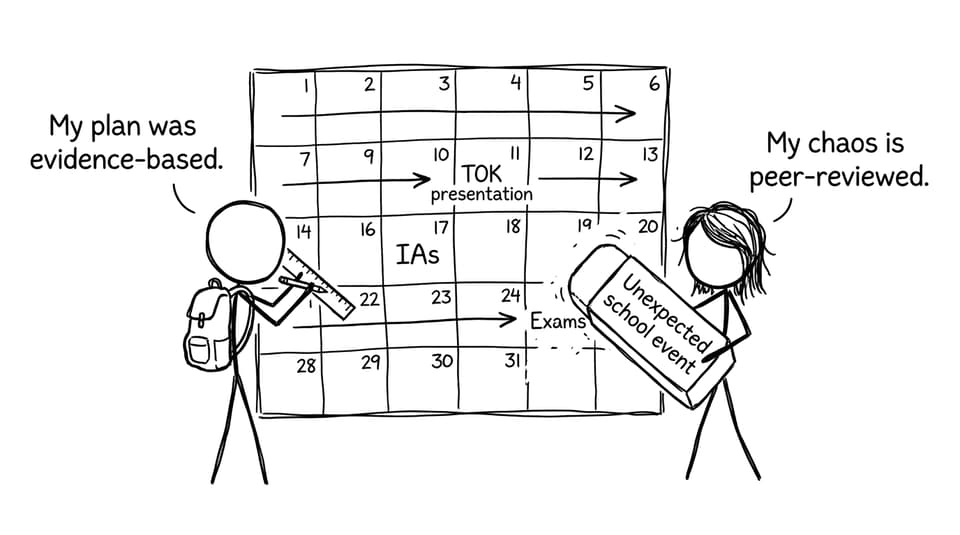
A perfectly ruled plan erased by “unexpected school event” chaos
FAQ
Does the IB Core actually affect my final result?
Yes, the IB Core can affect both your eligibility for the diploma and your total points. TOK and the EE are graded A to E, and they combine to contribute up to three additional points that sit on top of your subject scores. CAS is not graded, but it is a hard requirement: incomplete CAS can block the diploma even if your exam grades are strong. The practical takeaway for exam students is that “I’ll do core later” is not a strategy, it’s a risk. If you want a scoring-focused explanation, read How IB Core Points Worked in 2025. Treat the IB Core like a small weekly habit, not a last-minute project.
What’s the best way to balance IB Core work with revision?
Balance comes from shrinking the tasks until they’re repeatable. Instead of a four-hour TOK/EE day, aim for 30-45 minute blocks that happen every week, even during heavy revision periods. Link core work to what you are already studying: a TOK reflection on an assumption you made in a science question, or an EE paragraph revised using the same clarity standards you use in Paper responses. This prevents the IB Core from feeling like a separate life. On RevisionDojo, you can move between Study Notes, Flashcards, and Questionbank practice without losing momentum, then use AI Chat to unblock writing quickly. The goal is consistency, not intensity.
I’m behind on the IB Core: what should I do first?
Start by identifying what can actually block the diploma: CAS completion status and any TOK/EE deliverables with near deadlines. Then choose the smallest next action that creates proof of progress, like drafting one EE subsection, outlining a TOK claim with a real-life example, or uploading one CAS evidence item with a short reflection. Being behind usually feels overwhelming because everything is vague; clarity reduces panic. RevisionDojo helps by turning big tasks into tighter loops: draft, get criterion-level feedback with Grading tools, revise, and repeat. Combine that with short daily recall using Flashcards so subject revision doesn’t slide. If you need a broader mindset reset during exam season, read Is IB Actually the Hardest Curriculum?.
Conclusion: a realistic final verdict on the IB Core
The Diploma Programme is respected because it’s demanding, but the IB Core is what makes it feel like more than six classes. It builds the habits that turn study into judgment: what counts as evidence, how to argue clearly, how to keep commitments when life gets busy.
If you’re preparing for exams, don’t aim to “finish the IB Core.” Aim to run it weekly, quietly, alongside your revision. Use RevisionDojo as your home base: Study Notes for clarity, Flashcards for recall, Questionbank for marks, AI Chat and Grading tools for better writing, plus Predicted Papers and Mock Exams for confidence under time pressure.