


Introduction: when one number changes your whole plan
The night before results, most people don’t think in paragraphs. They think in numbers. A single boundary can turn “I’m fine” into “I need a rescue plan” -- or the other way around. If you’re studying IB Economics, knowing the IB Economics SL grade boundaries 2025 (Timezone 2) is not about obsessing. It’s about aiming your effort where it actually moves your grade.
This breakdown covers the Internal Assessment (IA), Paper 1, Paper 2, and the final overall grade boundaries for IB Economics SL in 2025 (TZ2). Then we’ll turn the table into a strategy you can use this week.
Quick checklist (use this before each revision session)
-
Know your target grade boundary (and the marks you can realistically gain).
-
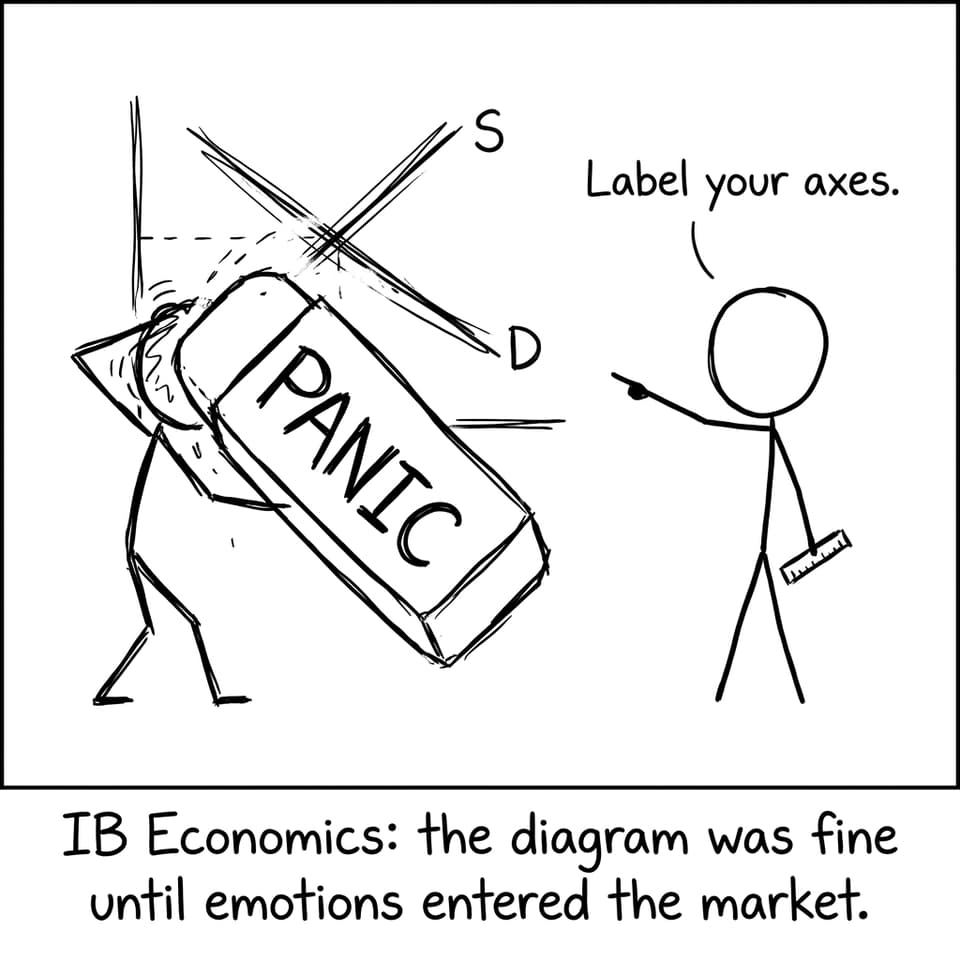
Train diagrams until labels feel automatic (axes, shifts, equilibrium).
-
Collect 3-5 flexible real-world examples you can reuse.
-
Practise under time pressure using exam-style questions.
-
Get feedback fast (so you don’t repeat the same mistake).
For structured practice, start at the IB Economics hub, then rotate between Economics Cheatsheets and the IB Economics Questionbank.
IB Economics SL grade boundaries 2025 (Timezone 2)
These IB Economics boundaries are shown as mark ranges for each grade.
Internal Assessment (out of 45)
-
Grade 7: 37--45
-
Grade 6: 32--36
-
Grade 5: 26--31
-
Grade 4: 21--25
-
Grade 3: 13--20
-
Grade 2: 7--12
-
Grade 1: 0--6
Paper 1 (out of 25)
-
Grade 7: 20--25
-
Grade 6: 18--19
-
Grade 5: 15--17
-
Grade 4: 13--14
-
Grade 3: 11--12
-
Grade 2: 6--10
-
Grade 1: 0--5
Paper 2 (out of 40)
-
Grade 7: 33--40
-
Grade 6: 27--32
-
Grade 5: 22--26
-
Grade 4: 16--21
-
Grade 3: 12--15
-
Grade 2: 6--11
-
Grade 1: 0--5
Final IB Economics SL grade boundaries (out of 100)
-
Grade 7: 80--100
-
Grade 6: 68--79
-
Grade 5: 55--67
-
Grade 4: 44--54
-
Grade 3: 32--43
-
Grade 2: 16--31
-
Grade 1: 0--15
How to use IB Economics boundaries (without spiralling)
Grade boundaries don’t tell you what to memorise. They tell you what to prioritise.
Use boundaries to pick “high-return” improvements
In IB Economics, the easiest marks are often the least glamorous: precise definitions, correctly labelled diagrams, and application that actually uses the data or extract. If you’re hovering near a boundary, your goal is usually not “learn a new unit” -- it’s “stop leaking 6 marks in predictable places.”
A simple training loop:
-
Learn one concept using Understanding IB Economics: A Comprehensive Guide.
-
Drill it with targeted sets in the IB Economics Topic 1 Questionbank.
-
Build speed with examiner-style practice from Economics Predicted Papers.
Match your practice to Paper 1 and Paper 2 reality
Paper 1 rewards structure: define, diagram (when relevant), explain the shift, then evaluate. Paper 2 rewards calm data handling: quote the figure, connect it to theory, and finish with a balanced judgment. If you want a repeatable system, borrow the routines in IB Economics Revision Methods That Actually Work.
FAQ
Are these IB Economics SL grade boundaries guaranteed for every school?
These IB Economics SL grade boundaries are specific to 2025 and Timezone 2, so they’re meant for students sitting that version of the exams. Boundaries can differ by timezone and session because exam difficulty and cohort performance vary. That’s why you should treat boundaries as a planning tool, not a promise. The smart move is to combine them with your own performance data from timed practice. RevisionDojo helps by letting you practise in a way that feels like the real thing, using Questionbank sets and predicted-paper style papers.
How can I improve fastest if I’m stuck on a grade boundary in IB Economics?
In IB Economics, the fastest improvements usually come from consistency, not new content. First, audit your last few responses and list the repeated issues: missing labels, vague definitions, no real-world example, or evaluation that never reaches a judgment. Then pick one fix per week and drill it deliberately. Use a tight resource stack: a cheatsheet for clarity, a few Study Notes for depth, and then lots of exam-style questions with feedback. On RevisionDojo, that looks like rotating between Study Notes, Flashcards for key terms, and AI Chat to test your explanations out loud.
What should I do differently for IA vs Paper 1 and Paper 2 in IB Economics?
Your IB Economics IA is about focused analysis: a specific article, a clear chain of reasoning, and diagrams that directly serve the commentary. It’s less about breadth and more about precision and relevance. Paper 1 and Paper 2, on the other hand, reward flexible thinking under time pressure: you need clean definitions, fast diagrams, and evaluation that considers stakeholders and trade-offs. So your revision should split: IA polishing (clarity, terminology, diagram relevance) and exam training (timed practice, markscheme thinking). RevisionDojo’s Coursework Library and Grading tools can help you tighten IA quality, while Mock Exams and Predicted Papers help you build exam stamina.
Conclusion: turn IB Economics boundaries into a calm plan
The point of knowing IB Economics SL grade boundaries for 2025 (Timezone 2) is simple: you stop guessing. You can see what the next grade costs in marks, then train the exact skills that buy those marks: definitions, diagrams, application, evaluation.
If you want a one-place system for that, use RevisionDojo as your loop: Questionbank for targeted practice, Study Notes and Flashcards for retention, AI Chat for explanation drills, and Predicted Papers and Mock Exams to build timing. Your boundary is just a number -- your preparation is what moves it.
