
Introduction
The night before results day, most IB Economics students don’t worry about everything. They worry about one thing: the tiny gap between “I think I did okay” and the number that actually becomes your final grade.
That gap is where grade boundaries live.
In this guide to IB Economics HL grade boundaries 2025 (P22, Timezone 0), you’ll see the cutoffs for the Internal Assessment, Paper 1, Paper 2, Paper 3, and the final grade out of 100. Then we’ll turn those numbers into something useful: a plan to build a buffer you can trust.
Quick checklist: how to use IB Economics grade boundaries
-
Know the IB Economics HL boundaries for each component so you can spot where marks are cheapest.
-
Aim for a buffer, not a perfect prediction (boundaries shift by session).
-
Train to finish: Paper 1 planning, Paper 2 scanning, Paper 3 working.
-
Keep your IA steady so exams don’t need to “rescue” you.
-
Use targeted practice (not random revision) to convert time into marks.
If you want a place to track boundaries across subjects and sessions, bookmark IB Grade Boundaries and sanity-check totals with the IB Grade Calculator.
IB Economics HL grade boundaries 2025 (P22, TZ0)
Below are the official ranges for IB Economics HL.
Internal Assessment (out of 45)
-
Grade 7: 37-45
-
Grade 6: 32-36
-
Grade 5: 26-31
-
Grade 4: 21-25
-
Grade 3: 13-20
-
Grade 2: 7-12
-
Grade 1: 0-6
Paper 1 (out of 25)
-
Grade 7: 19-25
-
Grade 6: 15-18
-
Grade 5: 12-14
-
Grade 4: 8-11
-
Grade 3: 6-7
-
Grade 2: 3-5
-
Grade 1: 0-2
Paper 2 (out of 40)
-
Grade 7: 33-40
-
Grade 6: 27-32
-
Grade 5: 22-26
-
Grade 4: 16-21
-
Grade 3: 12-15
-
Grade 2: 6-11
-
Grade 1: 0-5
Paper 3 (out of 60)
-
Grade 7: 46-60
-
Grade 6: 38-45
-
Grade 5: 30-37
-
Grade 4: 22-29
-
Grade 3: 15-21
-
Grade 2: 8-14
-
Grade 1: 0-7
Final IB Economics HL grade boundaries (out of 100)
-
Grade 7: 78-100
-
Grade 6: 64-77
-
Grade 5: 51-63
-
Grade 4: 37-50
-
Grade 3: 26-36
-
Grade 2: 13-25
-
Grade 1: 0-12
What these boundaries mean for your revision strategy
Grade boundaries in IB Economics are not just trivia. They are a map of where effort turns into points.
Build a buffer, not a gamble
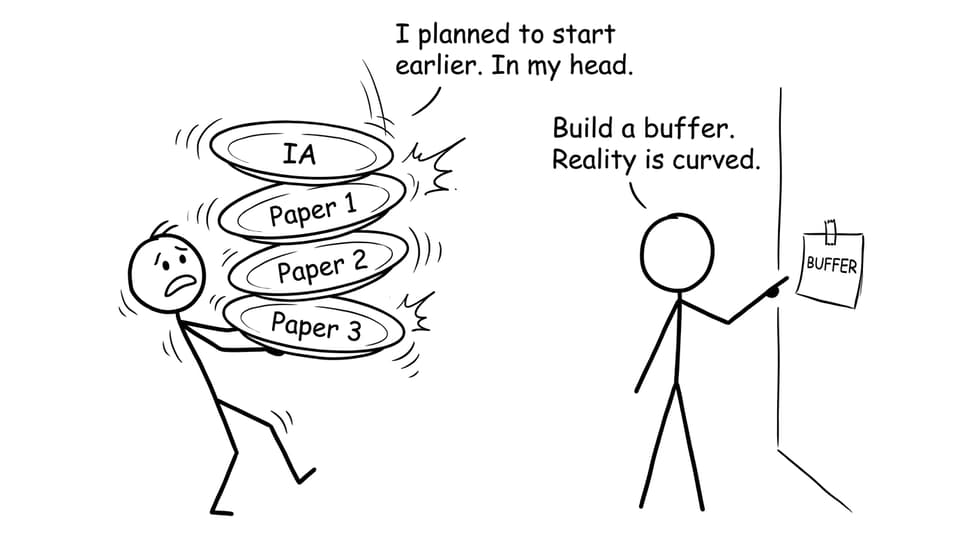
If your dream is a 7, don’t aim for 78 exactly. Aim for “78 plus room for a bad diagram label, a rushed evaluation, or one messy calculation.” That buffer mindset is why students with the same knowledge finish with different grades.
Paper-specific focus (HL)
-
Paper 1: Marks are often lost to weak structure. Use a repeatable paragraph method, define terms early, and treat diagrams like evidence. For targeted practice, drill essay-style prompts in the IB Economics Questionbank and review common traps in IB Economics HL: Top 7 Mistakes to Avoid (2025).
-
Paper 2: Time disappears when you read too slowly. Train yourself to skim for data, pick the right theory quickly, then evaluate with a real example. If your fundamentals feel shaky, start with Understanding IB Economics: A Comprehensive Guide.
-
Paper 3: This is where neat working becomes free marks. Practise calculations until your method is automatic using topic sets like IB Economics 1. Introduction to Economics Questionbank.
-
IA: Consistency matters. Use exemplar-quality standards from the IB Economics Coursework Exemplars and tighten your criterion performance with the IB Economics 10-mark Essay Grader.
A simple “7-chasing” routine for IB Economics (15 minutes a day)
-
5 minutes: one diagram from memory + labels.
-
5 minutes: one definition + one evaluation sentence.
-
5 minutes: one short quantitative question or data extraction step.
Need structure? Use RevisionDojo’s Study Notes, Flashcards, and AI Chat to correct misconceptions fast, then lock in marks with Mock Exams and Predicted Papers like Economics Predicted Papers (Free).
FAQ
Are IB Economics HL grade boundaries the same every year?
No, IB Economics grade boundaries change by exam session because they’re set after marking. If an exam is harder overall, boundaries typically move down; if it’s easier, they can move up. That’s why chasing an exact number is stressful and unreliable. Your best strategy is to use boundaries as a guide and then aim above them. RevisionDojo makes this easier because you can monitor trends on the IB Grade Boundaries page rather than relying on rumors. Over time, you’ll see that boundaries move, but strong technique stays valuable.
Which component is the fastest way to raise my IB Economics HL score?
For many students, the fastest gains in IB Economics HL come from “repeatable marks” like clean diagrams, correct definitions, and clear working on Paper 3. These are skills you can automate with short, frequent practice sessions. Paper 1 often improves quickly when you adopt a consistent structure and stop improvising under pressure. Paper 2 improves when you learn to pull the right data and apply theory without rewriting the whole case study. Your IA can also lift your final mark if you polish evaluation and diagram integration early. If you’re unsure where you leak marks, use RevisionDojo’s Grading tools and AI Chat to diagnose patterns rather than guessing.
Can I compensate for a weaker IA with strong exams in IB Economics HL?
Yes, strong exams can offset a weaker IA in IB Economics, but it’s not a comfortable plan. The problem is risk: exam-day performance is more volatile than coursework, especially when fatigue hits. A steadier approach is to treat the IA as your baseline and then build an exam buffer on top. That way, you don’t need a “perfect” Paper 1 or Paper 3 to reach your target grade. RevisionDojo’s Coursework Library helps you see what strong commentary writing looks like, and Tutors can help you fix issues before they become permanent. In the end, balance is what makes your final score predictable.
Conclusion
Grade boundaries don’t decide your future. They simply translate your performance into a number. When you understand the IB Economics HL grade boundaries for 2025 and build a buffer through disciplined practice, you stop revising in circles and start collecting marks.
If you want to turn this breakdown into results, use RevisionDojo’s Questionbank, Study Notes, Flashcards, AI Chat, Mock Exams, Predicted Papers, Coursework Library, Grading tools, and Tutors to train the exact skills that boundaries reward in IB Economics.