
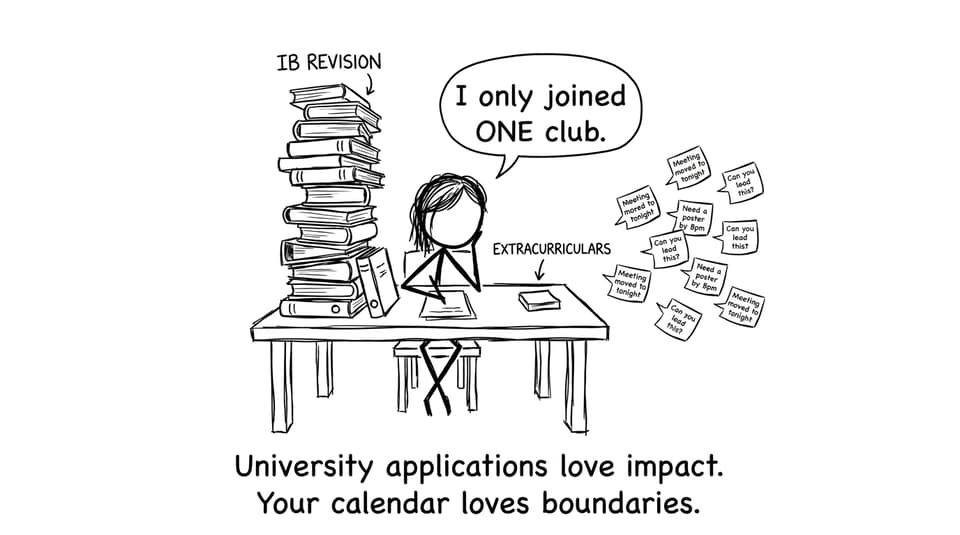
Extracurriculars can feel like the loudest part of a University application. The roles, the titles, the late-night group chats, the "quick" meeting that eats your whole evening.
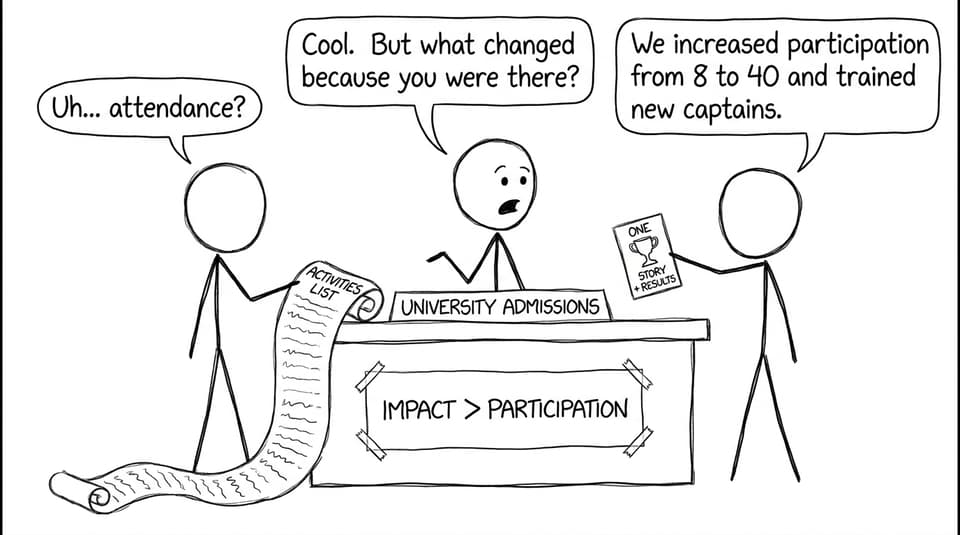
But admissions readers are quietly asking a different question: When you showed up, did anything move?
For IB students preparing for exams, this is good news. You don’t need more activities. You need a clearer story of impact, built around evidence you can actually defend while your revision schedule stays intact. That is how extracurriculars become a strength in a University application instead of a distraction.
The 60-second overview (save this)
-
Pick 3-5 activities that show commitment and growth (not everything you ever touched).
-
Describe impact, not attendance.
-
Connect at least one activity to an academic direction (lightly, honestly).
-
Use a simple story structure (STAR works).
-
Protect exam performance with realistic weekly boundaries.
If your schedule is already tight, pair this with How to Balance IB and Extracurriculars Without Burning Out and How to Create a Balanced IB Study Schedule.
Choose activities like a University reader would
A University doesn’t need proof that you can be busy. It needs proof that you can commit, learn, and follow through.
When deciding what to include, prioritize activities that show:
-
Longevity (months/years beats a two-week spike)
-
Responsibility (you owned a piece of work)
-
Initiative (you improved something, started something, fixed something)
-
Community (other people benefited, not just you)
CAS can help here, but only if you document it well. If your reflections are vague, your impact becomes hard to prove. Use 10 Powerful Tips to Write a CAS Reflection That Stands Out in 2025 and Using RevisionDojo to Strengthen IB CAS Reflection and Documentation.
Impact over participation (the sentence upgrade)
A University application reader scans fast. Help them by turning "what I did" into "what changed."
Try this upgrade formula:
Role + Action + Proof + Result
Instead of: “Member of debate club.”
Write: “Led weekly practice rounds, created a feedback rubric, and helped our team reach regional finals; younger members stayed and progressed into speaker roles.”
The point is not to sound impressive. The point is to sound specific. Specificity is credibility in a University application.
Connect extracurriculars to academics without forcing it
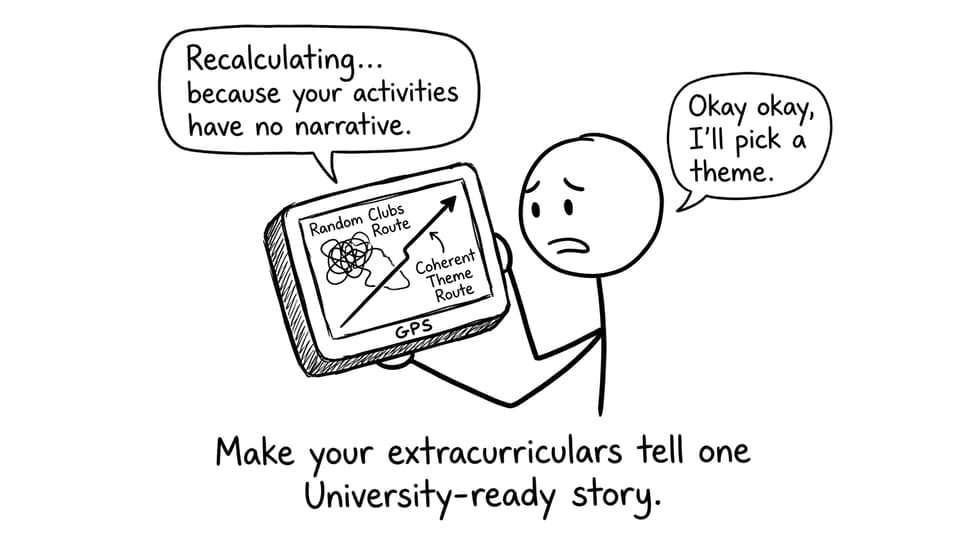
Linking everything to your intended course can feel fake. A better approach: connect one or two activities to the kind of problems you like.
Examples that usually feel natural:
-
Hospital volunteering -> interest in patient care systems, communication under pressure
-
Coding club -> enjoyment of building tools, debugging, teamwork
-
Theatre -> public speaking, persuasion, empathy, disciplined practice
If you’re applying through UCAS, remember the personal statement is shared across choices, so coherent themes matter. See UCAS Application Structure Explained: Choices, Personal Statements, References and Common UCAS Myths Busted.
Use STAR to write like a calm, confident applicant
STAR is simple, and that’s why it works.
-
Situation: What was happening?
-
Task: What were you responsible for?
-
Action: What did you actually do?
-
Result: What changed? Include numbers when you can.
A STAR paragraph reads like proof. Proof is what a University can trust.
Protect your grades while building a University-ready profile
It’s hard to sell academic readiness to a University if exam preparation collapses.
Use boundaries that keep both worlds alive:
-
Two fixed extracurricular windows per week
-
One weekly "impact block" (planning, training, creating resources)
-
No last-minute leadership expansions during mock season
For practical systems, use Best Time Management Techniques for IB Students in 2025 and How to Study for IB Exams: Step-by-Step Guide.
When you need a study engine that still leaves room for activities, RevisionDojo helps you compress effort into results: Questionbank for targeted practice, Study Notes for clarity, Flashcards for daily recall, AI Chat for quick unblocking, Grading tools to learn mark logic, Mock Exams and Predicted Papers for timed realism, plus a Coursework Library and Tutors when you need strategy.
Conclusion: make your extracurriculars believable
Your University application doesn’t need a louder list. It needs a truer one.
Pick the few activities you can describe with impact, write them with STAR-level clarity, and protect your exam performance with boundaries that hold. Then use RevisionDojo to keep revision efficient while your profile stays human: build confidence through the Questionbank, tighten memory with Flashcards, fix gaps with AI Chat and Study Notes, and rehearse pressure with Mock Exams and Predicted Papers.
If you want more guidance on keeping both academics and activities stable, start with Balancing Extracurriculars and IB Studies Effectively; build your University story from the inside out.