


A city wakes up to smog, long hospital queues, and soaring electricity bills. None of these problems were “chosen” by consumers or planned by firms. They’re what happens when imperfections collide. In IB Economics, market failure is often taught in neat boxes: externalities, public goods, information gaps, market power. Real economies don’t stay in boxes. They stack, and the stack wobbles.
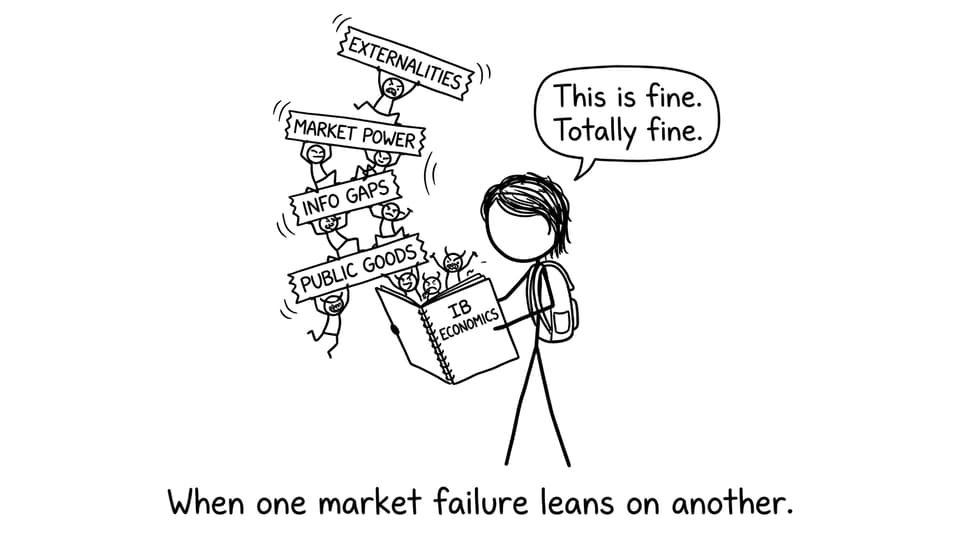
A quick IB Economics checklist for interacting market failures
Use this quick scan before you write evaluation:
-
Name the failures (externality? public good? asymmetric information? market power?)
-
Explain the link (how does one cause or amplify the other?)
-
Show the welfare impact (MSB/MSC logic, efficiency, equity)
-
Evaluate policy trade-offs (who gains, who loses, unintended consequences)
If you need the syllabus-aligned map of the whole unit, start with IB Economics resources.
When market power and externalities team up
A common real-world pairing is market power + negative externalities. Think of energy, cement, or large-scale transport: industries with high barriers to entry, few firms, and big pollution costs.
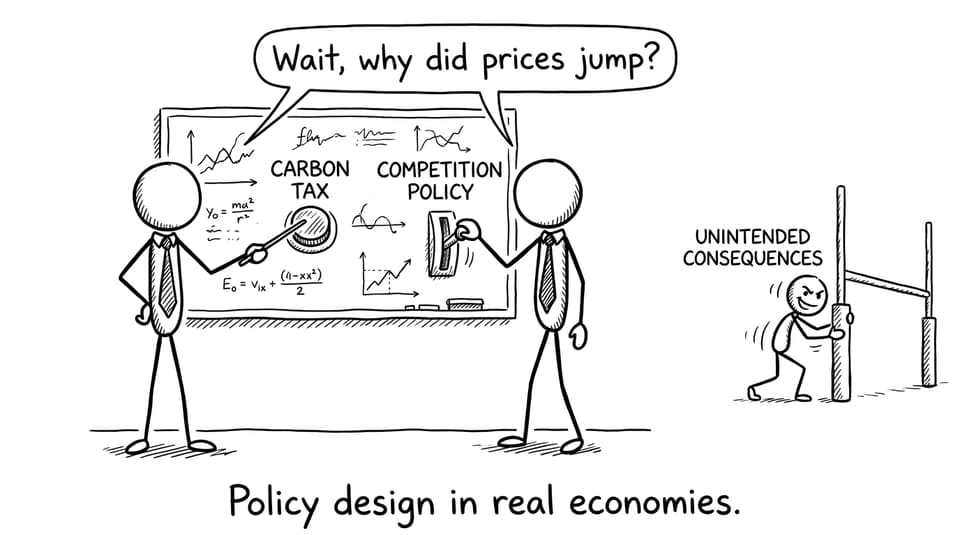
In IB Economics, it’s tempting to say: “Monopoly restricts output, so pollution falls.” That can be true, but it’s incomplete. Less output might reduce emissions, yet the monopoly price can create allocative inefficiency and worsen equity. If a government taxes emissions without considering market power, the dominant firm may pass the cost to consumers, protect its market share, and make entry even harder.
To revise the theory cleanly, use Market failure: market power (topic page) alongside the Market power notes and test yourself with the Market power questionbank.
Information asymmetry can block “good” policies
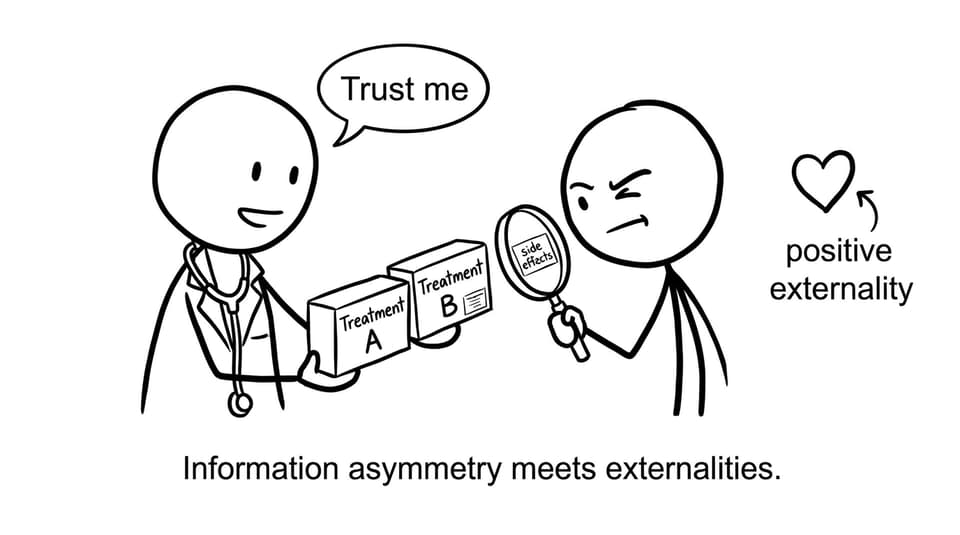
Asymmetric information doesn’t just create a problem by itself; it can break the solutions to other failures.
Healthcare is the classic IB Economics example. There are often positive externalities (vaccination, early treatment, herd immunity). Governments may subsidize care to increase consumption. But if patients can’t judge quality, or providers have incentives to oversupply certain treatments, the subsidy may not translate into better outcomes. You can end up with higher spending and still poor welfare.
If you’re revising the broader market failure mix, externalities, public goods, and information issues in one place, use Market failure: externalities, common pool resources, public goods, asymmetric information (topic page) and the matching topic notes.
Public goods and externalities overlap more than you think
“Clean air” is a great line for your exam script because it sits in two categories:
-
As a public good (non-rival, non-excludable)
-
As the outcome harmed by a negative externality (pollution)
That overlap matters. A carbon tax targets the externality, but the goal is to protect a shared resource that markets underprovide incentives for. In evaluation, you can argue that policies must consider measurement difficulties, monitoring costs, and international coordination.
For clear definitions and strong examples, review What are public goods? (IB Economics market failure guide).
How to write evaluation when failures interact (exam-ready)
In IB Economics, top answers don’t just list policies. They explain the collision.
Try this structure:
-
Claim: A tax/subsidy/regulation corrects one failure.
-
But: Another failure changes the size or direction of the impact (market power, info gaps, free-riding).
-
Therefore: Combine policies or justify sequencing (e.g., competition policy plus pollution pricing; information campaigns plus subsidy).
When you want fast practice under time pressure, RevisionDojo’s Comprehensive IB Question Bank guide explains how to use the Questionbank strategically. Then layer in Study Notes, Flashcards, AI Chat for quick clarification, and Grading tools to tighten your evaluation.
Conclusion: turn the messy reality into marks
Market failures interact because economies are interconnected: power shapes prices, information shapes choices, and spillovers shape everyone else’s outcomes. In IB Economics, you can turn that mess into a clear advantage by explicitly linking failures and evaluating policy trade-offs.
If you want to revise this topic faster, RevisionDojo brings it together in one place: Questionbank practice, Study Notes, Flashcards for definitions, AI Chat for quick “why” questions, Grading tools for evaluation, plus Predicted Papers, Mock Exams, a Coursework Library, and Tutors when you want feedback that feels like a real marker. Start with the IB Economics unit pages and build from there.