
A hook you can feel in your timetable
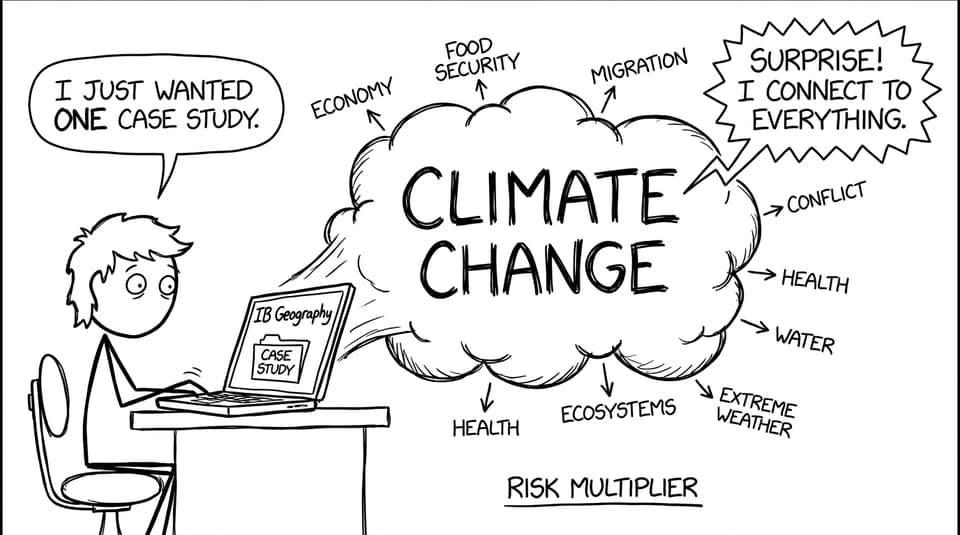
The strange thing about climate change is that it rarely arrives as a single headline. It shows up as a heatwave that stretches a bit longer than last year, a flood that knocks out transport for weeks, or a food price spike that quietly changes what families can afford. In IB Geography, that creeping, everywhere-at-once quality is exactly why climate change is treated as a global risk rather than just an environmental topic. It behaves like a risk multiplier: it takes existing pressures and turns the volume up.
If you are revising IB Geography for exams, the most valuable move is to explain connections clearly: climate process → hazard → vulnerability → impacts → responses.
Quick exam checklist (what to mention fast)
-
Use the term risk multiplier and explain it.
-
Link to hazard frequency/intensity (heatwaves, storms, drought).
-
Add food and water security impacts.
-
Show economic and supply chain disruption.
-
Include human security: health, displacement, conflict risk.
-
Evaluate inequality: highest risk often where adaptive capacity is lowest.
-
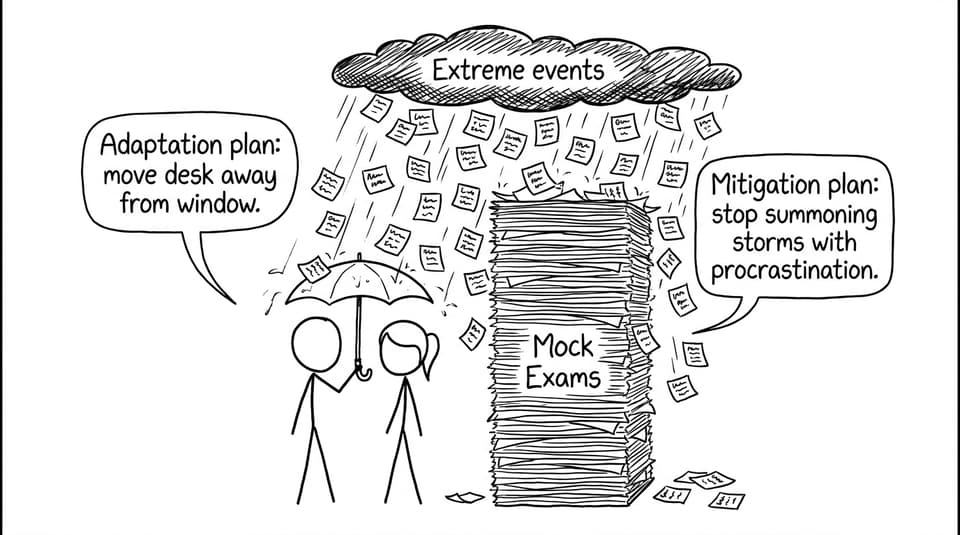
End with governance: mitigation + adaptation + resilience.
Climate change increases global risk by intensifying hazards
In IB Geography, risk is not just the hazard itself. Risk is what happens when a hazard meets exposure and vulnerability. Climate change raises risk by making some extremes more frequent, more intense, or more unpredictable. That matters because infrastructure, farming calendars, and emergency services are designed around “normal” ranges.
When those ranges shift, recovery becomes harder. A community that can bounce back from a once-in-50-years flood may struggle if major floods arrive every decade. The risk compounds: homes are rebuilt, savings shrink, and the next event hits a weaker system.
To tighten your climate paragraphs, revise the core content in 2.2 Consequences of Global Climate Change and the structured lesson flow in 2.2 Consequences of global climate change (Learn).
Food and water security: the quiet accelerator of instability
Climate change increases global risk by disrupting the basics that keep societies stable: reliable water and affordable food. Shifts in rainfall, higher evaporation, glacier retreat, and more frequent drought can reduce water availability or make it seasonal and unpredictable. Agriculture then absorbs the shock. Crop yields fall during heat stress, pests spread into new regions, and livestock losses rise in prolonged drought.
In IB Geography, this is a perfect place to demonstrate nexus thinking: water affects food; food prices affect political stability; instability affects migration and urban pressure. If you need crisp exam-ready phrasing and examples, build them from 3.2.2 Climate Change and the Nexus Notes.
Economic disruption: when local hazards become global shocks
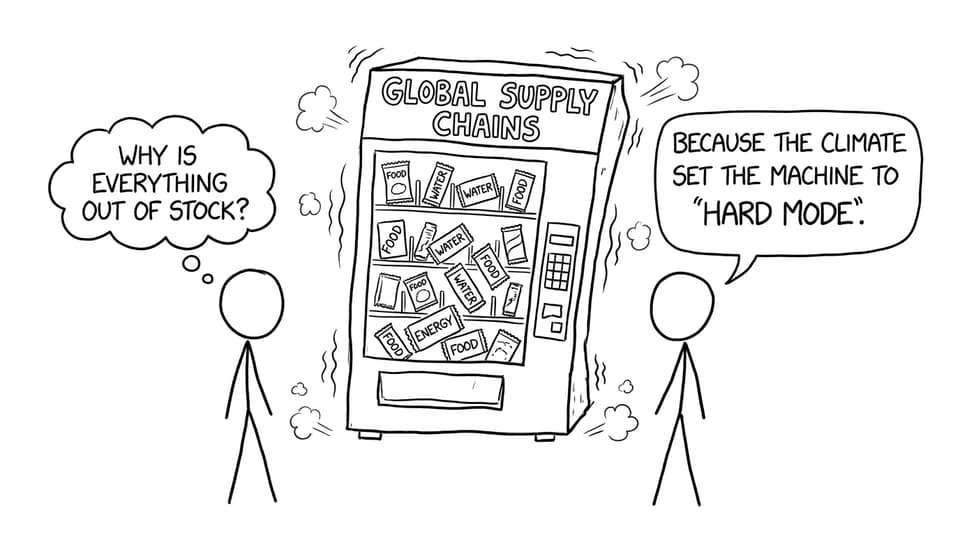
A storm is local, but its consequences can travel. Climate-related damage can hit ports, roads, energy grids, and manufacturing zones, interrupting trade and production. In an interconnected economy, that can trigger supply shortages and price spikes far from the original hazard.
This is a strong evaluation angle for IB Geography: climate risk is not evenly distributed, but economic shocks spread through networks. Countries reliant on climate-sensitive sectors (agriculture, tourism, fisheries) face higher exposure, while low-income states may lack insurance, infrastructure, or funds for adaptation.
To practise writing this under timed conditions, pull prompts from the 6 Global Risks and Resilience Questionbank and then check your structure using RevisionDojo’s AI Chat and Grading tools.
Human security and governance: why the impacts escalate
Climate change increases global risk through human security pathways: heat stress, changing disease patterns, air quality issues, and displacement from sea-level rise or repeated disasters. When people move, destination regions can face housing and service pressure, and political tension can rise if resources are already tight.
At the global scale, governance becomes part of the risk story. Climate change requires long-term coordination, but incentives are short-term and uneven. Delayed mitigation locks in higher future risk; uneven adaptation widens inequality and undermines cooperation.
For syllabus-aligned consolidation, review C.4.4 Climate Change Impacts and Adaptation alongside the broader unit hub 6 Global Risks and Resilience (HL only).
Closing: turn global risk into a clear paragraph
Climate change increases global risk because it pushes hazards beyond familiar limits, strains food and water security, disrupts economies, and escalates human security pressures, all while exposing deep inequality in adaptive capacity. In IB Geography, your advantage is clarity: show the chain of impacts, use the phrase risk multiplier, and evaluate who is most vulnerable and why.
When you are ready to practise it like the exam, open RevisionDojo’s Questionbank, build a short Mock Exam, and use the feedback tools to turn knowledge into marks.