


A cheap product can carry an expensive shadow. The buyer pays the market price, the producer receives revenue, yet people outside the transaction may breathe dirtier air, endure more noise, or face greater congestion.
Governments try to correct negative externalities by making decision-makers account for these wider costs. They can impose indirect taxes, regulate harmful activity, create tradable permits, subsidise cleaner alternatives, provide information, establish legal liability, or invest in infrastructure. In an IB Economics answer, the strongest approach is not merely listing these policies. You must explain how each one moves the market toward the socially efficient level and then evaluate whether it is likely to work.
For a foundation in the theory, review RevisionDojo's market failure and externalities notes.
The exam-ready overview
When answering a question about government responses to negative externalities, remember this sequence:
-
Define the negative externality and identify affected third parties.
-
Explain why the unregulated market overallocates resources.
-
Introduce a relevant government policy.
-
Use an accurate diagram and explain the movement toward the social optimum.
-
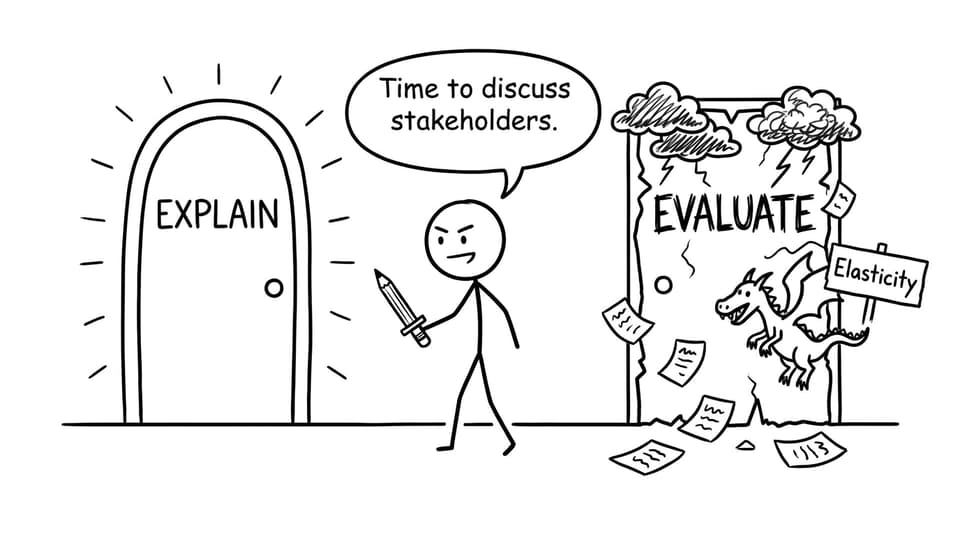
Evaluate effectiveness, equity, enforcement, information, and stakeholder effects.
-
Reach a justified conclusion based on the example.
This sequence turns policy knowledge into analysis. RevisionDojo's guide to government intervention questions can help you practise that structure.
Why negative externalities cause market failure
A negative externality exists when production or consumption imposes an uncompensated cost on a third party. Pollution from manufacturing is a negative production externality because people beyond the market transaction may bear environmental or health-related costs.
In the standard production diagram, marginal social cost is greater than marginal private cost because MSC includes both the producer's private costs and the marginal external cost. The free-market output therefore exceeds the socially efficient output, creating welfare loss.
The essential idea is that the price signal is incomplete. The product appears cheaper than its true cost to society. RevisionDojo's explanation of why externalities misallocate resources develops this chain of reasoning in more detail.
Indirect taxes internalise the external cost
A Pigouvian tax is an indirect tax intended to make producers or consumers account for the external cost of their decisions. For a negative production externality, the tax increases firms' costs and shifts the supply curve upward. Output falls, price rises, and the market moves closer to the socially efficient quantity.
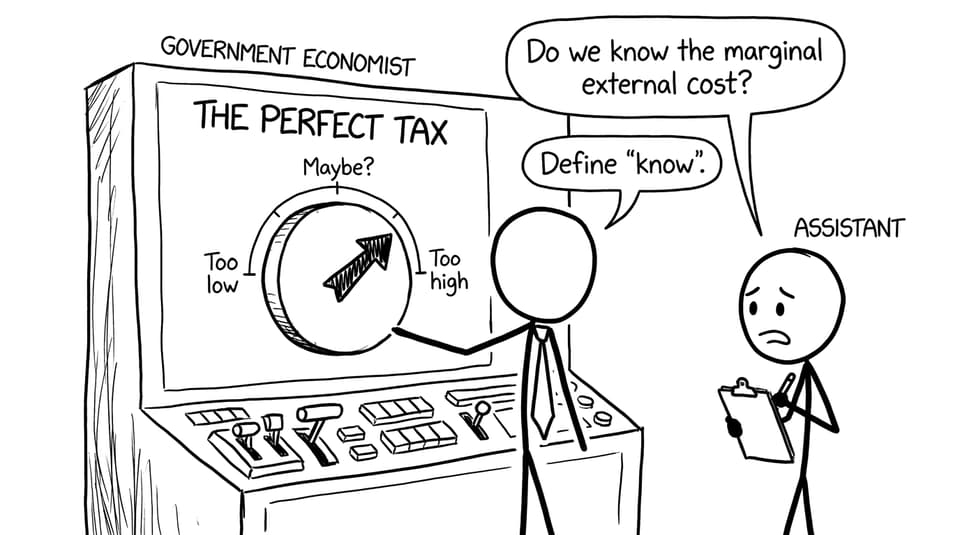
In theory, the ideal tax equals the marginal external cost at the socially optimal output. Reality is less tidy. Governments rarely know the precise monetary value of every environmental, health, or congestion cost.
Evaluation should consider price elasticity. If demand is relatively inelastic, a large tax may produce only a small decrease in quantity. The tax may also be regressive if lower-income households spend a larger proportion of their income on the taxed product. However, it raises government revenue that could finance compensation, cleaner infrastructure, or environmental programmes.
Regulation places direct limits on harmful activity
Regulation uses legal rules rather than relying mainly on price signals. Governments may establish emissions standards, restrict operating hours, ban certain products, require cleaner technology, or impose maximum pollution levels.
Its main strength is directness. If a harmful substance poses serious or irreversible risks, waiting for firms to respond gradually to a tax may be inappropriate. Regulation can establish a clear minimum standard immediately.
The limitation is that uniform rules may ignore differences between firms. One producer may reduce emissions cheaply, while another faces much higher costs. Monitoring and enforcement also require government funding, and weak penalties may encourage non-compliance. For additional evaluation traps, see common mistakes in government intervention answers.
Tradable permits combine a cap with market incentives
Under a tradable permit scheme, the government caps the total permitted quantity of pollution and issues or auctions allowances. Firms must hold enough permits to cover their emissions, but they may trade those permits.
A firm that can reduce pollution at a relatively low cost has an incentive to do so and sell spare permits. A firm with higher abatement costs may choose to purchase them. This can distribute pollution reduction toward firms able to achieve it more cheaply.
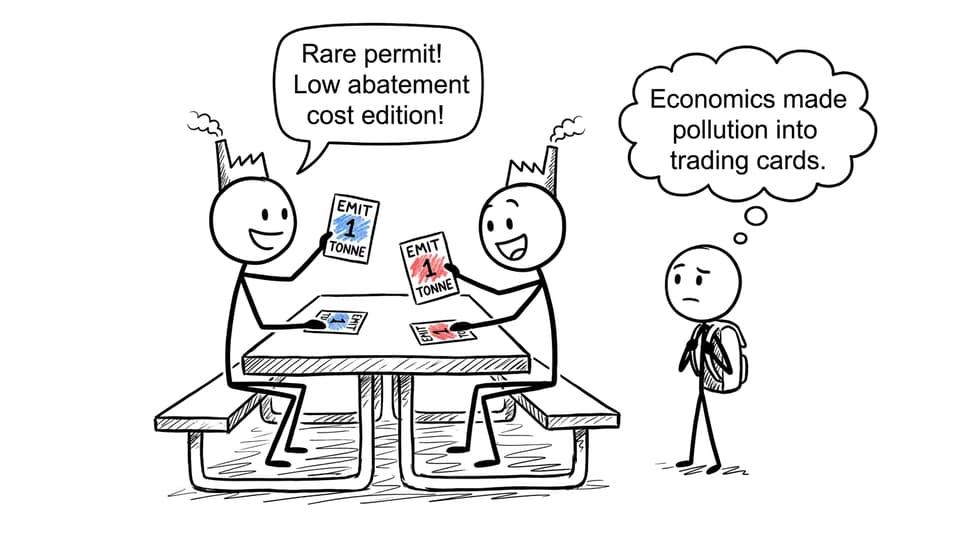
The European Union Emissions Trading System is a real-world cap-and-trade example covering specified emissions from major sectors. For exam evaluation, remember the distinction: a permit system offers greater certainty about the total permitted quantity, while the permit price can fluctuate. Its success still depends on an appropriately strict cap, reliable emissions data, and meaningful enforcement.
Subsidies make cleaner substitutes more attractive
Governments can subsidise public transport, renewable energy, home insulation, recycling systems, or cleaner production technology. Rather than making the harmful option more expensive, a subsidy reduces the relative price or cost of an alternative.
This may encourage substitution and support innovation, particularly where cleaner technologies have high initial costs. Yet subsidies carry an opportunity cost because public money cannot be used elsewhere. They may also reward firms that would have adopted cleaner methods without assistance or create dependence on continuing government support.
For broader topic coverage, use the IB Economics Study Notes alongside the focused government responses to externalities topic.
Information, liability, and infrastructure support change
Information campaigns can address negative consumption externalities by explaining risks and influencing demand. Health warnings, anti-littering campaigns, and energy-efficiency labels may help consumers make better-informed choices. Their impact can be limited when habits are deeply established or demand is relatively unresponsive.
Legal liability offers another route. If those causing harm must compensate affected parties, more of the external cost enters private decision-making. However, identifying responsibility and measuring damages may involve costly, lengthy legal processes.
Public investment can reduce external costs more practically. Reliable public transport may reduce dependence on private cars, while waste collection and monitoring systems can limit environmental harm. These measures are often most effective as part of a policy combination rather than as isolated solutions.
How to evaluate policies in an IB Economics essay
There is rarely a universally best intervention. Your judgement should depend on the market and the externality. Ask:
-
Can the external cost be measured accurately?
-
How elastic are demand and supply?
-
Can the policy be monitored and enforced?
-
Who bears the cost?
-
How quickly must the externality be reduced?
-
Could government failure make the outcome worse?
-
Would a combination of policies work better?
A tax might suit widespread emissions that can be measured, while regulation may be preferable where even a small quantity creates severe harm. Tradable permits can work well when a reliable cap and monitoring system are possible. The quality of your conclusion comes from these conditions, not from declaring one policy automatically superior.
Turn policy knowledge into exam marks
Negative externalities are costs that escape the original transaction. Government intervention tries to bring them back into view through prices, rules, incentives, rights, and public investment.
To convert that understanding into confident exam writing, use the IB Economics resource hub. RevisionDojo brings together the Questionbank, Study Notes, Microeconomics Flashcards, AI Chat, Grading tools, Predicted Papers, Mock Exams, Coursework Library, and Tutors. Learn the theory, practise the diagram, evaluate the trade-offs, and make every paragraph move toward a reasoned judgement.