Electron shielding is the kind of idea that feels “small” until it quietly explains half the periodic table.
In IB Chemistry, students often memorize trends (radius down a group, ionization energy across a period) and only later realize there’s a single lever behind many of them: how much the nucleus can “reach” the valence electrons. When shielding changes, the nucleus effectively gets louder or quieter to the outer electrons, and chemical behavior shifts with it.
Quick checklist for IB Chemistry exam answers
When a question mentions shielding, train yourself to write this chain:
-
More inner shells/electrons (especially new energy levels) → more electron shielding
-
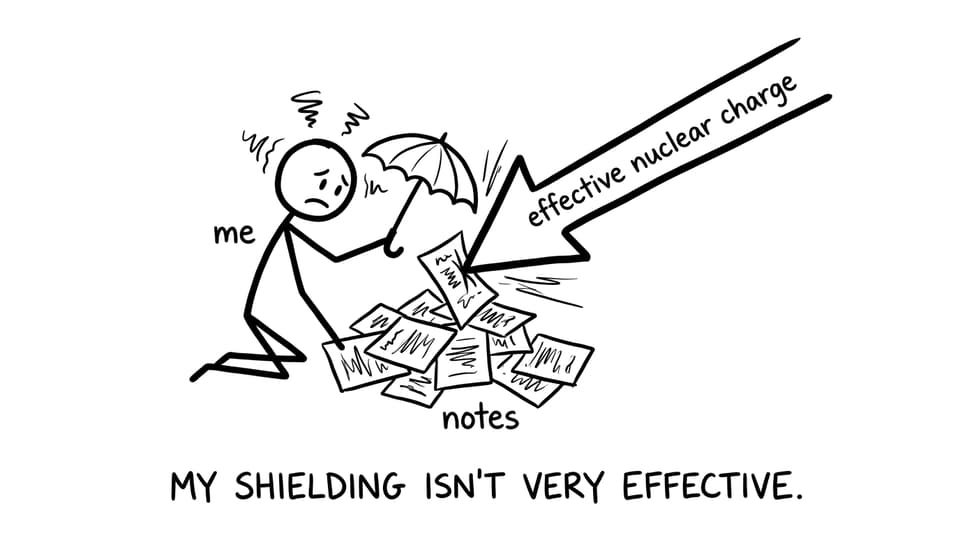
More shielding → lower effective nuclear charge felt by valence electrons
-
Lower effective nuclear charge → weaker attraction to valence electrons
-
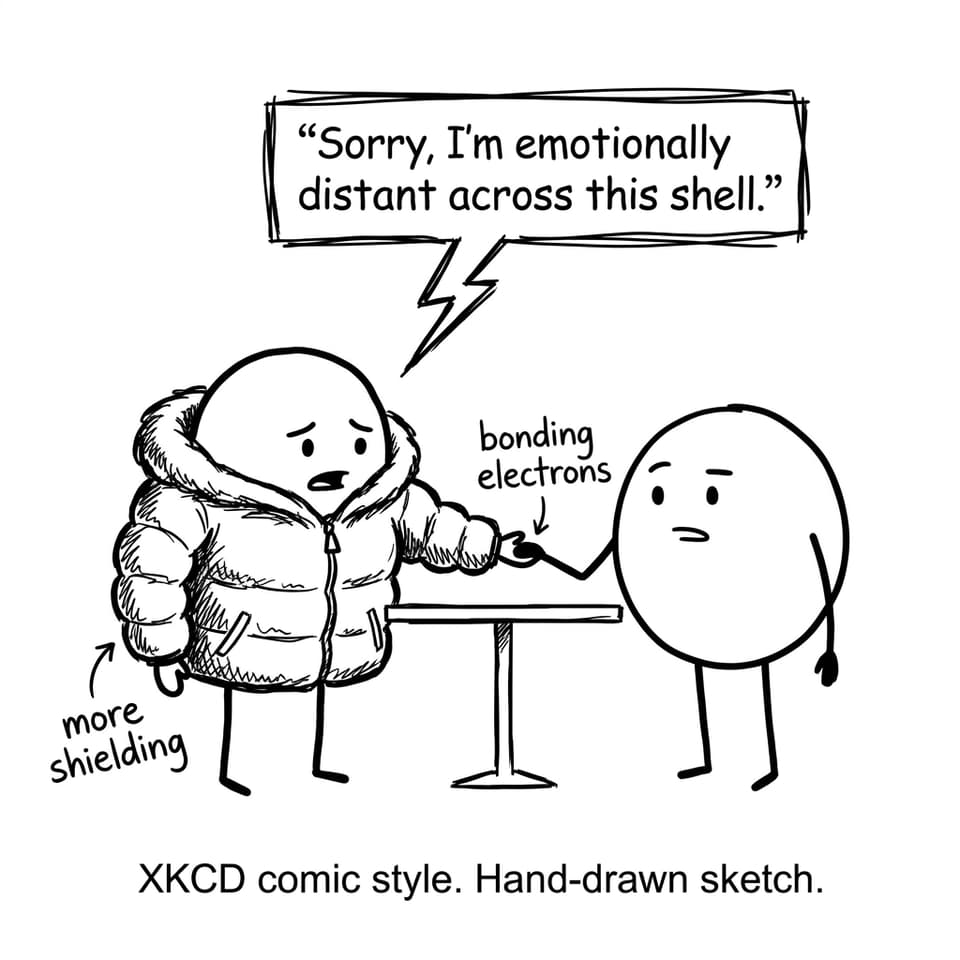
Weaker attraction → larger radius, lower ionization energy, typically lower electronegativity
If you want a clean definition to anchor the rest, see What Is the Shielding Effect?.
What “shielding” really changes: effective nuclear charge
In IB Chemistry, “shielding” means inner electrons repel outer electrons and partially block the nucleus’s pull. The nucleus still has the same number of protons, but valence electrons experience a reduced pull (effective nuclear charge).
Across a period, electrons are added to the same main energy level, so shielding changes only slightly, while proton number increases. Down a group, new shells are added, shielding jumps, and the outer electrons feel dramatically less pull.
To connect this to exam data-booklet thinking, practice reading position and trend logic with How to Use the IB Periodic Table in Exams and Revision.
Shielding and atomic radius: why size drives behavior
More shielding usually means a bigger atom. The outer electron cloud sits farther from the nucleus because the pull is weaker and there are additional shells.
That size change is not just “geometry.” A larger atomic radius often means:
-
Valence electrons are held less tightly
-
Metallic atoms lose electrons more easily
-
Reactions that depend on electron loss can speed up (classic Group 1 trend)
If atomic size trends are a weak point, revise with What Is the Periodic Trend for Atomic Radius? or Trends in Atomic Radius Explained.
Shielding and ionization energy: the “ease of losing electrons” story
Ionization energy is where shielding becomes instantly testable. In IB Chemistry, you’re expected to explain why ionization energy decreases down a group using:
-
increased distance (new shell)
-
increased electron shielding
-
reduced effective nuclear charge
So when shielding increases, ionization energy tends to drop because removing an outer electron requires less energy.
For a focused explanation and language you can reuse in long-answer questions, see Ionization Energy Explained Simply and HL nuance with Ionization Energy (HL) Notes.
Shielding, electronegativity, and bonding tendencies
Electronegativity is the nucleus trying to pull bonding electrons toward itself. If shielding increases, that pull weakens, and electronegativity typically decreases.
This matters because it nudges bonding behavior:
-
lower electronegativity elements are more likely to form cations
-
higher electronegativity elements pull electron density, strengthening polar bonds
-
changing electronegativity changes how “ionic vs covalent” a bond feels
That’s why periodic trends are not separate chapters in IB Chemistry; they’re one connected model.
Transition metals: why shielding gets weird (and oxidation states multiply)
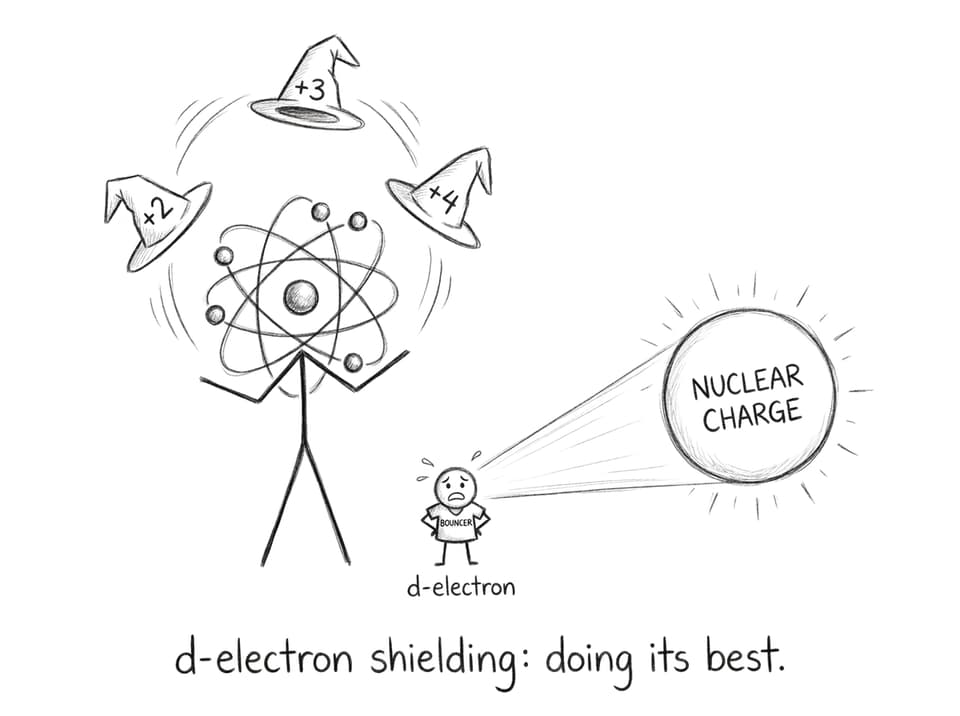
Transition metals add electrons to d-subshells, and d-electrons are not great shields compared with s-electrons. Across the d-block, effective nuclear charge can increase in ways that make electron removal more “context dependent.”
That’s one reason transition metals show variable oxidation states: the energy differences between losing different numbers of electrons can be relatively small, so the chemical environment can decide.
To connect periodic reasoning to reactivity-style questions, use Reactivity of Elements Based on Periodic Trends.
Closing: turn “shielding” into predictable chemistry
In IB Chemistry, electron shielding is the quiet engine behind size, ionization energy, electronegativity, and the reactivity patterns you’re asked to justify. Once you treat shielding as a cause (not a fact to memorize), your answers become shorter, clearer, and more consistent under pressure.
If you want to lock this in before exams, build a mini routine on RevisionDojo: use the Study Notes to anchor concepts, drill the Flashcards for key language, apply it in the Questionbank, and check your reasoning with AI Chat and Grading tools. When you’re ready to simulate the real thing, use Mock Exams and Predicted Papers to practise explaining shielding like an examiner expects.

