
In IB Economics, development policies often look clean on paper: invest in schools, build roads, expand healthcare, reform trade. Then reality arrives, slow, political, and full of trade-offs. A policy that should lift living standards can stall for reasons that have nothing to do with the diagram you drew.
This post breaks down the challenges that limit development policies in a way you can use in essays and data response. Think of it as a checklist for evaluation: why policies fail, why outcomes differ across countries, and what an examiner expects you to notice.
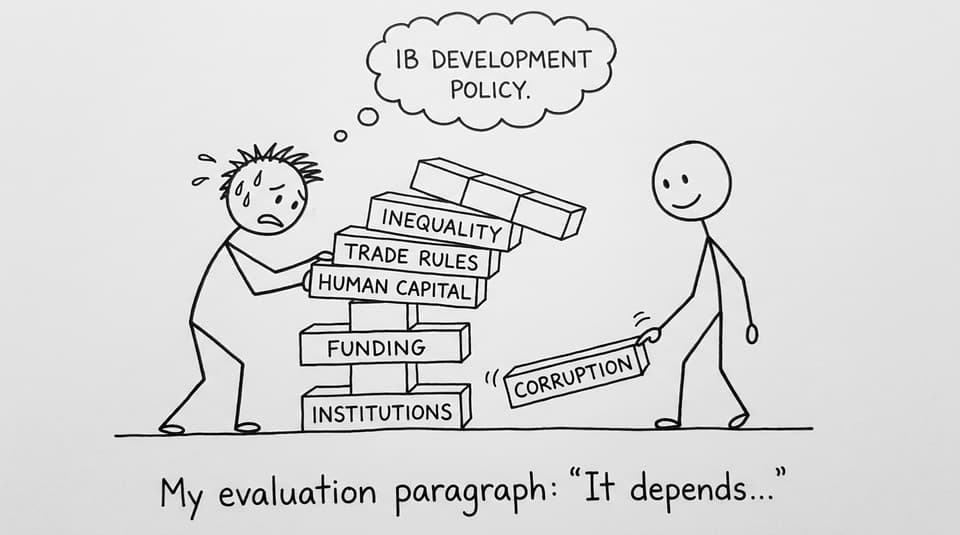
Quick checklist (use this for evaluation)
When you evaluate a development strategy in IB Economics, scan for:
-
Institutional weakness (governance, corruption, enforcement)
-
Budget constraints and unstable revenue
-
Human capital gaps (education, health, skills)
-
Structural dependence (commodities, low diversification)
-
External constraints (trade rules, geopolitics, climate shocks)
-
Social barriers (inequality, exclusion, conflict)
For syllabus-aligned revision, start with IB Economics Topic 4.10 overview.
Weak institutions: the policy leaks before it lands
In IB Economics, “institutions” are the invisible pipes of an economy: legal systems, property rights, tax collection, contract enforcement, and government credibility. If the pipes leak, extra spending does not reliably turn into outcomes.
Weak institutions can mean corruption diverts funds, procurement is inflated, or regulations are enforced inconsistently. Political instability can also shorten time horizons: long-term education reform is hard when leadership changes quickly.
If you need concrete institutional examples for chains of reasoning, use Political and social barriers notes (4.9.3) and connect it to your evaluation paragraph.
Insufficient financial resources: good plans, empty wallet
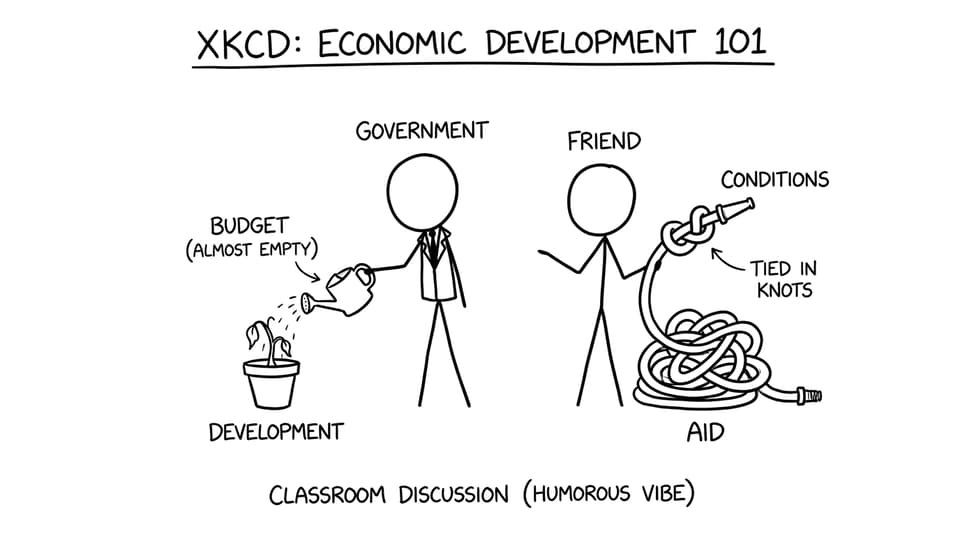
Many governments face a tight budget constraint: a narrow tax base, large informal sectors, and limited borrowing capacity. In IB Economics, this is where policy trade-offs become real. Funding a new highway might mean underfunding clinics. Expanding schooling might require cutting subsidies elsewhere.
External finance can help, but aid and lending may be unpredictable or tied to conditions, limiting domestic choice. Even when money arrives, absorption capacity matters: can the country plan, spend, and monitor effectively?
To revise how strategies are meant to work (and where funding becomes the bottleneck), see Strategies to promote growth and development notes (4.10.1).
Human capital gaps: policies assume skills that do not exist yet
A country can import machines. It cannot import a healthy, skilled workforce overnight.
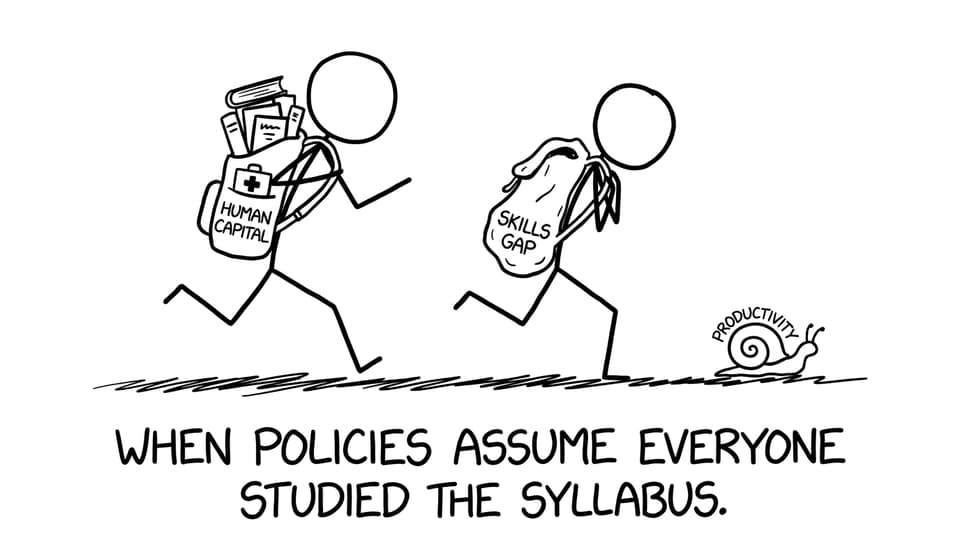
Low educational attainment, limited access to healthcare, and high disease burdens reduce productivity and slow the adoption of technology. Development policies aimed at industrialization or export upgrading can struggle if firms cannot hire trained workers or if illness reduces labor supply.
In IB Economics, this is a strong evaluation move: explain how the same policy works differently depending on starting human capital.
For broader context, pair your answers with Key factors behind economic development.
Structural economic constraints: commodity dependence and low diversification
Some economies are trapped by what they produce and export. Heavy reliance on primary commodities can create volatile export revenues, making planning difficult and public spending unstable. Narrow production structures also make countries vulnerable to global shocks (price drops, demand slumps, supply chain disruptions).
In IB Economics, link this to development strategy limits: diversification takes time, infrastructure, skills, and often a stable investment climate. Without those, policies can become fragile.
For a quick syllabus route into these barriers, use 4.9 Barriers to growth and development notes.
External constraints: rules, shocks, and climate pressure
Development does not happen in a sealed room. Global trade rules, geopolitical tensions, and the technology divide can restrict policy space. Climate change adds a new layer: droughts, floods, and storms destroy capital, disrupt agriculture, and increase fiscal pressure.
This is where top answers in IB Economics become balanced: acknowledge what policymakers control, then evaluate what they cannot.
If you want to connect development policies to sustainability and long-run outcomes, see Meeting the Sustainable Development Goals notes (4.10.4).
Social and cultural barriers: exclusion shrinks the economy
When inequality is high or groups are excluded by gender, ethnicity, or geography, the economy runs below its potential. Participation falls, talent is wasted, and social cohesion weakens. Policy implementation also becomes harder when trust in institutions is low.
In IB Economics, this is powerful evaluation: inclusive policies may raise long-run growth and stability, but they require capacity, funding, and political commitment.
To build sharper examples on redistribution and inequality, use Further policies to reduce poverty and inequality notes (3.4.10).
Conclusion: the examiner is looking for friction
The fastest way to level up in IB Economics is to treat every development policy like a real project, not a slogan. Ask where it leaks: institutions, funding, human capital, structure, external shocks, and social inclusion. Then write your evaluation as a calm, conditional judgment.
If you want to revise this topic efficiently, build a short plan using RevisionDojo’s Study Notes, drill it with the Questionbank, and lock in definitions with Flashcards. Your next IB Economics essay should read like someone who understands not just what governments want to do, but why it is so hard to make it stick.