
If you have ever tried to revise while your brain is already packing for summer, you know the problem: your body is still in the exam hall, but your mind has started writing its freedom speech.
That is why one question keeps showing up in group chats, notes apps, and the quiet panic before bed: when do IB exams end in May 2026? And more importantly, how do you avoid fading out right before the finish line?
This guide breaks down the May 2026 IB exam end window, why your personal final day may be different from your friend’s, and the Studying Tips that help you keep your grades stable through the last paper.
May 2026 IB exams: when they end (and why it is not one date)
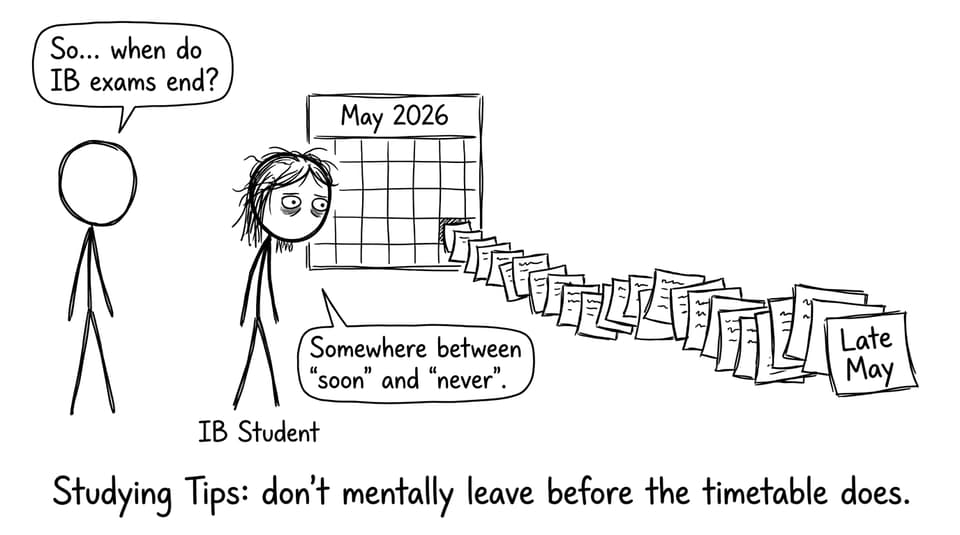
The most accurate way to say it is this: IB May 2026 exams end in mid-to-late May.
That is not a vague answer to avoid commitment. It is how the timetable is designed. The IB spreads papers across several weeks, and the combination of your subjects (plus SL vs HL papers) determines your personal finish.
Here is the key point most students miss: there is no single universal “last day” for everyone. Two students at the same school can finish days apart, and both are still following the official schedule.
Studying Tips for this reality: plan around your final paper, not the class mood. A lot of grade drops happen when a student stops acting like they are still in the session.
To anchor your planning, start by building a full timeline in the RevisionDojo Study Planner, then work backwards from your own last exam.
Quick timeline checklist (so you stop guessing)
Use this quick scan to organise your May 2026 exam season without overthinking it.
-
Find your final exam date from the official schedule your school shares
-
Identify your “late-week” subjects (often maths, sciences, HL-only papers)
-
Build a “two-speed” plan: heavy weeks vs light consolidation weeks
-
Keep daily recall running until the end (Flashcards are perfect here)
-
Schedule at least one timed practice block per subject during the final stretch
-
Protect sleep most aggressively in the last week, not the first
If you need a structure that holds under pressure, borrow the rhythm from Balanced IB Study Schedule That Actually Works and adapt it around your exam order.
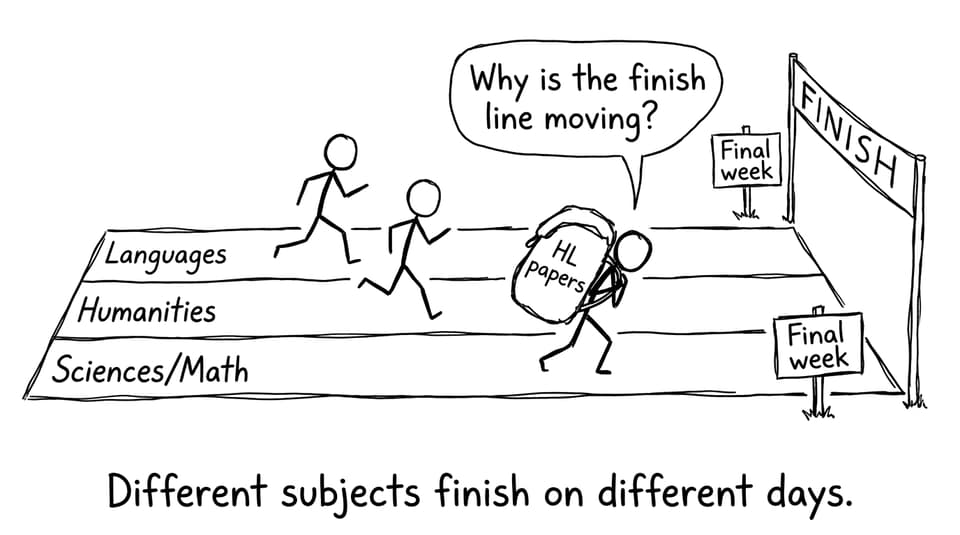
Why IB exams do not end on the same day for everyone
The IB timetable is built for a global system. It is trying to reduce clashes, keep subject papers sensibly spaced, and manage time zone security.
So in practice:
-
Some subject combinations finish earlier
-
Others stretch into the final week
-
HL candidates often sit extra papers that appear later
That is why you might see language-heavy students feel “done” earlier, while science/maths students are still carrying a full load.
Studying Tips you can actually use:
-
Treat the exam period like a marathon with checkpoints
-
After each paper, do a short reset routine (food, walk, 20 minutes off)
-
Then return to a smaller version of revision: targeted questions + mistake review
RevisionDojo makes that smaller revision easier because you can move quickly between Study Notes, Flashcards, and the Questionbank without rebuilding your system every day. If you have not explored the platform’s full loop, the overview in RevisionDojo App: The Smarter Way to Prep for IB Exams is a helpful starting point.
Which subjects are typically scheduled last (what to expect)
The final week often contains papers that are mentally expensive: longer responses, multi-step reasoning, or HL-only components.
While the exact list depends on the official timetable, students commonly see late placement for combinations such as:
-
Mathematics HL components
-
Science Paper 2 style exams
-
Some group 3 subjects
-
Late language components (depending on level and paper)
The danger is not that these papers are “harder.” The danger is that you meet them tired.
Studying Tips for late papers:
-
In the final week, switch from “learning” to “executing”
-
Do short timed sets and review marking patterns
-
Keep revision sessions brief but frequent (consistency beats heroic hours)
A practical way to train execution is to use the RevisionDojo Questionbank for targeted practice, then use AI Chat to ask why marks were lost and how to phrase answers more like the mark scheme expects.
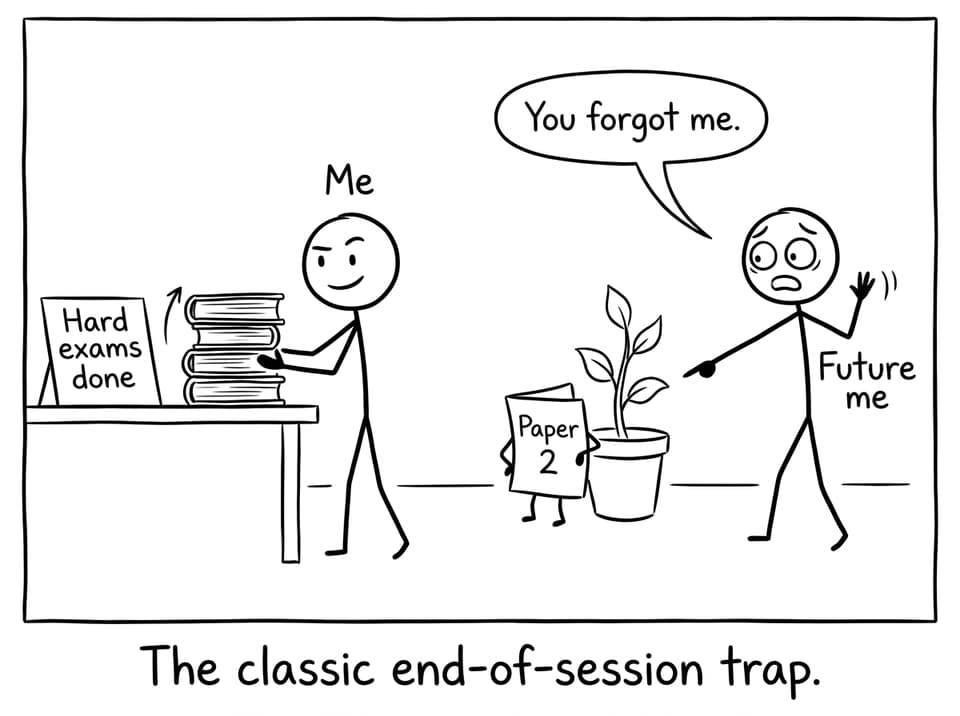
The biggest end-of-exams mistake: leaving early (mentally)
Most students do not sabotage the last paper because they are lazy.
They sabotage it because they are human.
Your brain sees that your toughest subject is finished and starts negotiating: “I deserve a break.” Then revision collapses, sleep gets messy, and you walk into the final exam slightly under-prepared but very confident that it will be fine.
That emotional swing is exactly why the last days can quietly cost grades.
Studying Tips to avoid the trap:
-
Keep a minimum daily routine until your final exam (even 45 minutes counts)
-
Do not “reward yourself” with sleep loss
-
After each exam, write one lesson in a mistake log and move on
If you want a concrete routine for the final stretch, use the structure in IB: The Last 2 Weeks Before Exams (What Matters). It is one of the cleanest ways to stay steady through the end.
How to plan revision all the way to your final May 2026 exam
The best approach is to plan in phases, because your energy changes.
Early session (week 1)
You still have stamina. Use it.
-
Timed practice blocks (build rhythm)
-
Marking and feedback loops
-
Light Flashcards daily
Middle session (week 2-3)
This is where discipline matters.
-
Rotate subjects to avoid burnout
-
Use Mock Exams for stamina training (one per week is enough)
-
Keep revisiting your mistake log
Final stretch (last few days before your final paper)
This is consolidation, not reinvention.
-
Short Questionbank sets on your weak topics
-
Flashcards for definitions, formulas, quotes, key diagrams
-
One timed mini-section to stay sharp
A strong workflow on RevisionDojo looks like this:
-
Study Notes to patch a gap quickly
-
Flashcards to keep recall fast
-
Questionbank to prove you can score under pressure
-
Grading tools to learn what examiners reward in writing
-
Predicted Papers and Mock Exams to rehearse timing
-
Coursework Library to reduce background stress from IAs
-
AI Chat when you are stuck and do not want to lose an hour
-
Tutors when you need a human to diagnose what is holding you back
If you want a broader timeline leading into May exams, How Early Should You Start Studying for IB May Exams? pairs well with this end-of-session strategy.
Closing: finish like it still counts (because it does)
The exam season does not end when your hardest subject ends. It ends when your last paper is done.
If you want the simplest advantage in May 2026, it is this: keep your routine alive until the end. Keep your Studying Tips boring and repeatable. A little practice each day beats a dramatic final push followed by a quiet collapse.
Build your full May 2026 timeline in the RevisionDojo Study Planner, then use RevisionDojo’s Study Notes, Flashcards, Questionbank, AI Chat, Grading tools, Predicted Papers, Mock Exams, Coursework Library, and Tutors to keep improving right up to your final exam day. Strong finishes create strong results.