Is collaboration mandatory in IB Theatre?
The first time most students hear the words “Collaborative Project” in IB Theatre, there’s a tiny, private hope: Maybe this is optional. Maybe there’s a solo version. Maybe I can just do the work and submit it.
But theatre rarely rewards wishful thinking. And neither does the IB.
Yes: collaboration is mandatory in IB Theatre. The Collaborative Project is a compulsory internal assessment at both SL and HL, worth 25% of your final grade. There is no opt-out pathway. The course is built on the idea that theatre is made with people, not just near them.
If you want the big-picture structure of the course first, bookmark Dive into the World of IB Theatre: An In-Depth Syllabus Overview.
Quick checklist: what the IB expects for IB Theatre collaboration
Use this as your non-negotiables list for IB Theatre:
-
Work in a group of 2-6 people
-
Create an original piece from a shared starting point (stimulus)
-
Make and present a 7-10 minute performance (recorded for submission)
-
Ensure each student has a clear artistic contribution (not necessarily acting)
-
Submit individual reflective documentation (because your grade is individual)
For deeper detail on what the component is testing, read Understanding the Collaborative Project in IB Theatre.
What “collaboration” actually means in IB Theatre
In IB Theatre, collaboration doesn’t mean “everyone helps a bit.” It means the group builds a piece together from a shared origin, and you can show evidence that your ideas were shaped by genuine exchange: negotiation, disagreement, revision, compromise, discovery.
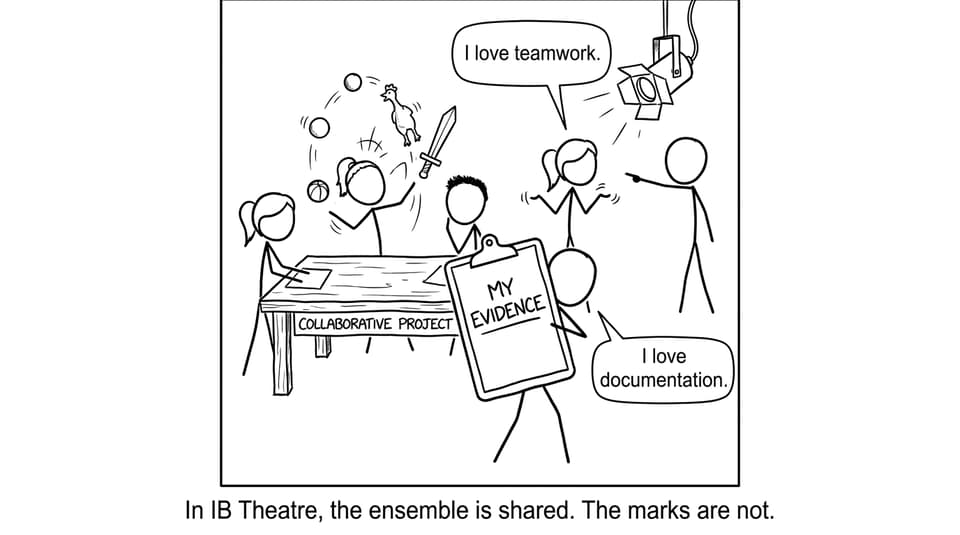
The performance is collective. The assessment is not.
That’s why strong groups still lose marks when they treat documentation like an afterthought. Your examiner needs to see how you think as a theatre-maker inside the group process.
If you want a step-by-step roadmap, use How to Succeed in the IB Theatre Collaborative Project.
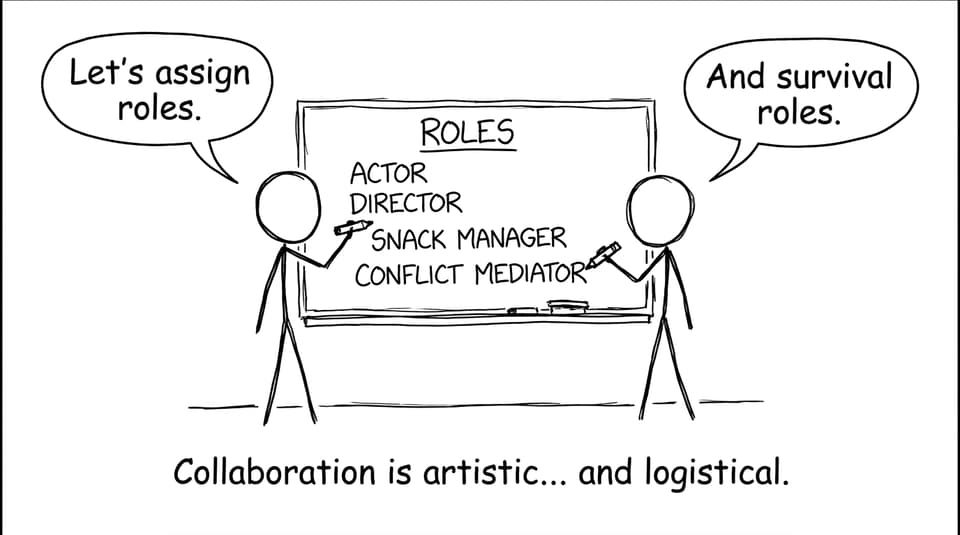
Your role can be performance or production
A common misunderstanding in IB Theatre is that “collaboration” equals “acting.” It doesn’t. Your artistic contribution can be:
-
performing
-
directing
-
dramaturgy
-
shaping structure or script
-
lighting, sound, costume, props, multimedia, stage design
What matters is that the contribution is real, purposeful, and documented with evidence of decision-making.
How to protect your marks when group work gets messy
Every class has it: the student who overcommits, the student who disappears, the student who changes the concept three days before filming.
The best defense in IB Theatre is a simple system: define roles early, rotate responsibilities where useful, and keep proof of what you did.
A practical template you can borrow is in How to Balance Roles and Responsibilities in the Collaborative Project.
Write reflections like an examiner is allergic to vague claims
Instead of writing “I helped with staging,” write:
-
what you changed (blocking, transitions, pacing)
-
why you changed it (intention, audience impact, research influence)
-
what feedback forced you to revise
-
what didn’t work and what you learned
If reflection is where you tend to lose marks, keep How to Reflect on the Collaborative Project for Maximum Marks open while you write.
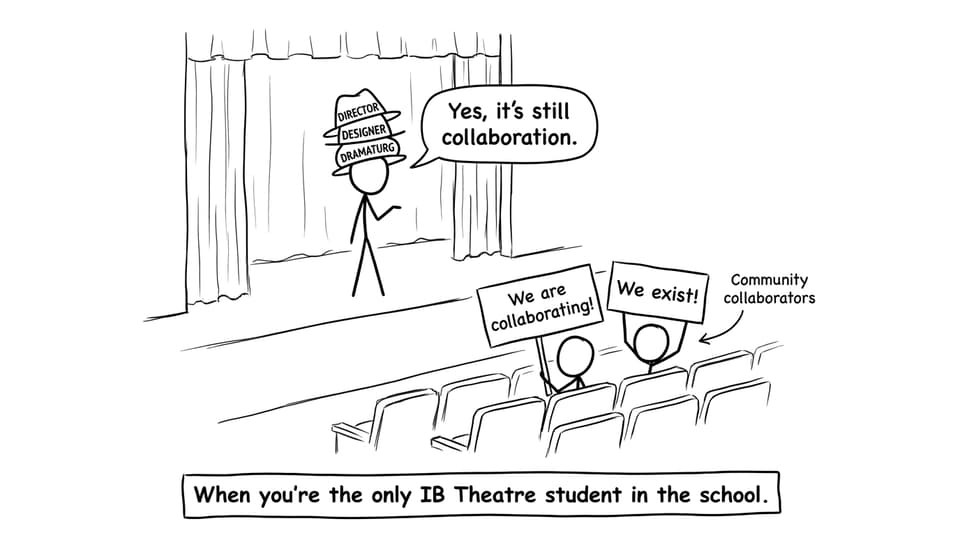
What if you’re the only IB Theatre student at your school?
This happens more than schools admit. And it can feel unfair: How can collaboration be mandatory if I’m alone?
In IB Theatre, the expectation doesn’t disappear; it adapts. You can collaborate with people who are not enrolled in the course, as long as the collaboration is genuine and you can document it.
Good alternatives include:
-
partnering with students from another school (in person or online)
-
working with a community theatre group or drama club
-
collaborating with family/friends as performers while you direct/design
For detailed options, see How to Execute an IB Theatre Collaborative Project Solo.
How RevisionDojo supports IB Theatre collaboration (and exam prep)
Students rarely lose marks in IB Theatre because they didn’t “try hard.” They lose marks because they can’t prove their thinking.
RevisionDojo helps you turn messy rehearsal reality into clear assessment evidence through:
-
Study Notes for fast, accurate terminology and course structure
-
Flashcards to lock in practitioners, conventions, and key concepts
-
an exam-focused Questionbank to test understanding under pressure
-
AI Chat to refine reflection wording and tighten analysis
-
Grading tools to check whether your documentation matches criteria
-
Mock Exams and Predicted Papers to stay exam-ready
-
a Coursework Library and Tutors when you need exemplars and feedback loops
To keep exploring IB Theatre resources, browse All IB Theatre Posts.
Final takeaway
Collaboration isn’t a side quest in IB Theatre; it’s a core requirement, built into a task worth 25% of your grade. Your job is to collaborate and to document it like an artist who understands assessment.
Treat the ensemble as the studio, and your documentation as the receipt. Then use RevisionDojo to turn your process into marks, your reflection into clarity, and your IB Theatre preparation into something calm and controlled.