



When you’re revising at 1:00 a.m., it’s easy to treat grade boundaries like a rumour: something you’ll only learn after it’s too late. But in IB Language B, boundaries are more like a map legend. They don’t change the terrain, but they tell you how your marks turn into the grade that shows up on results day.
This breakdown covers IB French B HL grade boundaries 2025 (Timezone 0) across the Individual Oral (IA), Paper 1, Paper 2 Listening, Paper 2 Reading, and the final mark out of 100. Use it to set realistic targets, spot where you can gain marks fast, and build a calmer revision plan with RevisionDojo.
Quick checklist: how to use IB Language B boundaries
-
Convert the boundary table into per-component targets (not vague hopes).
-
Train all four skills: oral, writing, listening, reading.
-
Do at least one timed block weekly using a structured workflow (practice, feedback, retest).
-
Track your current mark and estimate your grade with the IB Grade Calculator.
-
Keep your resources in one place: IB French B Resources and IB French B Revision Notes (SL/HL).
IB French B HL Grade Boundaries 2025 (Timezone 0)
Below are the Timezone 0 grade boundary ranges for each assessed component.
Individual Oral (IA) grade boundaries (out of 30)
-
Grade 7: 27--30
-
Grade 6: 22--26
-
Grade 5: 18--21
-
Grade 4: 13--17
-
Grade 3: 7--12
-
Grade 2: 4--6
-
Grade 1: 0--3
Paper 1 grade boundaries (out of 30)
-
Grade 7: 27--30
-
Grade 6: 24--26
-
Grade 5: 20--23
-
Grade 4: 17--19
-
Grade 3: 11--16
-
Grade 2: 6--10
-
Grade 1: 0--5
Paper 2 Listening grade boundaries (out of 25)
-
Grade 7: 23--25
-
Grade 6: 20--22
-
Grade 5: 16--19
-
Grade 4: 13--15
-
Grade 3: 10--12
-
Grade 2: 5--9
-
Grade 1: 0--4
Paper 2 Reading grade boundaries (out of 40)
-
Grade 7: 36--40
-
Grade 6: 32--35
-
Grade 5: 28--31
-
Grade 4: 24--27
-
Grade 3: 17--23
-
Grade 2: 9--16
-
Grade 1: 0--8
Final IB French B HL grade boundaries (out of 100)
-
Grade 7: 88--100
-
Grade 6: 76--87
-
Grade 5: 63--75
-
Grade 4: 51--62
-
Grade 3: 33--50
-
Grade 2: 17--32
-
Grade 1: 0--16
To compare with other subjects or sessions, bookmark IB Grade Boundaries and the subject-specific page IB French Language B Grade Boundaries.
What these IB Language B boundaries mean for your revision
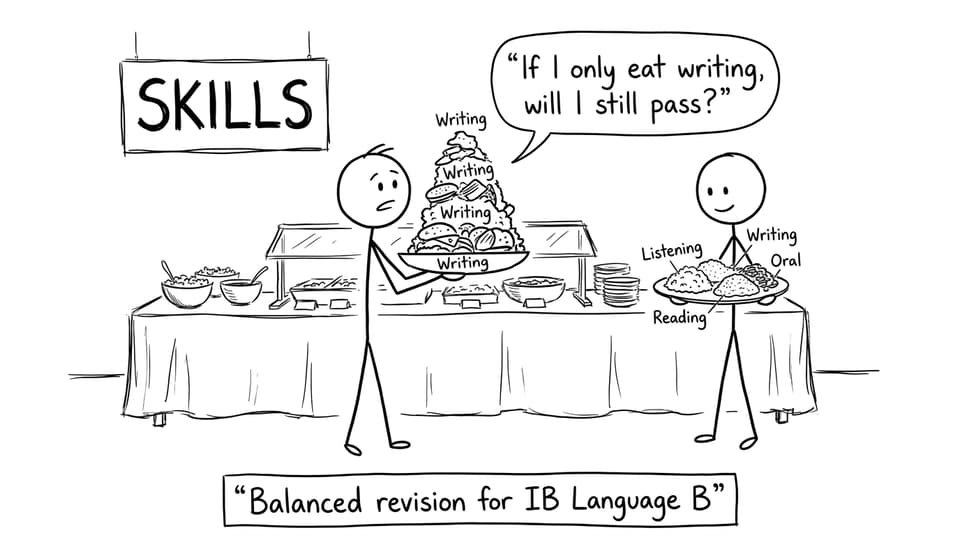
Grade boundaries in IB Language B are a reminder that the course rewards balance. A strong writer who ignores listening often discovers the hard way that Paper 2 isn’t “free marks.” And a confident speaker who never trains timing can bleed marks in Paper 1.
A practical approach is to “buy marks” where they’re cheapest:
-
IA (Oral): You can improve quickly through repetition. Record yourself, tighten your structure, and build a small bank of flexible phrases. Use RevisionDojo’s AI Chat to roleplay follow-up questions and refine responses.
-
Paper 1 (Writing): Marks often hide in clarity: purpose, audience, register, and paragraph intent. Drill targeted writing prompts using the Questionbank (start here: Questionbank). Then use Grading tools to spot the same errors you keep repeating.
-
Listening: If listening feels random, give it structure. Learn signpost phrases, predict content before audio starts, and practise note symbols. RevisionDojo’s topic support helps here: Listening Skills (IB French B).
-
Reading: Train inference and tone, not just vocabulary. Do short sets and review why wrong options were tempting.
If you want a bigger strategy view, these guides are worth keeping open while you plan: IB Language B Syllabus: Breakdown & Study Strategy and How to Effectively Revise for Language B Exams.
FAQ: IB Language B French B HL boundaries (TZ0)
Why are grade boundaries different for each component in IB Language B?
Each component measures a different skill under different conditions, so the mark distributions differ. The Individual Oral rewards interaction, fluency, and how well you develop ideas in real time. Paper 1 rewards controlled writing choices: text type, register, structure, and accuracy. Paper 2 listening and reading reward comprehension, inference, and attention to nuance. Because these skills don’t scale identically, the cut scores don’t either. Thinking in component targets helps you study more precisely instead of revising “French” as one big blur.
How is the final grade out of 100 decided?
Your marks from each component are combined into a final total out of 100, then compared to the final boundary table for your session and timezone. That’s why being near a boundary can feel intense: a small gain in one component can move your final grade. The most helpful habit is to track your current estimated total and update it after each timed practice. You can do this quickly with RevisionDojo’s IB Grade Calculator. If you also want to understand how boundaries are set in the first place, read IB Grade Boundaries: How They’re Actually Calculated. This turns boundaries from “mystery” into “mechanism.”
Which part is usually hardest for French B HL students?
Many students struggle most with Paper 2, because it punishes hesitation. In listening, missing one detail can cause a cascade of wrong answers if you chase what you missed instead of rejoining the flow. In reading, the challenge is often subtle: tone, implied meaning, and distractor options that sound almost right. The fix is rarely “learn more vocabulary” alone; it’s building exam habits: predict, scan, prove answers with evidence, and manage time. RevisionDojo’s Mock Exams and Predicted Papers are useful here because they force realistic pacing without guesswork. Pair that with Flashcards for daily connector and verb practice, and improvement becomes visible.
Final takeaway: use IB Language B boundaries to build margin
The smartest way to use IB Language B grade boundaries is not to obsess over the exact cut score. It’s to build margin. Aim to be comfortably inside your target band by training the skills that convert fastest into marks.
If you want one place to do that--with Study Notes, Flashcards, AI Chat, Grading tools, Predicted Papers, Mock Exams, a Coursework Library, and Tutors when you need a human voice--start with IB French B Resources and run a weekly loop: practise, review, retest. That’s how IB Language B boundaries stop being stressful and start being useful.