



The first time you walk into a Group 4 lab, you think the hard part will be the experiment.
Then you hear the real assignment: write it up like it’s obvious.
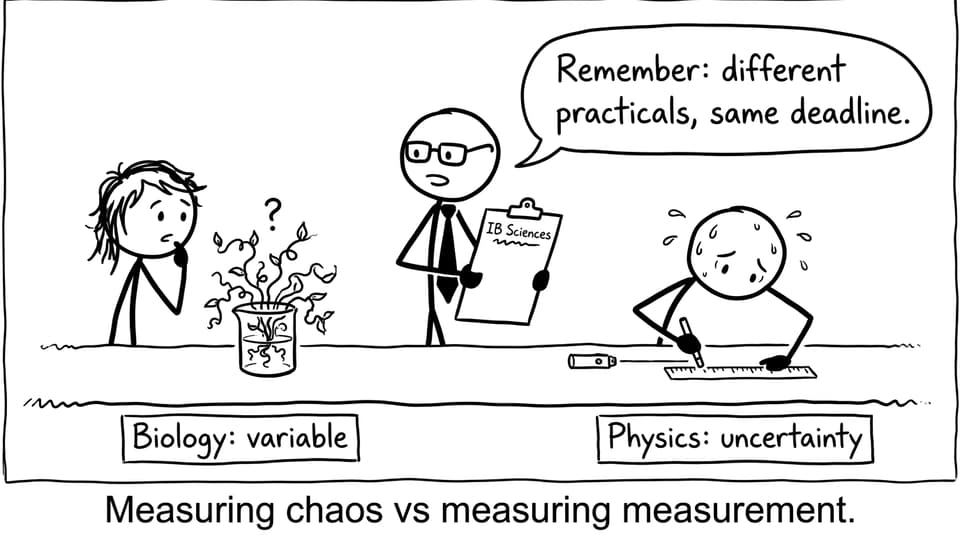
That’s why the question “IB Biology vs IB Physics lab work: which has more practicals?” is really a question about daily life in IB Sciences. Will you be doing something hands-on every week, or will you spend three lessons chasing one clean set of measurements? The honest answer: Biology usually feels like more practicals, while Physics often feels like longer practicals.
Quick checklist: which IB Sciences practical style fits you?
-
Choose Biology practicals if you like variety, observation, and real-world messiness.
-
Choose Physics practicals if you like precision, controlled variables, and data modeling.
-
For both IB Sciences, your grade depends on how well you explain method, data processing, and evaluation.
If you want a single home base for planning your approach, start with the IB Biology resources hub and the IB Physics resources hub and compare what “practice” actually looks like in each.
IB Sciences in Biology: more frequent, more varied practicals
Biology practical work tends to show up more often because so many concepts are easiest to learn by seeing them. In a typical term you might rotate through microscopy, enzymes, transport, physiology, genetics, and ecology tasks. Even when two labs share the same theme, living systems introduce variation that forces you to think.
Common Biology practical patterns include:
-
Microscopy and biological drawing/observation
-
Enzyme rate investigations (temperature, pH, concentration)
-
Population sampling or simple fieldwork-style methods
-
Human physiology measurements (reaction time, heart rate, lung capacity)
This is why Biology often wins the “how many practicals” debate in IB Sciences: you can run smaller investigations across many units, and teachers can slot them in regularly.
To make Biology labs pay off during exam season, use targeted retrieval: How to Use Flashcards for IB Biology Revision helps you convert practical experiences into recallable exam language.
IB Sciences in Physics: fewer practicals, heavier measurement and analysis
Physics practicals can be less frequent, but they’re often built around one idea: can you measure and model this relationship cleanly? Instead of moving fast through many contexts, you tend to refine one setup. The skill isn’t just “doing the lab”; it’s controlling variables and handling uncertainty until the results say something meaningful.
Typical Physics practical themes:
-
Motion and forces (timers, motion sensors, video analysis)
-
Circuits and electrical measurements
-
Optics setups (refraction/reflection, focal length)
-
Graphing relationships and discussing uncertainty and errors
Physics is where many IB Sciences students first realize that “good data” is something you build, not something you find.
A practical lifesaver: keep the Physics Data Booklet close while practicing questions, because it trains you to think the way the assessment expects.
Why the practical balance differs (and why it matters for exams)
The difference isn’t that one subject is “more practical” inside IB Sciences. It’s that the subjects reward different instincts.
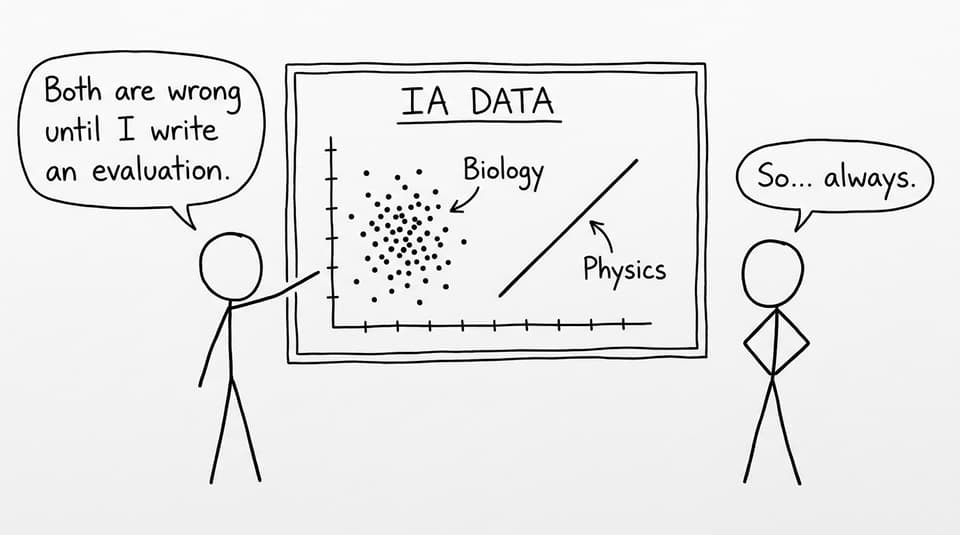
Biology practicals often teach you to:
-
Handle variability and imperfect trends
-
Describe methods clearly when living systems don’t behave identically
-
Link results back to biological mechanisms
Physics practicals often teach you to:
-
Minimize uncertainty and justify equipment choices
-
Use graphs and models to test laws
-
Explain limitations with mathematical clarity
When exams approach, this matters because students who only remember the story of a lab struggle with exam command terms. The fix is to practise exam-style application using the RevisionDojo Questionbank, then use AI Chat to ask, “What would an examiner award marks for here?” That loop is how IB Sciences students turn practical experience into grades.
Turning practicals into IA marks (without losing weeks)
In both subjects, the Internal Assessment rewards students who can explain decisions, not just report results. Biology IAs often center on managing biological variability, while Physics IAs often center on calibration, control, and uncertainty.
Two strong starting points:
-
The broader IB IA Guides hub
If you’re unsure what a high-quality finished investigation looks like, browse exemplars: IB Biology Exemplars and IB Physics Exemplars. If you want feedback before it’s too late, RevisionDojo’s Grading tools (including the IB Biology IA Grader) are a calm way to check rubric coverage.
Final takeaway: which IB Sciences subject has more practicals?
If you’re choosing based on lab work alone, the simple pattern holds: Biology usually gives you more frequent, varied practicals; Physics usually gives you fewer practicals with more time spent on precision and analysis. But both are core IB Sciences experiences, and both reward students who can explain what they did and why it matters.
If you want to feel calmer heading into labs, IAs, and exams, build your routine with RevisionDojo: use Study Notes to understand, Flashcards to retain, Questionbank to apply, AI Chat to clarify, Grading tools to audit quality, and Mock Exams and Predicted Papers to perform under time pressure.