

Mass movement is one of those IB Geography topics that feels simple until you try to explain it under timed conditions. Gravity is always there, quietly pulling downhill, but slopes don’t fail every day. Then one afternoon it rains for hours, a road is cut into a hillside, or the ground shakes, and suddenly the “stable slope” in your notes becomes a headline.
In IB Geography, the best answers don’t just list triggers. They show how driving forces increase or resisting forces weaken, and why several factors often combine to produce a landslide, rockfall, mudflow, slump, or soil creep.
The quick exam checklist (learn this, then apply it)
When asked what triggers mass movement events, run through:
-
Water (rainfall, storms, snowmelt, saturation, pore water pressure)
-
Slope angle (steeper slope = larger downslope component of gravity)
-
Geology and structure (rock type, clay, joints, bedding planes, slip planes)
-
Weathering (freeze-thaw, chemical weathering weakening material)
-
Seismic activity (earthquake shaking reduces cohesion and friction)
-
Human activity (deforestation, excavation, loading, poor drainage)
For a tighter definition and syllabus framing, pair this with IB Geography D.1.4 Mass Movements Notes.
Water: the most common trigger in IB Geography answers
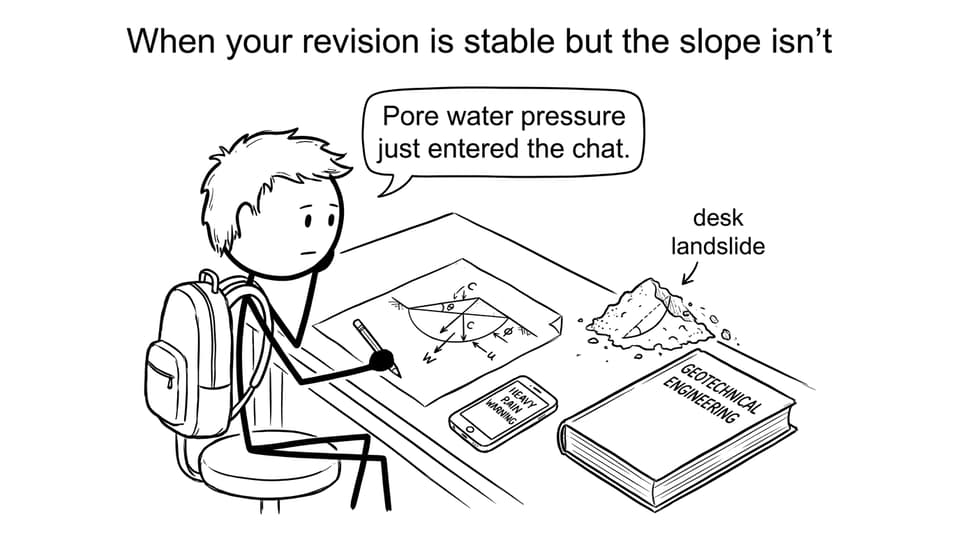
Water is the classic trigger because it attacks slope stability in multiple ways at once. Heavy or prolonged rainfall adds weight to slope material, increasing the driving force. At the same time, water can act like a lubricant, reducing friction between particles. When soils become saturated, pore water pressure rises, lowering effective stress and making failure more likely.
In exam terms, this is your clean chain: rainfall leads to saturation, which leads to increased pore water pressure + reduced friction, which leads to slope failure. For linked hazard thinking, see D.5.1 Spatial Interactions and Hazard Risk (Synthesis) Notes.
Slope angle and relief: when gravity gets an advantage
Slope angle matters because steep slopes have a stronger downslope component of gravity. That’s why rockfalls and rapid landslides are more common in mountainous and tectonically uplifted areas. But IB Geography questions often reward nuance: gentler slopes can still fail through slumping or soil creep, especially when waterlogged or made of weak material.
If you need to revise the range of processes, use What Are the Main Types of Mass Movement?.

Geology and structure: the hidden slip plane problem
Some slopes are “pre-loaded” to fail because of their geology. A common IB Geography example is permeable rock over impermeable rock: water percolates down then builds up at the boundary, creating a potential slip plane. Rock type also matters. Unconsolidated material and clay-rich soils tend to have lower shear strength than more resistant bedrock.
Weaknesses like joints, faults, and bedding planes give movement a pathway. This is why two hillsides with the same rainfall can behave very differently.
Weathering and earthquakes: weakening vs sudden shock
Weathering is the slow builder. Freeze-thaw pries rock apart, increasing debris and making rockfalls more likely. Chemical weathering can weaken rock structure in warm, wet climates. Over time, the slope’s resisting forces decline until a smaller trigger event tips it over.
Earthquakes are the opposite: sudden energy that reduces friction and cohesion immediately. Shaking can trigger landslides even where slopes looked stable yesterday. For broader hazard-system context, connect this to What Are the Characteristics of Geophysical Systems?.
Human activity: when we change the slope faster than nature
Human triggers show up everywhere in IB Geography markschemes because they’re easy to evaluate. Deforestation removes roots that bind soil, increasing erosion and instability. Road building and mining can undercut slopes, while construction can add load at the top. Poor drainage increases infiltration and saturation, feeding back into the water trigger.
For mitigation angles (useful in evaluative questions), read Reduce Mass Movement Risk for IB Geography and D.4.3 Pre-Event Management Strategies Notes.

How to turn triggers into top-mark IB Geography paragraphs
A strong IB Geography paragraph usually does three things: names the factor, explains the mechanism (driving vs resisting forces), and links to a likely type of movement. If you want to train that pattern fast, use RevisionDojo’s IB Geography Option D Geophysical Hazards hub alongside the Option D Questionbank to practise exam-style wording with feedback.
Final takeaway for IB Geography revision
Mass movement events happen when the balance tips: resisting forces weaken, driving forces rise, or both. In IB Geography, your edge comes from explaining the mechanism (especially water and geology) and showing how triggers interact. If you want to lock this in quickly, combine RevisionDojo’s Study Notes, Flashcards, AI Chat, and Grading tools with targeted practice from the Questionbank and Mock Exams inside the IB Geography resources hub.