



A strange thing happens the first time you meet “work” in IB Physics: you realise your brain has been using the word incorrectly for years.
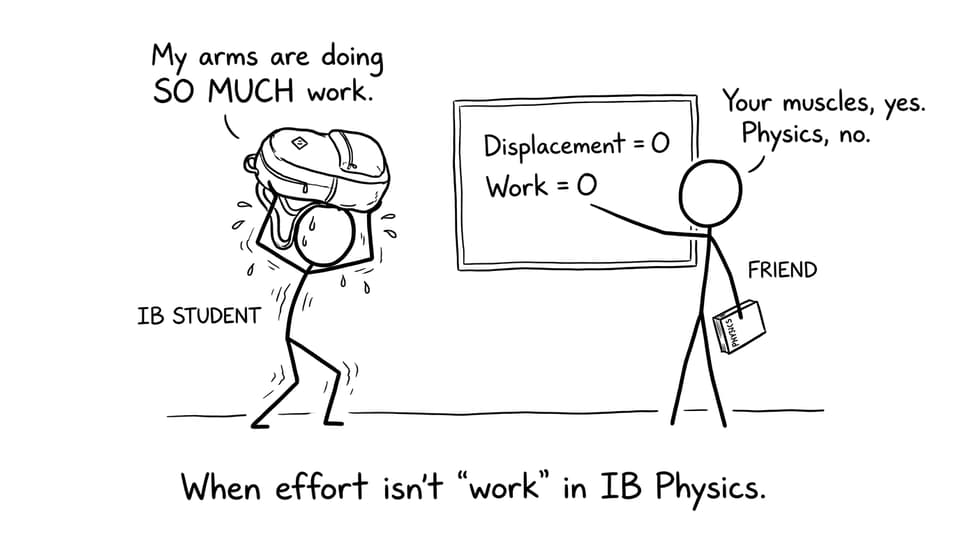
You can sweat through a wall sit, your legs shaking, your heart racing, and your friends will say you’re “doing work.” But in IB Physics, that whole heroic scene can add up to zero. Not “small.” Not “almost.” Zero. And that’s the point: physics doesn’t care how hard something feels. It cares what a force does.
IB Physics definition of work (the exam-friendly version)
In IB Physics, work is the energy transferred when a force causes a displacement.
The core equation you’ll use again and again is:
-
W is work done (joules, J)
-
F is the force (newtons, N)
-
d is the displacement (metres, m)
-
θ is the angle between the force and the displacement
If you want the full syllabus-aligned explanation with examples, keep the official notes open while you practise: 2.3: Work, energy, and power Notes.
Three quick conclusions that show up in IB Physics questions
-
Same direction (θ = 0°): (\cos\theta = 1) so (W = Fd). Maximum work.
-
Perpendicular (θ = 90°): (\cos\theta = 0) so (W = 0). No work done by that force.
-
Opposite direction (θ = 180°): (\cos\theta = -1) so work is negative.
That “negative work” idea is one of the cleanest ways to describe energy leaving a system, especially with friction.
Why work matters so much in IB Physics
Work is the bridge between forces and energy. Once you see that, lots of mechanics stops feeling like separate chapters.
A simple anchor statement for IB Physics is:
Work done on an object equals the change in its energy (often kinetic energy).
This is why “work” quietly supports topics like kinetic energy, gravitational potential energy, elastic energy, and power. If you’re revising broadly, it helps to keep mechanics organised through the hub here: IB Physics Mechanics (SL/HL).
And when you want the formulas exactly as they’ll appear in your exam context, keep this bookmarked: IB Physics Data Booklet.
A mini checklist for solving work questions fast
When a work question appears in IB Physics, run this mental checklist:
-
What force is doing the work? (Weight? Friction? Applied force? Tension?)
-
What is the displacement, and in what direction?
-
Is the force constant, or does it change?
-
What is θ (angle between force and displacement)?
-
Should the answer be positive, zero, or negative?
-
Are you being asked for energy change, efficiency, or power after finding work?
To drill this efficiently, practise by topic so your brain learns patterns. RevisionDojo’s 2.3: Work, energy, and power Questionbank is built for exactly that kind of repetition with feedback.
How “work” appears in IB Physics exam problems
Most exam-style IB Physics work questions fall into a few familiar shapes:
Work from force and distance (with angles)
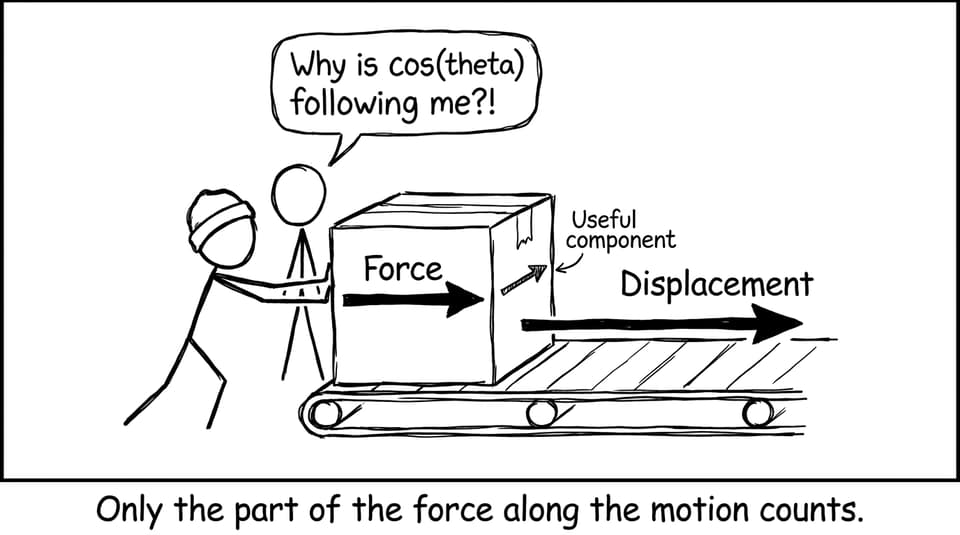
You’ll be given a force magnitude and a displacement, sometimes with an angle. The trick is remembering only the component of force along the displacement counts.
Work from a force-displacement graph
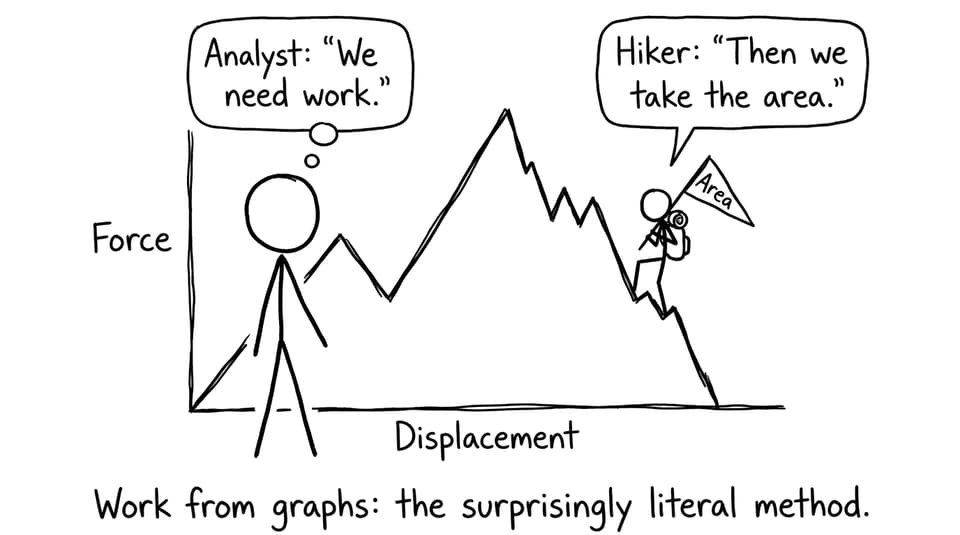
If force varies with displacement, work is the area under the F versus x graph. That’s often quicker than trying to invent a single “average force” unless the graph makes that obvious.
Work, energy, and power chained together
A typical chain is: calculate work, link it to energy transfer, then find power using (P = \frac{W}{t}) or (P = Fv) when appropriate. If you want to strengthen the energy side of the chain, this supporting read helps: IB Physics: How to Find Total Mechanical Energy.
Work in an IB Physics IA (why it’s a common choice)
Work is popular in IB Physics investigations because it’s measurable and it connects theory to real losses.
Examples include:
-
estimating the work done against friction for different surfaces
-
comparing energy input to useful output (efficiency)
-
exploring elastic work with springs and extensions
The best IAs don’t just “calculate.” They explain what the work represents physically: where energy goes, what assumptions were made (constant force, negligible air resistance), and how uncertainty affects conclusions.
Common misconceptions (and how to fix them)
Many students lose marks in IB Physics not because the math is hard, but because the meaning is fuzzy.
-
“If I’m tired, I did work.” Not necessarily. No displacement means no work done by that force.
-
“Work is always positive.” No. Friction commonly does negative work.
-
“Any force means work.” Only the component parallel to the displacement contributes.
If your definitions feel shaky, use a precise reference list while revising: IB Physics Key Definitions.
Bring it home: make “work” your advantage in IB Physics
Once “work” clicks in IB Physics, you stop trying to memorise isolated formulas. Instead, you start seeing one story: forces transfer energy through displacement.
To turn that understanding into exam marks, RevisionDojo helps you practise it from every angle: targeted Questionbank drills, clear Study Notes, rapid Flashcards, and AI Chat that explains your specific mistake without judgment. When you’re ready to simulate the real thing, use Mock Exams and Predicted Papers, then tighten your explanations with the Grading tools. And if you want a human to sanity-check your approach, RevisionDojo Tutors can help you build confidence fast.
If “work” has ever felt like a trick word, make it your foundation, then let IB Physics questions become predictable.