

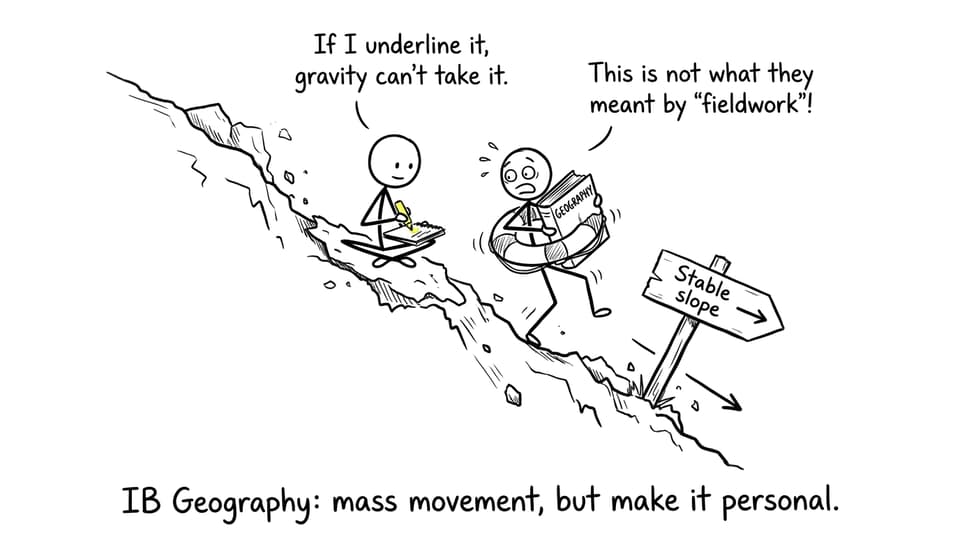
Mass movement never announces itself politely. One minute a slope looks ordinary; the next, gravity collects its debt. In IB Geography, that uncomfortable truth shows up in Option D as a neat list of processes, triggers, and hazards. But in the exam, marks go to students who can explain the difference between fast and slow movement, dry and saturated material, and a free-falling cliff face versus a sliding plane.
IB Geography quick checklist: what examiners want
Before you memorise definitions, make sure you can do these quickly:
-
Define mass movement as downslope movement under gravity
-
Classify by speed (rapid vs slow) and material (rock vs soil/debris)
-
Link each type to a trigger (rainfall, freeze-thaw, earthquakes, undercutting)
-
Add one consequence (risk to roads, settlements, river channels)
For syllabus-aligned revision, start with the IB Geography Option D Geophysical Hazards hub and pair it with the D.1.4 Mass Movements notes.
The main types of mass movement (with exam-ready cues)
Rockfall (falls)
Rockfall is the most direct: fragments detach from a steep slope or cliff and fall freely through the air. In IB Geography, it’s a classic example of rapid movement with minimal warning. Freeze-thaw weathering often prepares the slope by widening joints, and gravity finishes the job. A strong point to add is location: mountain roads, quarry faces, and coastal cliffs are high-risk because steep gradients make falls more likely.
Landslides (slides)
Landslides involve rapid movement down a slope along a slip plane. The key phrase for IB Geography answers is “defined plane of weakness.” Heavy rainfall commonly increases the weight of material and reduces friction, while earthquakes can destabilise slopes instantly. Impacts are typically dramatic: buildings and transport routes can be destroyed in seconds, and vegetation can be stripped away.
Mudflows and debris flows (flows)
Mudflows (or debris flows) happen when water mixes with fine sediment and loose material, creating a fast, fluid mass. The distinguishing feature in IB Geography is that flows behave more like a liquid than a rigid block. They often follow channels, which is why they can travel far beyond the initial slope failure site. Steep slopes, intense rainfall, and volcanic ash deposits can all increase the likelihood.
Slumping (rotational slip)
Slumping is slower and more structured. Material rotates downslope along a curved slip plane, so you often see a stepped scar at the top and a bulging toe at the base. In IB Geography, mention saturation and weak material (especially clay) and you’re most of the way there. Riverbanks and coastal cliffs are common settings, especially where erosion undercuts the slope.
Soil creep (creep)
Soil creep is the slowest type, but it’s sneaky. Over long periods, soil gradually shifts downslope due to repeated expansion and contraction. Wetting/drying, heating/cooling, and freeze-thaw can all contribute. In IB Geography, this is your best example of low energy, high time. It rarely makes headlines, but it can warp fences, crack walls, and deform roads.

What controls slope stability in IB Geography?
Most mass movement questions reward you for linking type to conditions. The big controls are:
-
Slope angle (steeper often means faster)
-
Geology and structure (planes of weakness, clay layers)
-
Water content (adds weight and reduces friction, increases pore water pressure)
-
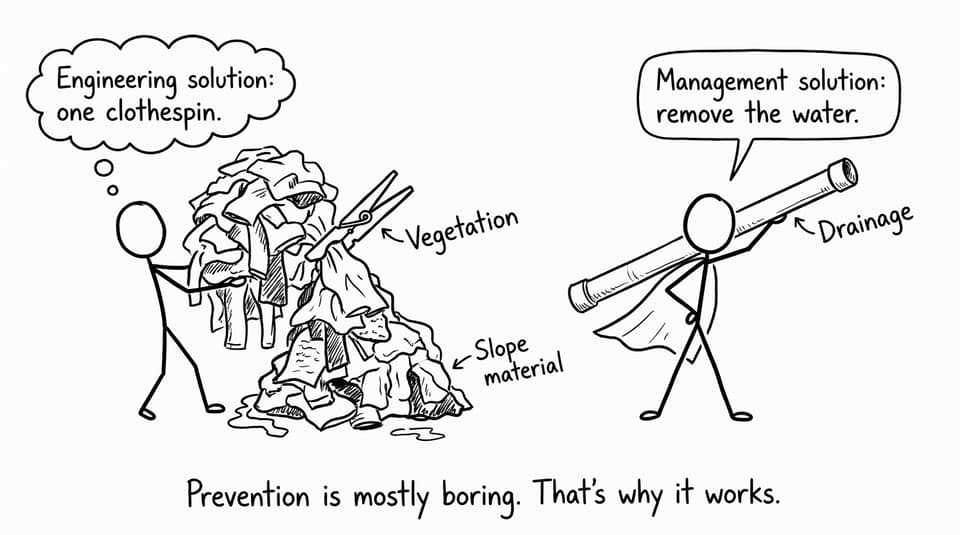
Vegetation (roots add cohesion and intercept rainfall)
-
Human activity (undercutting, construction loading, deforestation)
To connect processes to management (a common evaluation move), see How can the risk of mass movement be reduced? and broaden your hazard framing with What are the characteristics of geophysical systems?.
How RevisionDojo helps you revise mass movement faster
Mass movement is easy to “understand” and still miss marks on. RevisionDojo is built for turning understanding into exam performance:
-
Use the IB Geography Option D Questionbank to practise classifying events and explaining triggers.
-
Lock in definitions with Option D Geophysical Hazards Flashcards and the wider Geography Flashcards collection.
-
Build essay clarity with Study Notes, AI Chat, and Grading tools, then pressure-test timing with Mock Exams and Predicted Papers.
-
If you’re polishing coursework, the Coursework Library and Tutors help you turn a messy draft into a clear argument.
Closing: turn processes into marks
Mass movement in IB Geography is really a story about small changes that build quietly, then move suddenly. Learn the main types: rockfall, landslide, mudflow, slump, and soil creep, and you’ll recognise the patterns examiners reward: triggers, mechanics, impacts, and management. If you want to revise with less guessing, use RevisionDojo’s Study Notes, Flashcards, Questionbank, AI Chat, Grading tools, Mock Exams, Predicted Papers, and Tutors to turn slope processes into confident, exam-ready answers in IB Geography.