
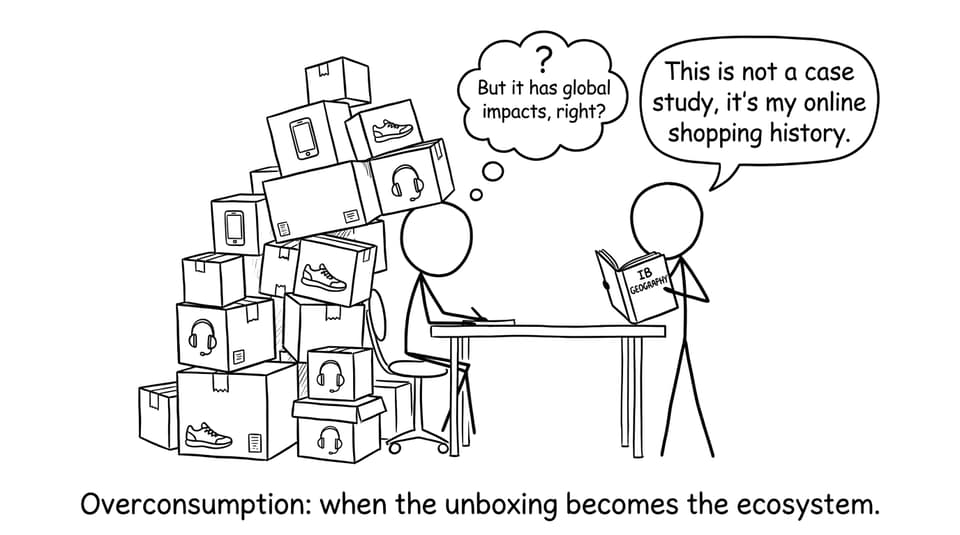
Overconsumption rarely looks dramatic in the moment. It looks like a delivery box on a doorstep, a new charger because the old one is “somewhere,” or a quick upgrade that feels harmless. But in IB Geography, that ordinary moment is the start of a chain reaction: resources extracted, energy burned, waste produced, ecosystems strained. When you revise the environmental impacts of overconsumption, you’re really revising how small decisions scale up into global patterns.
Quick IB Geography checklist: what to mention
Use this mini-checklist when a question asks about overconsumption in IB Geography:
-
Define overconsumption (use exceeds regeneration rate)
-
Link to resource depletion (energy, water, soils, minerals)
-
Explain pollution and waste streams (plastic, e-waste, chemical runoff)
-
Add deforestation/habitat loss (land-use change driven by demand)
-
Connect to climate change (GHG emissions across production and transport)
-
Evaluate uneven responsibility (HICs vs LICs, environmental justice)
For deeper syllabus alignment, anchor your revision in the unit hub: IB Geography: Global Resource Consumption and Security.
Resource depletion: when “more” empties the future
One of the clearest environmental impacts of overconsumption is resource depletion. Fossil fuels, freshwater, fertile soils, and key minerals are used faster than natural systems can recover. As the easiest reserves run down, extraction shifts to deeper, riskier, and more fragile environments, which often increases land disruption and energy costs.
In IB Geography, you can strengthen this point using measurement tools like ecological footprint and biocapacity. RevisionDojo’s notes on this are especially useful for quick stats and definitions: 3.1.2 Measuring Resource Consumption Notes.
Pollution and waste: the invisible after-party of consumption
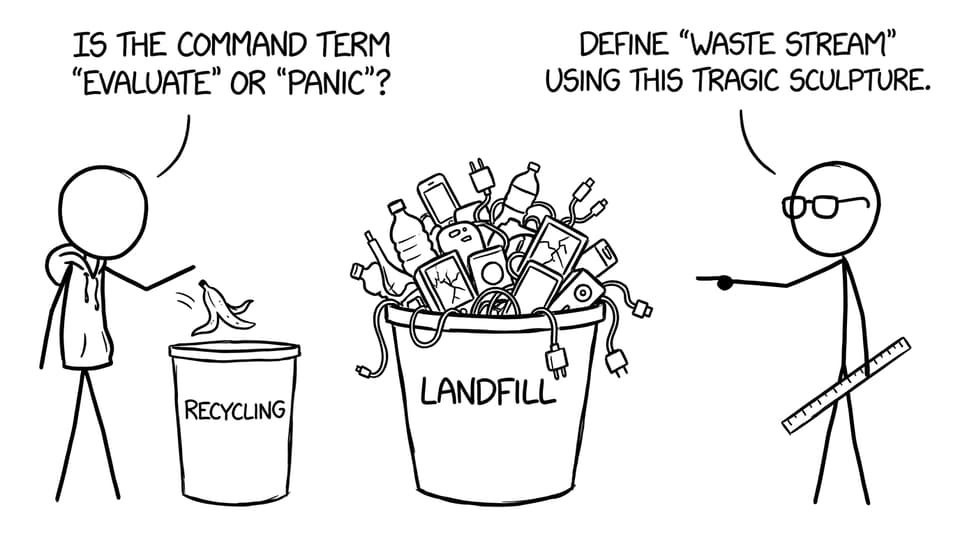
Overconsumption doesn’t end at the checkout. It continues as air pollution from industry and transport, water pollution from chemicals and runoff, and soil contamination from landfill leakage. It also creates larger waste streams, especially plastics and electronic waste, which persist for decades and move through food chains.
A good exam answer connects pollution to place: who produces the waste, who receives it, and why it accumulates there. To practise writing that kind of explanation under time pressure, use the IB Geography Questionbank for Topic 3.1 Global Trends in Consumption.
Deforestation and habitat loss: land cleared for demand
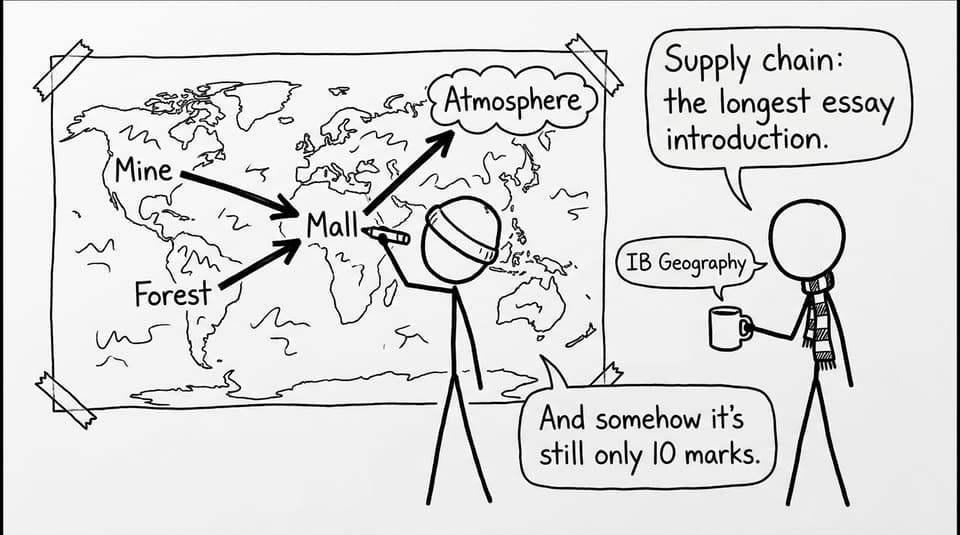
Demand for timber, beef, palm oil, metals, and urban land accelerates deforestation and habitat destruction. The environmental impacts stack up: biodiversity declines, ecosystems fragment, and carbon sinks shrink. In IB Geography, it helps to phrase this as land-use change driven by consumption patterns (often in producer regions) serving consumer markets elsewhere.
If you want an easy way to link the concept to wider resource interdependence, pair it with the WFE nexus: What Is the Water-Food-Energy Nexus?.
Climate change: the footprint behind every lifestyle
Overconsumption drives high energy demand, and much of that energy still comes from fossil fuels. Emissions come from manufacturing, global shipping, electricity use, and consumption-heavy lifestyles (frequent travel, fast fashion, high-meat diets). The result is stronger climate warming and more extreme weather risk.
For a connected understanding (and great evaluation language), build links between consumption, climate risk, and security using: IB Geography: Climate Change, Food and Water Security.
Unequal responsibility: the ethics built into the pattern
A key IB Geography insight is that overconsumption is uneven. High-income countries typically have much higher per capita consumption and ecological footprints, while many low-income countries experience disproportionate extraction impacts, pollution burdens, and climate vulnerability. This creates a strong evaluation point: environmental damage is global, but responsibility and benefits are not.
To add clear framing for that inequality, revise: IB Geography: Global Patterns of Resource Consumption.
How to turn this into exam marks (fast)
If an 8 or 10 marker asks about environmental impacts, aim for:
-
One tight definition
-
3-4 impacts explained with process language (how and why)
-
One line of evaluation on scale, inequality, or trade-offs
RevisionDojo makes that practice loop easier: use Study Notes for structure, Flashcards for definitions, and the AI Chat to test your explanations. Then move to the Questionbank, build timed sets with Mock Exams, and check progress with Grading tools. When you’re close to exams, Predicted Papers help you practise realistic question styles without guessing what matters.
Browse more support in one place: IB Geography Resources and Geography Flashcards.
Conclusion: overconsumption is a chain, not a moment
Overconsumption can feel private, but its environmental impacts are public: depleted resources, polluted systems, shrinking habitats, and a warming climate. For IB Geography, the goal isn’t just listing impacts. It’s showing the links between consumption, place, and power, and writing that clearly under exam conditions.
If you want to turn this topic into reliable marks, revise the core concepts with RevisionDojo’s notes and flashcards, then pressure-test your understanding with the Questionbank, Mock Exams, and Predicted Papers. IB Geography rewards students who can connect the dots. RevisionDojo helps you practise doing exactly that.