
RevisionDojo logoRevisionDojo logo
FeaturesSubjectsPricingSchools
Back to all posts
  1. Home
  2. /Blog
  3. /IB Psychology IA Tips: A Clear Internal Assessment Guide

IB Psychology IA Tips: A Clear Internal Assessment Guide

IB Psychology
RevisionDojo Team
•Last updated: 19 Jul 2026•6 min read
ShareShare on XShare on WhatsAppShare on LinkedInShare on Facebook
Add as a preferred source on Google
IB Psychology IA Tips: A Clear Internal Assessment Guide

Join 650k+ students breezing through the IBReady to breeze through the IB?

Footer

General

  • Download apps
  • For parents
  • For schools
  • Pricing
  • Gift RevisionDojo
  • Tutoring
  • IB syllabus
  • MYP syllabus
  • Blog
  • Student Questions

Features

  • Question Bank
  • Test Builder & Exam Mode
  • Predicted Papers
  • Past Papers
  • Study Notes
  • Interactive Lessons
  • Flashcards
  • Jojo AI Tutor
  • Coursework Studio
  • View all features

Research

  • All research
  • Jojo AI vs leading AI study tools
  • 2026 State of Learning Survey
  • 2025 State of Learning Survey
  • IB Moderation Analysis
  • Jojo AI vs ChatGPT
  • Jojo AI vs Gemini
  • Jojo AI vs Perplexity
  • Jojo AI vs Claude
  • Jojo AI vs Poe

Platform

  • About RevisionDojo
  • RevisionDojo vs Others
  • Content philosophy
  • Trustpilot
  • Join usWe're hiring
  • Student Ambassador
  • Help center
  • Contact us
  • Terms of Service
  • Data & privacy
  • Privacy policy
  • Cookie policy
  • Trust Center

IB Subjects

  • Arabic A
  • Arabic A Lit
  • Arabic ab initio
  • Arabic B
  • Biology
  • Business Management
  • Chemistry
  • Chinese A Lang & Lit
  • Chinese B
  • Computer Science (CS)
  • Computer Science (First Exam 2027)
  • Design Technology (DT)
  • Design Technology (First Exam 2027)
  • Digital Society (DS)
  • Economics
  • English A Lang & Lit
  • English A Lit
  • English B
  • Environmental systems and societies (ESS)
  • French A
  • French A Lit
  • French ab initio
  • French B
  • Geography
  • German A
  • German A Lit
  • German ab initio
  • German B
  • Global Politics
  • History
  • History (First Exam 2028)
  • Mathematics Analysis and Approaches (AA)
  • Mathematics Applications & Interpretation (AI)
  • Philosophy
  • Physics
  • Psychology
  • Psychology (First Exam 2027)
  • Spanish A
  • Spanish A Lit
  • Spanish ab initio
  • Spanish B
  • Sports, exercise and health science (SEHS)
  • Theory of Knowledge (TOK)
  • World Religions
  • Arabic A
  • Arabic A Lit
  • Arabic ab initio
  • Arabic B
  • Biology
  • Business Management
  • Chemistry
  • Chinese A Lang & Lit
  • Chinese B
  • Computer Science (CS)
  • Computer Science (First Exam 2027)
  • Design Technology (DT)
  • Design Technology (First Exam 2027)
  • Digital Society (DS)
  • Economics
  • English A Lang & Lit
  • English A Lit
  • English B
  • Environmental systems and societies (ESS)
  • French A
  • French A Lit
  • French ab initio
  • French B
  • Geography
  • German A
  • German A Lit
  • German ab initio
  • German B
  • Global Politics
  • History
  • History (First Exam 2028)
  • Mathematics Analysis and Approaches (AA)
  • Mathematics Applications & Interpretation (AI)
  • Philosophy
  • Physics
  • Psychology
  • Psychology (First Exam 2027)
  • Spanish A
  • Spanish A Lit
  • Spanish ab initio
  • Spanish B
  • Sports, exercise and health science (SEHS)
  • Theory of Knowledge (TOK)
  • World Religions

MYP Subjects

  • MYP Biology
  • MYP Chemistry
  • MYP Design
  • MYP English Lang & Lit
  • MYP Extended Mathematics
  • MYP History
  • MYP Individuals & Societies
  • MYP Integrated Sciences
  • MYP Physics
  • MYP Standard Mathematics
  • MYP Biology
  • MYP Chemistry
  • MYP Design
  • MYP English Lang & Lit
  • MYP Extended Mathematics
  • MYP History
  • MYP Individuals & Societies
  • MYP Integrated Sciences
  • MYP Physics
  • MYP Standard Mathematics
RevisionDojo logo

© 2022 - 2026 RevisionDojo (MyDojo Inc)

RevisionDojo was developed independently of the IBO and as such is not endorsed by it in any way.

Download on the App StoreGet it on Google Play
GDPR compliant

A good IB Psychology IA feels like a small, honest experiment you could explain to a friend and defend to an examiner. A stressful one feels like juggling five variables, three ethics forms, and a word count that never stops shrinking.

This guide is designed to keep your IB Psychology Internal Assessment simple, controlled, and convincingly written, without losing the human curiosity that makes psychology worth studying.
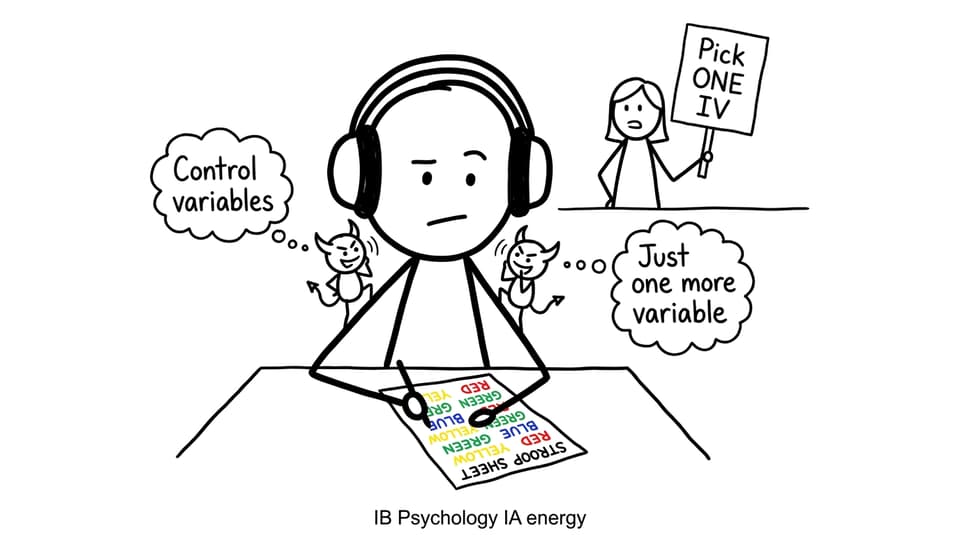
Stick-figure gremlins arguing about variables

IB Psychology IA quick checklist (save this)

  • A focused research question with one clear IV and DV

  • A replicable method (participants, materials, procedure)

  • Ethics handled cleanly (consent, withdrawal, confidentiality)

  • Results presented clearly (descriptive + one suitable inferential test)

  • Evaluation that shows you think like a researcher, not a salesperson

If you want the full criteria explained with examiner-style expectations, keep IB Psychology IA Explained: Complete 2025 Guide to Scoring High open as you draft.

Choose a topic that behaves (and still feels interesting)

Most strong IB Psychology IAs do not succeed because they are original. They succeed because they are controllable.

A classic example is attention and distraction using a simple cognitive task. For instance:

Research question (example): Does instrumental background music affect concentration in IB students during a Stroop task?

Why it works:

  • The IV is easy to manipulate (music vs silence)

  • The DV is measurable (time taken and/or errors)

  • You can standardize conditions without expensive equipment

If you want to see how that kind of investigation is framed and discussed, compare with this Psychology IA example discussion.

Write your IB Psychology IA like a scientist with a timer

Introduction: make the theory do real work

In IB Psychology, the introduction is not a history essay. It is a justification.

Keep it tight:

  • State the aim in one sentence.

  • Summarize relevant background research (enough to justify, not overwhelm).

  • Define and operationalize your variables.

  • Finish with your hypothesis (and a null, if required by your teacher).

When your theory feels wobbly, revise the research-method foundations using IB Psychology 2.4 Research Methodology and the supporting Research Methods notes.

Method: the examiner should be able to replicate you

A high-scoring IB Psychology method section reads like instructions.

Include:

  • Participants: age range, number, sampling method, allocation to conditions

  • Materials: what you used (task sheets, timer, playlist)

  • Procedure: step-by-step, with controls stated explicitly

Your biggest hidden mark-loss is usually controls. Same room, same time limit, same instructions, same task version, same device volume. Write that down.

Analysis: make small data look trustworthy

Yes, your sample might be small. That is normal. The goal is clarity, not grandeur.

  • Start with descriptive statistics (means, ranges, SD if appropriate).

  • Use a suitable inferential test based on design and measurement.

  • Present one clear graph.

  • State whether results support the hypothesis.
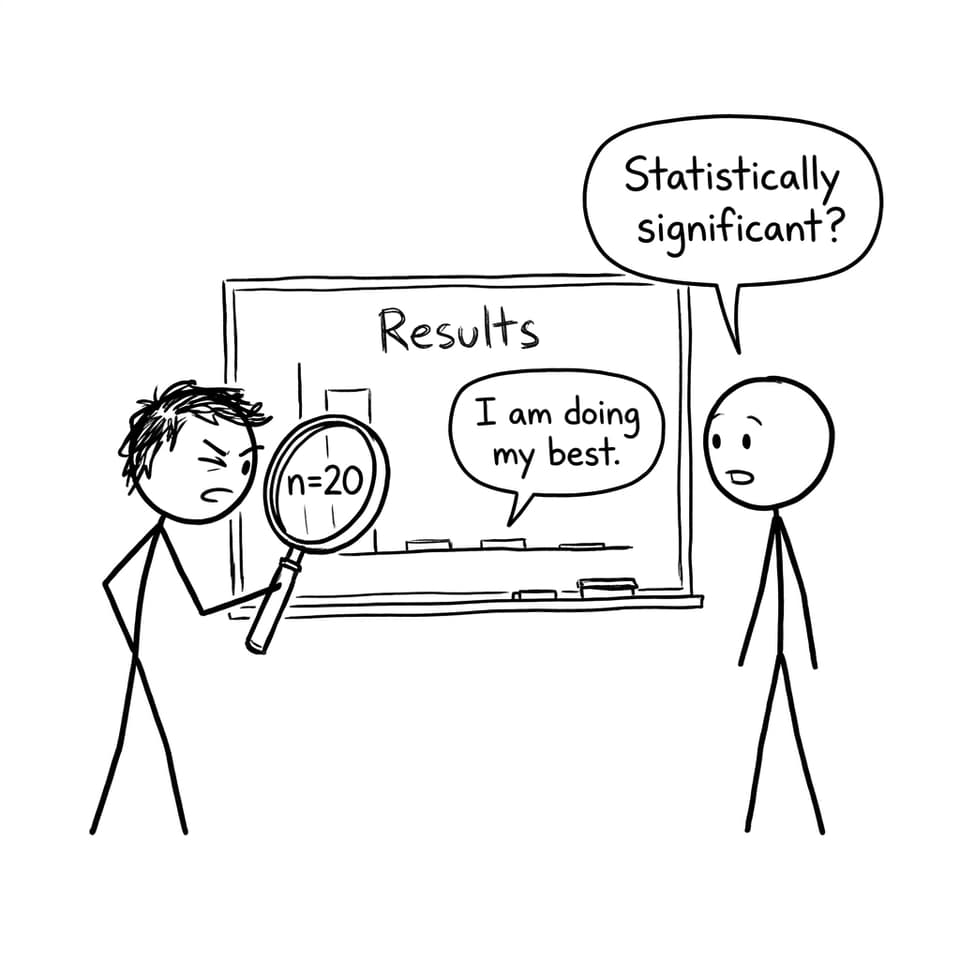
Tiny bar chart trying its best

To sharpen the statistics-and-method language that shows up across the course, build confidence with targeted practice on the IB Psychology Questionbank or the broader IB Psychology Resources hub.

Evaluation: be honest, then be strategic

Evaluation is where IB Psychology rewards maturity.

Strong evaluations typically include:

  • Strengths: clear operationalization, controlled procedure, appropriate test

  • Limitations: sampling bias, demand characteristics, order effects, low ecological validity

  • Improvements: crossover design, better standardization, larger and more diverse sample, counterbalancing

If you want a rubric-aligned way to check your draft, use RevisionDojo's IB Psychology IA Grader and compare against the criteria explained in the IB Psychology (First Exam 2027) IA Guide.
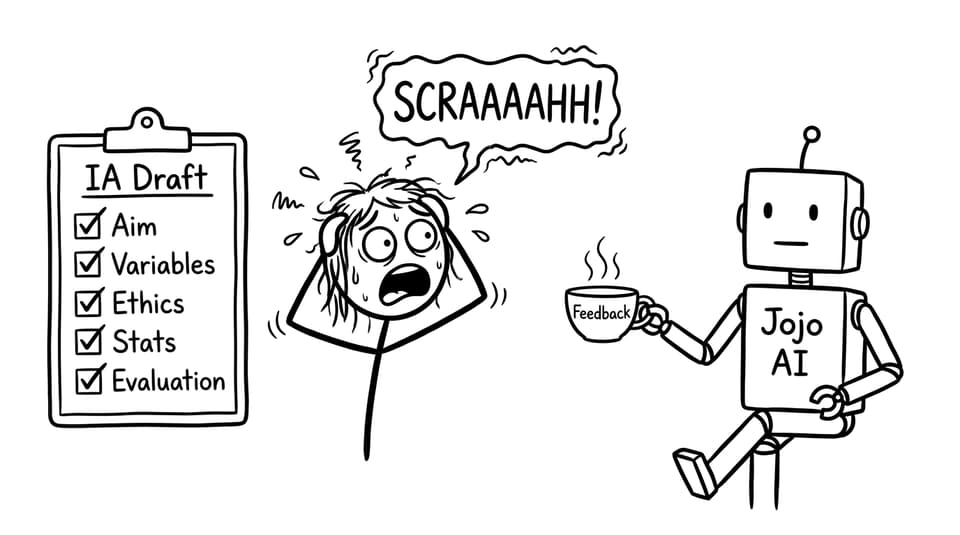
Jojo AI offering feedback tea

RevisionDojo tools that make IB Psychology IA work lighter

When deadlines stack up, it helps to offload the mechanical parts.

RevisionDojo supports IB Psychology students with:

  • Coursework Library of exemplars: Psychology IA examples and IB Psychology exemplars by subject

  • Grading tools (rubric-based feedback) and AI Chat for quick clarification

  • Study Notes and Flashcards for research methods recall

  • Questionbank, Mock Exams, and Predicted Papers to keep exam skills moving while your IA is in progress

  • Tutors when you want human feedback on structure and clarity

Conclusion: keep your IB Psychology IA simple, then make it sharp

A strong IB Psychology IA is built the same way a strong routine is built: fewer moving parts, practiced carefully, explained clearly.

Use a focused question, control what you can, analyze with calm precision, and evaluate like someone who is already thinking about the next study. When you want structure, exemplars, and fast rubric-based feedback, RevisionDojo can carry the heavy load with its Questionbank, Study Notes, Flashcards, AI Chat, Grading tools, Predicted Papers, Mock Exams, Coursework Library, and Tutors.

Start with the IB Psychology Resources hub, and make your next draft the one that finally feels under control.

How helpful was this article?
Add as a preferred source on Google

Continue studying with RevisionDojo

  • IB Coursework GraderCheck an IA, EE, or TOK draft against IB assessment criteria.
  • IB Coursework ExamplesLearn from high-scoring coursework across IB subjects.
  • IB Grade CalculatorEstimate an IB grade using session-specific boundaries.
  • IB Grade BoundariesExplore historical grade boundaries by subject and session.

Related Articles

IB Psychology · Oct 11, 2026 · 11 min read

IB Psychology EE Topics Worth Researching Now

Explore feasible IB Psychology EE topics for fall 2026, with focused research angles, source checks, key concepts, and practical scoping advice.

IB Psychology · Oct 10, 2026 · 9 min read

IB Psychology First Term Struggles: The Big Shock

IB Psychology first term struggles often begin when recall is not enough. Learn how to apply research, evaluate evidence, and build first-term habits.

IB Psychology · Oct 9, 2026 · 9

IB Psychology Mock Exam Prep for November

Prepare for November IB Psychology mocks with a focused four-week plan covering content recall, research, essay writing, timed practice, and review.

IB Psychology · Oct 7, 2026 · 11

IB Psychology IA Criteria Explained: How It Is Marked

Understand the current IB Psychology IA criteria, mark bands, moderator expectations, common mistakes, and practical steps for improving each section.

IB Psychology · Oct 6, 2026 · 11

IB Psychology IA Topics That Actually Work

Explore feasible IB Psychology IA topics, replication ideas, variables, study models, syllabus changes, and ethics checks for a strong investigation.

IB Psychology · Oct 4, 2026 · 9

Cómo crear flashcards de Psicología del IB eficaces

Aprende a crear flashcards de Psicología del IB con repaso activo, repetición espaciada, ejemplos eficaces y un calendario de revisión práctico.

min read
min read
min read
min read

Frequently Asked Questions