


Practical day panic usually starts with a myth: that IB Sciences have a single high-stakes “lab exam” where one spilled beaker ends everything.
In reality, what decides your practical marks in IB Sciences is quieter and longer: your Practical Internal Assessment (IA). It’s the kind of task where the smartest move isn’t perfection; it’s proof that you can think like a scientist, write like a scientist, and reflect like one too.
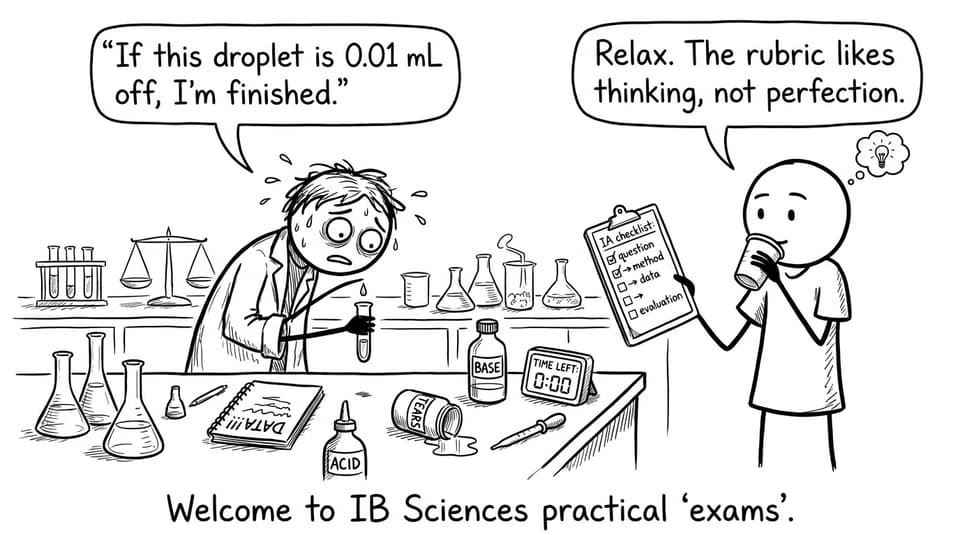
What “practical exams” really mean in IB Sciences
In the Diploma Programme, Group 4 subjects (Biology, Chemistry, Physics, and others) don’t typically run a one-day practical exam in the way some national systems do. Instead, the practical assessment is mainly your Internal Assessment (IA): an individual scientific investigation written up as a report.
The IA is mandatory, set by the International Baccalaureate, and it’s a significant portion of your final grade (commonly around 20%, with small variations by subject and syllabus). For many students, this is the most “practical exam” part of IB Sciences, because it’s where planning, measurement, analysis, and evaluation get judged.
If you want broader context on how practical work fits across the course, see How Many Hours of Practical Work Are Required in IB Sciences.
A quick checklist: what your IB Sciences IA must show
Use this as a fast “am I on track?” list for IB Sciences:
-
A focused, testable research question (measurable variables, not vague themes)
-
A method someone else could replicate (controls, materials, steps, safety)
-
Organized raw data + sensible processing (units, uncertainty, repeats)
-
Analysis that explains patterns using science (not just describing graphs)
-
Evaluation that treats limitations seriously and proposes realistic improvements
For rubric-aligned support across subjects, keep IB Internal Assessment Guides open while you plan.
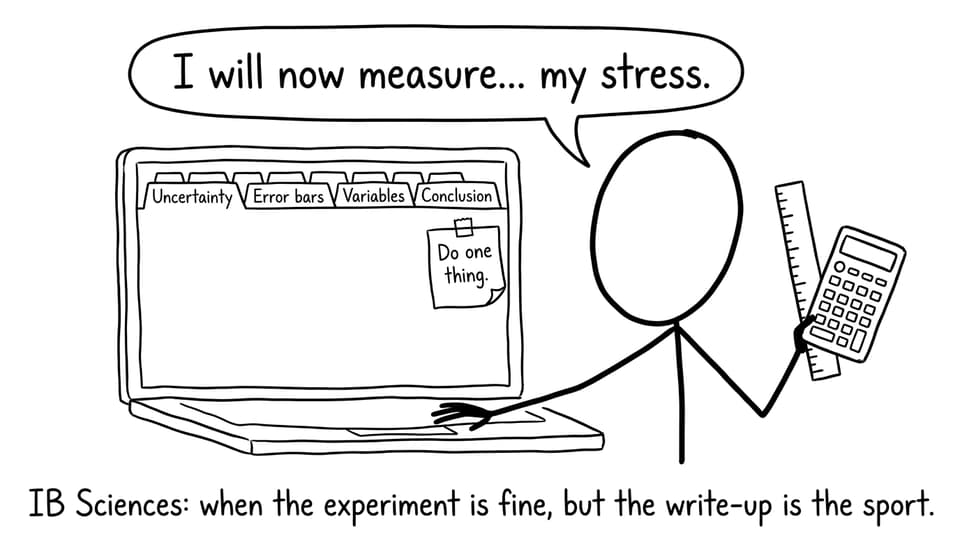
What examiners actually reward in IB Sciences practical work
A strong IB Sciences IA rarely looks like a “cool” experiment. It looks like a defensible one.
Examiners tend to reward:
A research question with no wobble
If your question is too broad, every section becomes guesswork. A narrow question makes your controls obvious, your graphs cleaner, and your conclusion harder to argue with.
If you’re stuck here, use IA Research Question: How to Write a Strong One to tighten it before you collect more data.
Data that’s honest, not pretty
Messy results don’t automatically lose marks in IB Sciences. What loses marks is pretending messiness didn’t happen. You score by showing repeats, uncertainty awareness, and sensible processing.
Evaluation that sounds like science (not apology)
The best evaluations don’t say “human error” and move on. They explain what likely caused error, how it affected results, and what specific change would reduce it next time.
How to prepare for IB Sciences practical assessment (without cramming)
Preparation for IB Sciences practical assessment is less about lab tricks and more about rehearsing the workflow.
Prepare by studying high-quality examples
Look at models like an athlete watches footage: to see what gets rewarded.
Use these exemplars to calibrate your standard:
Use tools that shorten the feedback loop
RevisionDojo is built for the reality of IB Sciences: you improve fastest when practice, feedback, and fixing mistakes are connected.
A practical workflow looks like this:
-
Use Study Notes to understand the theory behind your method (see IB Chemistry Resources for an example hub).
-
Drill exam-style data analysis with the Questionbank: Questionbank.
-
When coursework structure gets confusing, use the Coursework Library and the Grading tools (including subject graders like IB Chemistry IA Grader).
-
If you need quick clarity mid-draft, use AI Chat; if you need deep, human feedback, use Tutors.
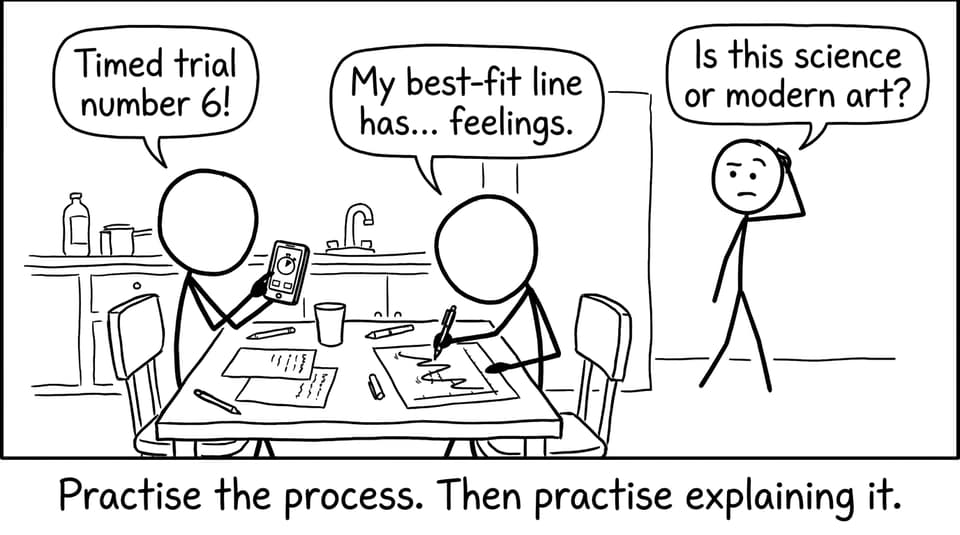
Handling “wrong” results in IB Sciences
One of the most freeing truths in IB Sciences: your hypothesis can be wrong and your IA can still score highly.
Unexpected results often give you more to evaluate: anomalies to explain, limitations to trace, improvements to justify. If your data disagrees with what you expected, treat it as information, not failure. Your job is to show scientific thinking on the page.
For extra subject-specific inspiration, browse Unique IB Physics IA Ideas for Top Marks or IB Biology IA: 8 Essential Tips to Score a 7.
FAQ: IB Sciences practical exams and the IA
Do IB Sciences have a practical exam day?
In most schools, IB Sciences don’t include a single standalone practical exam day that works like a timed lab test. Instead, the major practical assessment is your Internal Assessment, completed over time. That’s why planning matters so much: you’re judged on research design, data analysis, conclusion, and evaluation rather than speed under pressure. Your regular practical lessons still matter, because they build the skills the IA demands (uncertainty, controls, reliable measurement). Many students find this format more manageable once they realize it rewards careful thinking. If you want to understand how practical time accumulates across the course, the guidance in How Many Hours of Practical Work Are Required in IB Sciences helps set expectations.
What’s the fastest way to improve my IB Sciences IA score?
The fastest improvements in IB Sciences usually come from tightening what the rubric rewards, not adding more pages. Start by making your research question narrower and more measurable, because that forces a cleaner method and clearer analysis. Next, make your data presentation unmistakable: units, uncertainties, repeats, and graphs that match the relationship you’re testing. Then upgrade your evaluation by writing limitations as cause-and-effect claims (what caused the issue, how it impacted results, and how to reduce it). Finally, compare against strong examples to calibrate what “good” looks like in real student work. RevisionDojo helps speed this up by connecting exemplars, guides, and grading tools in one place through IB Internal Assessment Guides.
Can I do my IB Sciences IA at home?
Sometimes, but it depends on your school’s rules, safety expectations, and what supervision is required. Even when home investigation is allowed, the key is choosing a method that stays ethical, safe, and measurable with realistic equipment. The risk with home setups is usually not the experiment itself; it’s losing control of variables or measurement precision, which makes analysis weaker. If you do work at home, document decisions carefully so your method is replicable and defensible. Also make sure you can still produce sufficient, high-quality data with repeats and clear uncertainties. When you’re unsure, run your plan past a teacher early and use RevisionDojo’s resources to keep structure tight, starting from IB Internal Assessment Guides.
Conclusion: treat IB Sciences practicals like a story you can defend
The practical side of IB Sciences isn’t a one-day performance. It’s a slow build: good questions, careful methods, honest data, and thoughtful evaluation.
If you want that process to feel calmer (and score higher), use RevisionDojo as your home base: Study Notes to understand, Flashcards to retain, Questionbank to practise, AI Chat to unblock, Mock Exams and Predicted Papers to build confidence, and Grading tools, Coursework Library, and Tutors to strengthen your IA from draft to final. In IB Sciences, the goal isn’t perfect results; it’s a report that proves you know how science works.