


In IB Physics, the scariest moment isn’t when you see a hard question. It’s when you know the equation exists… and your brain can’t decide whether to remember it, look it up, or run away.
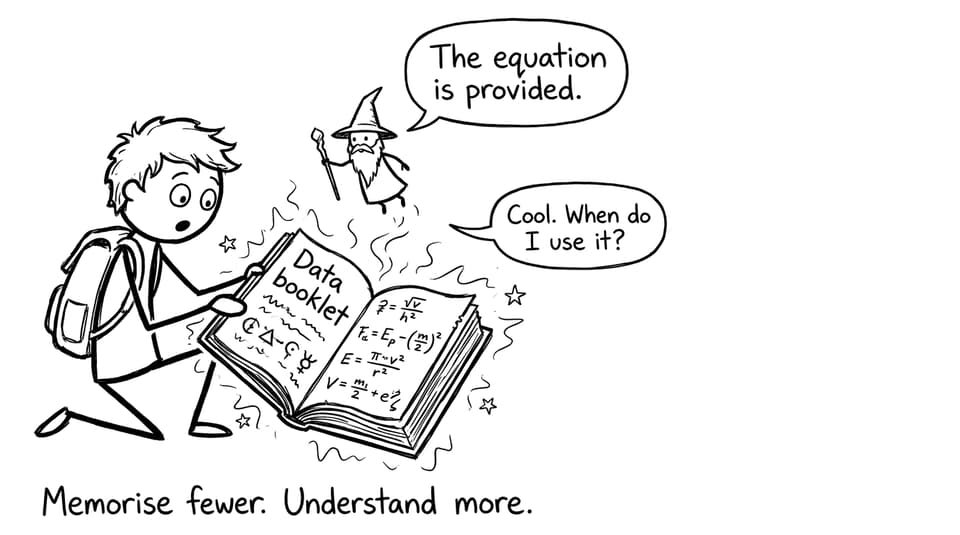
The good news: you don’t need to memorise every formula to do well in IB Physics. The better goal is calmer and more realistic: memorise a strategic core so your working memory stays free, and understand the rest so you can choose the right relationship under pressure.
A quick IB Physics equation checklist
Use this as your decision rule in IB Physics revision:
-
Memorise equations you use constantly (so you stop hunting for them).
-
Understand equations that depend on conditions and assumptions.
-
Practise navigating the data booklet until it feels boring.
-
Train application using exam-style questions, not rereading notes.
If you want a clean reference to train with, keep the IB Physics Data Booklet open during practice and build speed over time.
IB Physics equations worth memorising (high-frequency core)
In IB Physics, some relationships show up so often that memorising them is less about “rote learning” and more about removing friction.
Mechanics foundations
These are the equations that keep reappearing across topics and multi-step problems:
-
Newton’s second law: (F = ma)
-
Momentum and impulse: (p = mv), (J = F\Delta t = \Delta p)
-
Work and energy basics: (W = F s\cos\theta), (E_k = \tfrac{1}{2}mv^2), (P = \tfrac{W}{t})
-
Constant acceleration (SUVAT set):
-
(v = u + at)
-
(s = ut + \tfrac{1}{2}at^2)
-
(v^2 = u^2 + 2as)
-
Why memorise these in IB Physics? Because they’re “starter keys.” If you can write them instantly, you spend your exam time modelling the situation, not searching.
For targeted practice, the Mechanics topic hub and the broader IB Physics revision notes help you see these equations in context.
Derivation matters more than you think
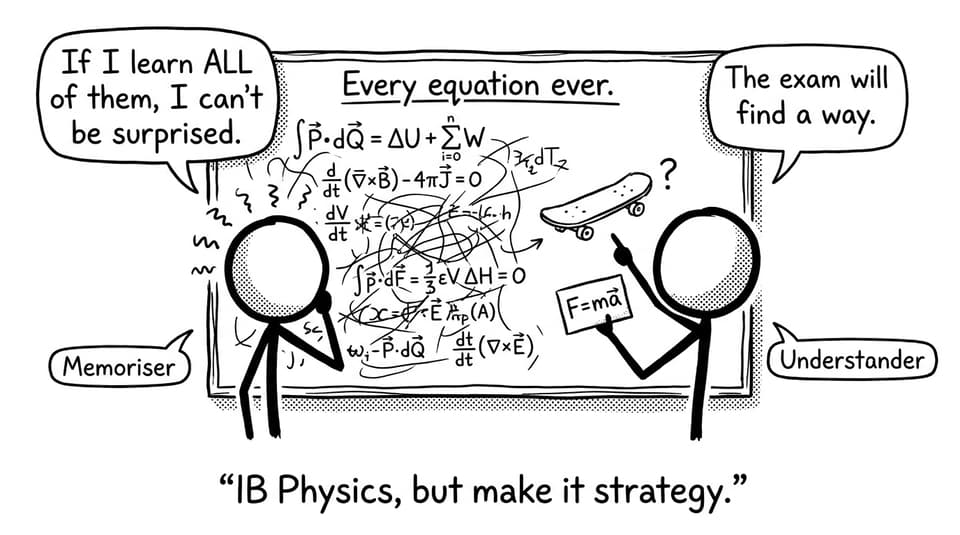
Memorising is fragile in IB Physics unless you can also explain where the equation comes from.
A great example is the kinematics set. When you understand that displacement is area under a velocity-time graph, SUVAT stops being a chant and becomes a tool.
If you want a step-by-step walkthrough, use Equations of motion (A.1.2) Notes.
IB Physics equations you should understand (not just recall)
Many IB Physics formulas are provided, but the exam still tests whether you know when the equation applies and what it assumes.
Circuits: the equation is easy, the situation is not
Yes, (V = IR) is straightforward. The trap is deciding:
-
is the component ohmic?
-
is it series or parallel?
-
what is happening to energy and power?
This is why IB Physics rewards conceptual clarity over perfect recall. Train this using the IB Physics Questionbank, where you can practise choosing relationships in realistic setups.
Thermal physics and gas laws: assumptions run the show
Gas laws and energy transfer equations work beautifully only when the conditions match.
A quick habit that boosts IB Physics marks: whenever you write an equation, write the assumption beside it (constant temperature, ideal gas behaviour, negligible losses, steady state, etc.).
To drill application, try Gas laws questionbank practice.
Waves and optics: your diagram is the “real equation”
In waves, you often know three equations that could work. The diagram tells you which one.
That’s why in IB Physics, a clean sketch (rays, normals, path difference) is often worth more than trying to memorise every special-case formula.
How to internalise IB Physics equations without drowning in them
A practical routine for IB Physics students:
-
Active recall first, then check: write the core equations from memory, then verify using the Physics Data Booklet.
-
Interleave topics: mix mechanics, thermal, and waves so you practise selecting equations, not just repeating them.
-
Use flashcards for definitions + symbols: this reduces silly mistakes with notation and units. Start with Topic A flashcards.
-
Time pressure reps: speed comes from repetition with feedback, not from “feeling ready.”
And if you want a clear system for using the booklet efficiently, read How to Use the IB Physics Data Booklet Effectively (2026 Exams).

FAQ: IB Physics equations and exam strategy
Do I need to memorise equations if the IB Physics data booklet is provided?
In IB Physics, you can technically rely on the data booklet, but it often makes you slower. Slowness becomes costly in multi-part questions where each step depends on the last. Memorising a small set of high-frequency equations (like (F=ma) and SUVAT) removes the repeated “search time” tax. It also reduces stress because you stop second-guessing where the formula lives. Most importantly, memorisation frees mental space for the real skill: modelling the situation. Use the data booklet as a safety net, not as your main engine.
What’s the difference between “memorise” and “understand” in IB Physics?
Memorise means you can write the equation immediately, correctly, with correct symbols, without prompts. Understand means you can explain what each variable represents, what assumptions are built in, and what happens if those assumptions break. In IB Physics, many students memorise (V=IR) but can’t explain what an ohmic conductor is, so they apply it blindly. Understanding also includes recognising limiting cases and checking units to spot nonsense answers. A good test is this: if I change the context slightly, can you still choose and adapt the equation? If yes, you understand it.
How do I practise IB Physics equations so they actually show up on exam day?
First, practise retrieval: cover your notes and write the core equations quickly, then check them. Next, practise selection: do mixed-topic questions where you must decide which relationship applies, not just substitute numbers. RevisionDojo’s IB Physics Questionbank is ideal for this because exam-style prompts force decision-making. Then practise method: write the equation, substitute with units, and show rearrangement clearly to earn method marks. Finally, add timed sets so your equation knowledge survives pressure. In IB Physics, calm is a skill you can train.
Conclusion: the IB Physics equation goal that actually works
You don’t win IB Physics by memorising everything. You win by memorising the equations you touch constantly, understanding the ones that depend on assumptions, and practising until the data booklet feels like familiar territory.
If you want a single place to build that fluency, RevisionDojo ties it together: syllabus-aligned Study Notes, exam-style Questionbank sets with feedback, Flashcards for active recall, and support tools like AI Chat, Grading tools, Predicted Papers, Mock Exams, a Coursework Library, and expert Tutors. Build your core equation memory, then spend the rest of your energy doing what IB Physics actually rewards: thinking clearly under time pressure.