



Motivation in IB Sciences rarely disappears all at once.
It leaks.
One missed study session becomes two. One confusing topic turns into a whole chapter you avoid. And suddenly you’re “behind,” which is a dangerous story to tell yourself because it makes studying feel like punishment instead of progress.
The good news is that motivation isn’t a personality trait. In IB Sciences, it’s mostly a system: small actions that make the next action easier. Below are 11 strategies that actually hold up in real exam season, when you’re tired, busy, and still expected to remember electrochemistry, homeostasis, and kinematics like it’s casual.
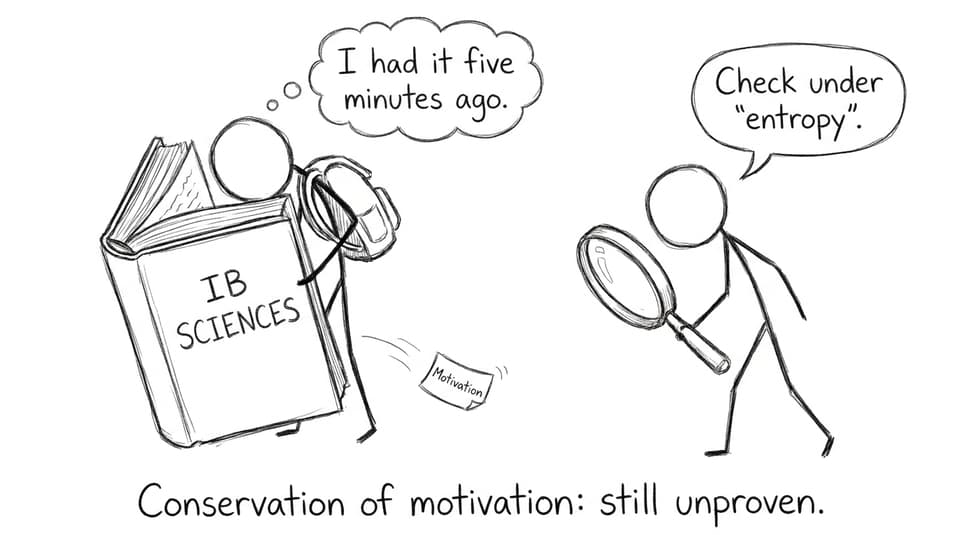
Quick checklist: your motivation toolkit for IB Sciences
If you want a fast way to use this article, start here. Pick three strategies and commit for seven days:
-
A micro-goal for each study session
-
One active recall method (questions or flashcards)
-
A simple progress tracker
-
A rotation plan across Biology/Chemistry/Physics/ESS
-
A weekly timed exam simulation
-
One accountability touchpoint
The point isn’t to become a perfect student. The point is to stay in motion in IB Sciences, because consistency beats intensity almost every time.
Why IB Sciences motivation breaks (and why it’s normal)
IB Sciences ask your brain to do two hard things at once: learn complex ideas and perform under strict exam constraints. Biology can feel like endless detail. Chemistry stacks concepts so one weak topic breaks the next. Physics punishes fuzzy understanding. ESS requires you to connect systems thinking with real data and evaluation.
Add IAs, TOK, EE, CAS, deadlines, sleep debt, and the quiet pressure of “I should be doing more,” and motivation starts to look less like inspiration and more like survival.
That’s why the best study plans don’t rely on mood. They rely on friction reduction.
11 proven strategies to stay motivated while studying IB Sciences
Set a “minimum viable session” (MVS)
On low-energy days, your goal is not a heroic three-hour grind. It’s a session so small you can’t argue with it.
Examples for IB Sciences:
-
12 minutes of Questionbank multiple choice on one subtopic
-
8 flashcards, then stop
-
One worked Physics problem with full checking
Once you start, you often keep going. But even if you don’t, you kept the habit alive.
If you need a place where sessions can be bite-sized, the RevisionDojo home hub is built for short loops: practice, feedback, repeat.
Write goals that you can actually finish today
Big goals motivate you on Sunday night. Small goals motivate you on Tuesday afternoon.
Try “finishable goals” like:
-
“Explain redox in 6 sentences without notes.”
-
“Get 70%+ on 20 questions from one Chemistry topic.”
-
“Make a one-page summary of membranes and transport.”
This matters because IB Sciences are cumulative. Completing a small loop builds confidence that you can complete the next one.
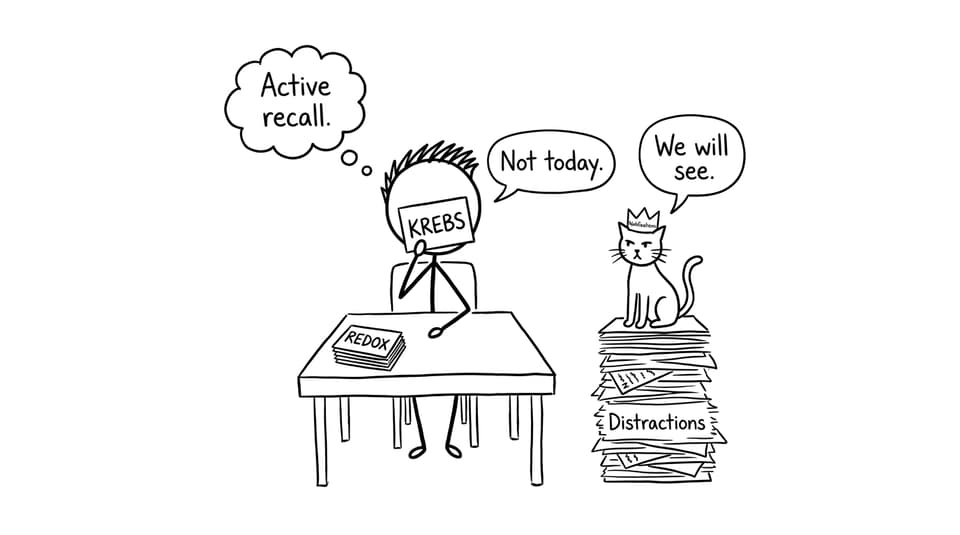
Use active recall as your default (not a bonus)
Rereading feels productive. But it rarely builds exam-ready recall.
For IB Sciences, active recall can be:
-
Doing exam-style questions
-
Turning notes into flashcards
-
Teaching the concept out loud
-
Writing from memory, then correcting
A simple upgrade is to pair your content review with a tool that forces retrieval. RevisionDojo’s IB Flashcards with Spaced Repetition (SRS) keep you honest, and that honesty is motivating because you can see what’s improving.
Rotate sciences to prevent burnout (and increase transfer)
Studying one subject for days can feel efficient, but motivation drops when boredom rises.
A rotation example:
-
Monday: Biology recall + short data-based question
-
Tuesday: Chemistry mechanisms + Questionbank set
-
Wednesday: Physics problems + error log
-
Thursday: ESS case study + evaluation practice
Rotation also creates “transfer” moments: you notice how variables, uncertainty, and modelling show up across IB Sciences.
Track progress in a way your brain can see
Motivation loves visible evidence.
Try one of these:
-
A checklist of syllabus subtopics
-
A “questions answered” counter
-
A weekly score trend from timed practice
-
A mistake log with three recurring patterns
If you want a structured way to practice and measure, subject hubs and question sets help you make progress tangible. For example, the IB Chemistry resources hub makes it easier to see what you’ve covered and what you’re avoiding.
Use exam-style questions early (confidence comes from proof)
The fastest way to feel motivated is to watch yourself get better at the thing that’s being assessed.
In IB Sciences, that usually means:
-
Short structured responses with markscheme logic
-
Data analysis questions
-
Multi-step calculations
When you practice with targeted sets, improvement becomes measurable. Try topic-level drilling like the IB Chemistry Questionbank to build momentum where it matters most.
Make a “two-day rule” for consistency
You can skip a day. You can’t skip two.
This rule works well for IB Sciences because gaps compound: missing one day of recall is manageable; missing two turns recall into relearning.
If you’re in a busy week, keep your two-day rule alive with micro-sessions: 10 minutes of flashcards, or one mini set of questions.
Run one timed simulation per week (pressure is a skill)
Many students lose motivation because they study a lot but don’t feel “exam-ready.” Timed practice fixes that feeling.
Once a week:
-
Sit a timed section
-
Mark it
-
Identify three patterns (not three questions)
-
Drill those patterns in the Questionbank
If you want realistic rehearsal, IB Predicted Papers by IB Examiners (Free) are built to simulate full-paper structure and decision-making under time pressure.
Find an accountability partner (and keep it lightweight)
Accountability works best when it’s simple.
A good weekly check-in:
-
“What are your three focus topics?”
-
“What’s one thing you’re avoiding?”
-
“What’s your next timed practice?”
In IB Sciences, a buddy also helps because you can teach each other. Teaching turns shaky knowledge into solid memory.
Protect your energy like it’s part of the syllabus
Motivation collapses when your body runs out of basic fuel.
Three non-negotiables:
-
Sleep (memory consolidation is real)
-
Movement (even a 10-minute walk resets attention)
-
Breaks (Pomodoro-style cycles are enough)
A calm body makes hard content feel possible. And “possible” is the emotion motivation depends on.
Reduce IA stress so it doesn’t sabotage exam motivation
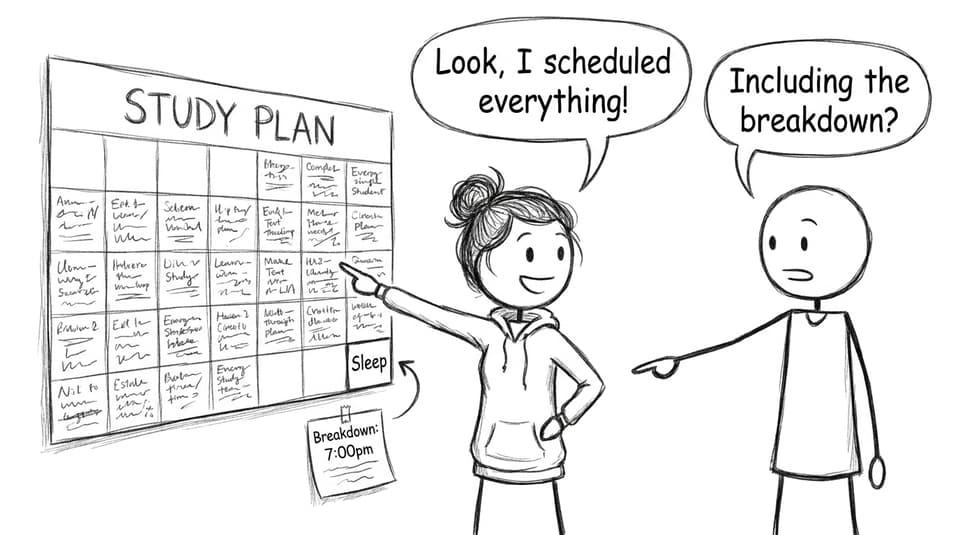
For many students, IB Sciences motivation drops because the IA hangs over everything. When coursework feels unclear, your brain treats studying as unsafe: “Why revise when the IA might ruin my grade anyway?”
Two fixes:
-
Look at strong exemplars to calibrate what “good” looks like
-
Get rubric-aligned feedback early
RevisionDojo’s Coursework feature hub and the guide to which subject has the longest IA are practical starting points when you need your stress to shrink back to size.
Use “ask fast” help when you get stuck
Stuck moments kill momentum. The longer you’re stuck, the more your brain labels the topic as painful.
A good rule: if you’ve been stuck for 7 minutes, get help.
On RevisionDojo, that can mean using AI Chat (Jojo) to unblock confusion, then jumping straight back into practice questions. Add Grading tools when you’re writing structured responses, and Tutors when you need a human to diagnose deeper misconceptions.
To keep your science revision aligned with how IB actually assesses, it can also help to study from structured guides like What is IB Biology: Complete Guide and strategy-focused reads like How to Pass IB Biology SL Exams: Proven Study Strategy.
Closing: build motivation like a lab process
In IB Sciences, motivation isn’t something you wait for. It’s something you engineer.
You set conditions. You run small trials. You measure what works. Then you repeat.
If you want a simple plan for this week: choose three strategies from above, do one timed simulation, and track your progress in a way you can see. Then use RevisionDojo to tighten the loop: Study Notes for clarity, Flashcards for daily recall, Questionbank for volume, AI Chat when you’re stuck, Grading tools to learn marks, Predicted Papers and Mock Exams for pressure practice, the Coursework Library to reduce IA stress, and Tutors when you need a human edge.
Keep it calm. Keep it consistent. Your future self in the exam hall will feel the difference in every question.