


Your best IB Visual Arts work usually starts with an uncomfortable moment: staring at a page that demands a “theme” before you feel ready to commit. The trick is to remember what examiners actually reward. A theme isn’t a slogan. It’s a container that helps your experiments, artist research, and reflections connect into one clear journey.
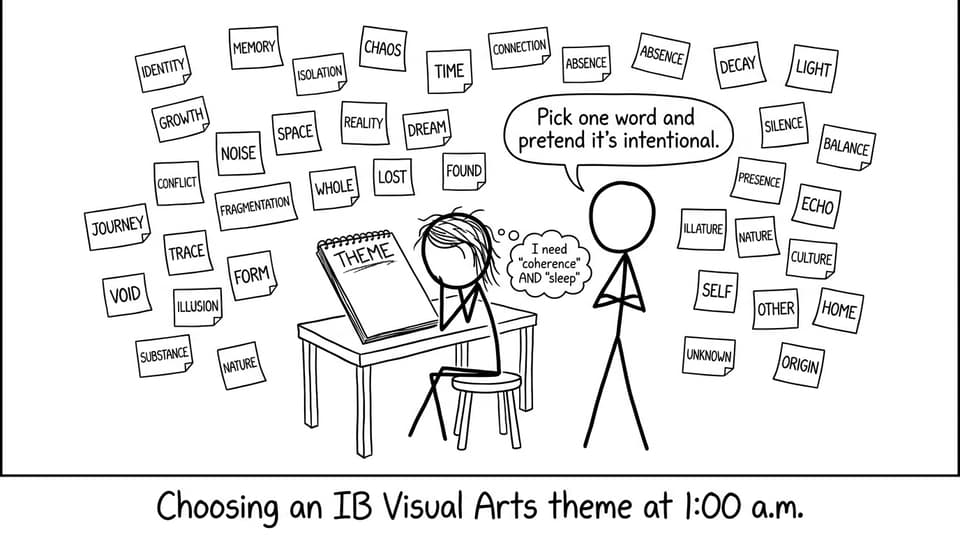
Why a theme matters in IB Visual Arts
In IB Visual Arts, a strong theme quietly does three jobs at once.
First, it creates coherence across the Process Portfolio and Exhibition, so your pages feel like chapters rather than random uploads. Second, it gives you a natural rationale for why you chose certain media, compositions, or symbols. Third, it makes reflection easier: instead of writing “I tried collage,” you can write “I tried collage to show fragmentation in memory.” If you want the bigger picture of how the course fits together, start with What is IB Visual Arts?.
A quick theme checklist (use this before you commit)
Before you lock anything in, run this fast test:
-
Personal pull: Would you still care about this in six weeks?
-
Flexibility: Can it produce 6-12 different outcomes across media?
-
Research-friendly: Can you connect it to artists from different contexts?
-
Reflection-ready: Can you explain why each experiment belongs?
-
Exhibition potential: Could it become a cohesive final body of work?
If you’re unsure what examiners value most, keep IB Visual Arts Assessment Criteria Explained Simply open while you plan.
How to choose a theme for your IB Visual Arts portfolio
Start with something real (not something that “sounds deep”)
Most students don’t struggle to find ideas. They struggle to find ideas they genuinely want to live with. In IB Visual Arts, authentic themes create better annotations because you naturally have opinions, memories, references, and conflicts to explore.
Try prompts like:
-
“A place I keep returning to, and why”
-
“A rule I grew up with”
-
“A modern habit I can’t stop noticing”
Need inspiration without copying? Scan high-quality models in the IB Visual Arts Examples section and notice how themes stay personal while outcomes stay varied.
Make it wide enough to experiment, narrow enough to curate
A theme should be a doorway, not a dead-end. “Transformation” can include body, architecture, language, or time. “Cats” might work only if it’s really about companionship, symbolism, or internet culture.
If you want practical guidance on building variety (without losing focus), read How to Show Experimentation in Your IB Visual Arts Process Portfolio and plan your experiments around your theme.
Let artist research shape the theme (and prove you’re thinking)
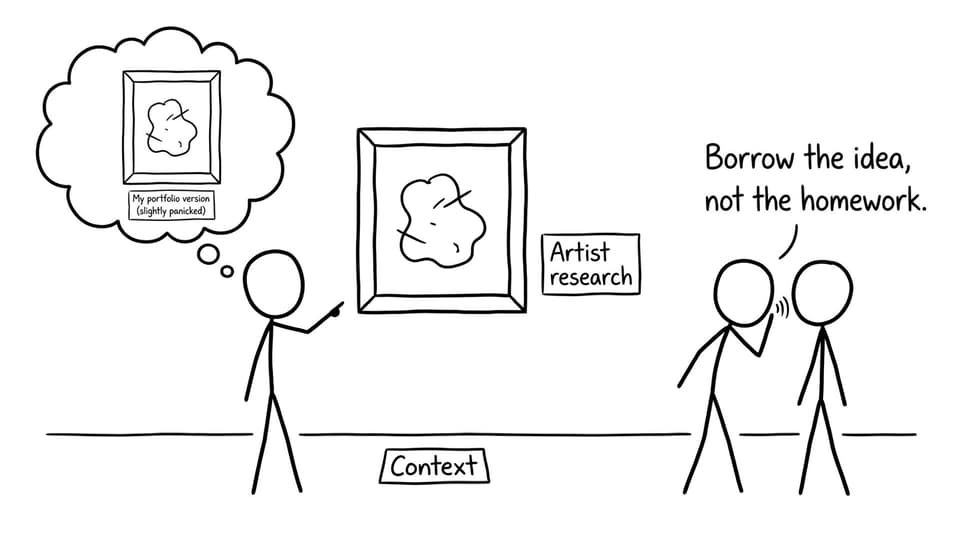
Themes get stronger when they meet other minds. The goal isn’t to imitate. It’s to build a conversation between your intent and an artist’s methods, context, or materials.
A simple workflow:
-
Choose 2-3 artists with different contexts.
-
Borrow one method (not an image) for an experiment.
-
Reflect on what changed in your message.
This also supports the Comparative Study component. For help structuring that side, use How to Prepare for the IB Visual Arts Comparative Study.
Brainstorm keywords, symbols, and “visual verbs”
When you write your theme, also write a word bank. Not just nouns (mirror, phone, soil), but verbs (fracture, collect, erase, compress). Verbs create action, and action creates series.
If you’re unsure what belongs in the portfolio overall, cross-check with What to Include in an IB Visual Arts Portfolio.
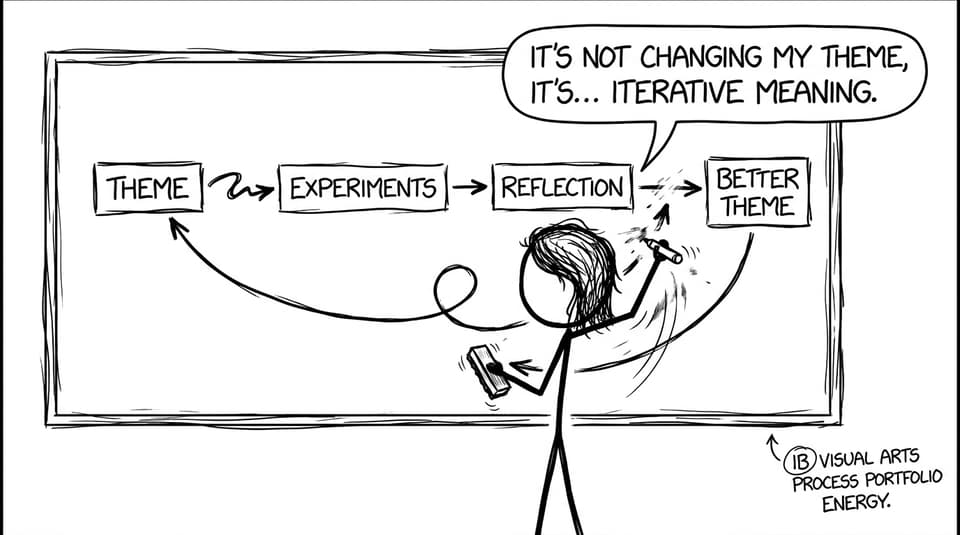
Refine after 2-3 experiments (your theme is allowed to evolve)
A secret of IB Visual Arts is that the best themes often appear after the first messy attempts. Treat early work like scouting. Your final phrasing can change as long as the direction becomes clearer, not more random.
If you want examples that translate well into final curation, browse Examples of Strong IB Visual Arts Exhibition Themes.
Common theme mistakes (and the easy fixes)
-
Too broad (“Life”): add a lens (“Life as routine,” “Life as archive”).
-
Too decorative (“Aesthetic minimalism”): add a question (“What does minimalism hide?”).
-
Too forced (picked to impress), tie it to a personal tension you can actually explain.
-
No link to voice: use this guide: How to Connect Personal Voice in Your IB Visual Arts Portfolio.
Closing: make your IB Visual Arts theme a tool, not a trap
A good IB Visual Arts theme should feel like a quiet engine: it keeps your experiments moving, your research meaningful, and your reflections easier to write. Choose something personal, test it for flexibility, and let your first experiments teach you what the theme truly is.
When you’re ready to tighten the loop, RevisionDojo helps you move faster: explore models in the Coursework Library, pressure-test ideas with AI Chat, build technique with Study Notes and Flashcards, and use grading tools to keep your Process Portfolio examiner-ready. Your theme doesn’t have to be perfect on day one. It just has to be strong enough to carry you forward in IB Visual Arts.


