


Inequality rarely looks dramatic at first glance.
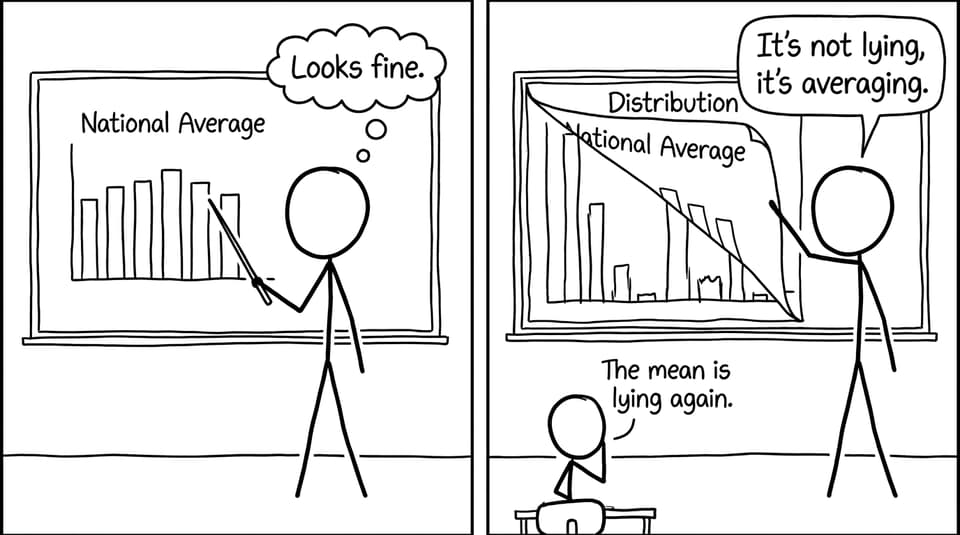
It looks like a national average that seems “fine.” A GDP graph trending up. A development index inching forward. Then you zoom in and notice the quiet truth: two people can live in the same country and inhabit different worlds. That hidden distance is exactly why inequality is such a high-yield theme in IB Geography, and why it keeps showing up in essays, data-response questions, and evaluation.
Quick exam checklist for IB Geography
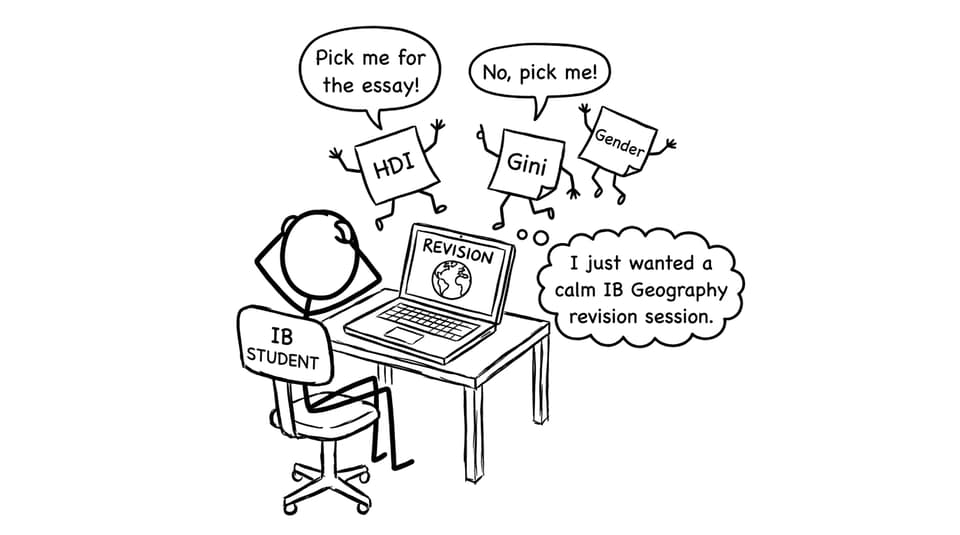
Use this as a fast planning tool before you write:
-
Define inequality (unequal access to income, services, and opportunity)
-
Link inequality to human development (health, education, standard of living)
-
Add one extra layer (gender inequality or regional inequality)
-
Explain why averages can hide unequal outcomes
-
Evaluate: growth != development if benefits are uneven
To revise indicators efficiently, pair this checklist with IB Geography 5.1.1 Measuring Human Development Notes.
Why inequality lowers human development
In IB Geography, human development is about people’s real lives, not just national income. Inequality damages that reality through pathways that reinforce each other.
Unequal healthcare and education
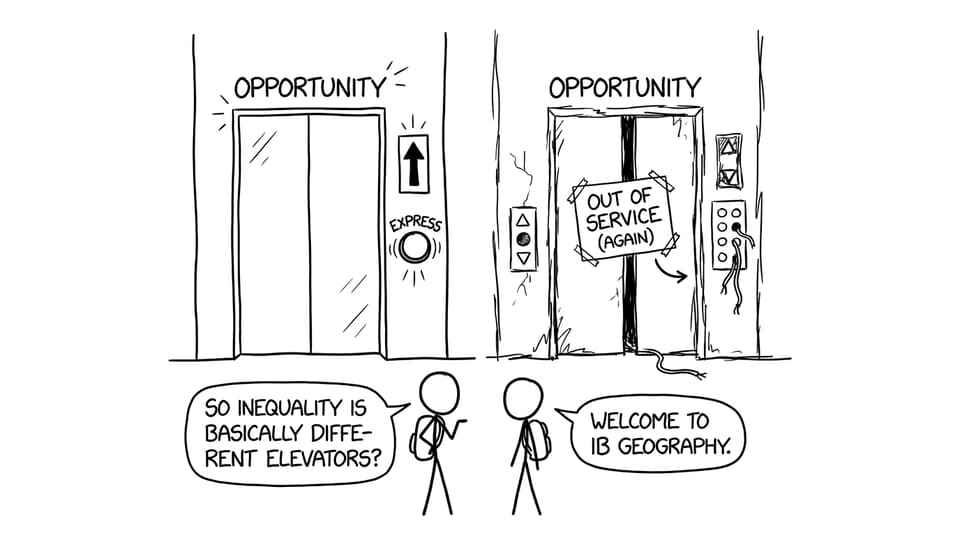
When access to clinics, vaccinations, qualified teachers, or safe schools depends on income or location, the development “ladder” turns into a development “lottery.” Higher-income groups tend to accumulate advantages: healthier childhoods, stronger qualifications, better jobs, and more stable housing. Lower-income groups face preventable illness, interrupted schooling, and lower life expectancy.
That matters because the Human Development Index is built on health and education, but it can still mask internal gaps. For deeper context, see What Is the Human Development Index (HDI)?.
Living conditions and everyday risk
Income inequality often shows up as uneven living standards: overcrowded housing, food insecurity, limited sanitation, and long commutes to basic services. These conditions increase exposure to disease and stress, lowering well-being even when a country’s headline indicators look respectable.
If you need a concrete angle for essays, connect inequality to deprivation and the informal economy using Poverty, Deprivation, and Informal Activity Notes.
Gender inequality slows development across indicators
Gender inequality is a multiplier effect in IB Geography. When women and girls have less access to education, employment, healthcare, or political participation, a country loses productivity and households lose resilience. Educating women is strongly linked to improved health outcomes and greater economic security, which then feeds back into higher human development.
To structure this in an exam answer, tie it to measurement tools like HDI and gender indices (GII/GDI) from the Measuring Human Development Notes.
Unequal opportunities weaken long-term growth
If wealth and resources are concentrated among a small group, many people struggle to access formal employment, credit, training, or entrepreneurship. That reduces social mobility and keeps large groups trapped in low-paid or insecure work. Over time, societies can face higher tension and lower trust, which further undermines development outcomes.
Regional inequality: the development gap inside a country
A classic IB Geography evaluation point: inequality isn’t only between countries. It’s also within them.
Investment often clusters in urban cores while rural or peripheral regions receive fewer services, weaker infrastructure, and fewer high-quality jobs. This can intensify rural-to-urban migration, strain housing and transport, and deepen the original gap.
For syllabus-aligned revision of this whole unit, use 5 Human Development and Diversity Notes and 5 Human Development and Diversity Lessons.
How to turn this into marks in IB Geography
Good answers don’t just describe. They show the logic: inequality limits access to services, services shape outcomes, and outcomes determine human development.
To practise this under exam pressure, use the Human Development and Diversity Questionbank and build a mini case-study bank with the Comprehensive Guide to Geography Case Studies for IB Exams.
RevisionDojo helps you rehearse this whole chain using Study Notes, Flashcards, and AI Chat for quick explanations, plus Grading tools to tighten evaluation and command terms. When you’re ready to simulate real conditions, the Predicted Papers and Mock Exams features make revision feel like the exam (which is the point).
Conclusion: the IB Geography takeaway
Inequality affects human development because it controls who gets the building blocks of a good life: healthcare, education, safe living conditions, and real economic choice. In IB Geography, the highest-scoring insight is simple: development isn’t only about growth; it’s about distribution.
If you want to turn that insight into reliable exam marks, use RevisionDojo to practise the full cycle: learn the concepts in Notes, lock them in with Flashcards, test them in the Questionbank, and refine your evaluation with AI Chat and grading tools. Then finish with realistic practice through Predicted Papers and Mock Exams, so “IB Geography” becomes something you can perform, not just understand.