

The night before an IB exam, networking starts to feel like magic. A message leaves your laptop, disappears into the air, and somehow returns as a webpage, a file, or a video call that only freezes when your teacher asks a question.
In IB Computer Science, you do not get marks for calling it magic. You get marks for explaining how data travels -- clearly, layer by layer -- using the TCP/IP model.
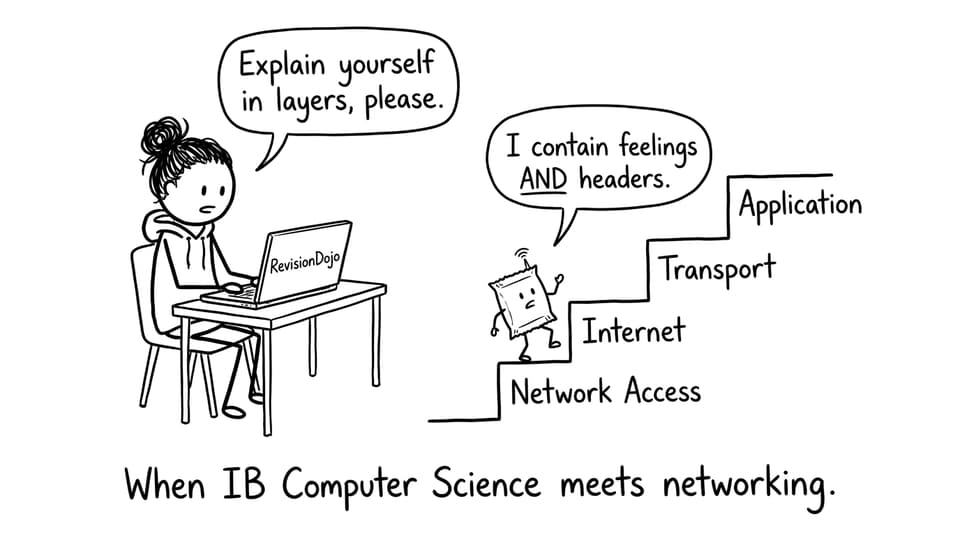
TCP/IP model overview (exam-ready checklist)
For IB Computer Science, your best answers do three things:
-
Name the four TCP/IP layers
-
State the job of each layer (function, not just vocabulary)
-
Describe encapsulation/decapsulation: headers added on the way down, removed on the way up
If you want a bigger map of the syllabus around this, start with the IB Computer Science Networks hub and the 3.1 Networks notes.
What is the TCP/IP model in IB Computer Science?
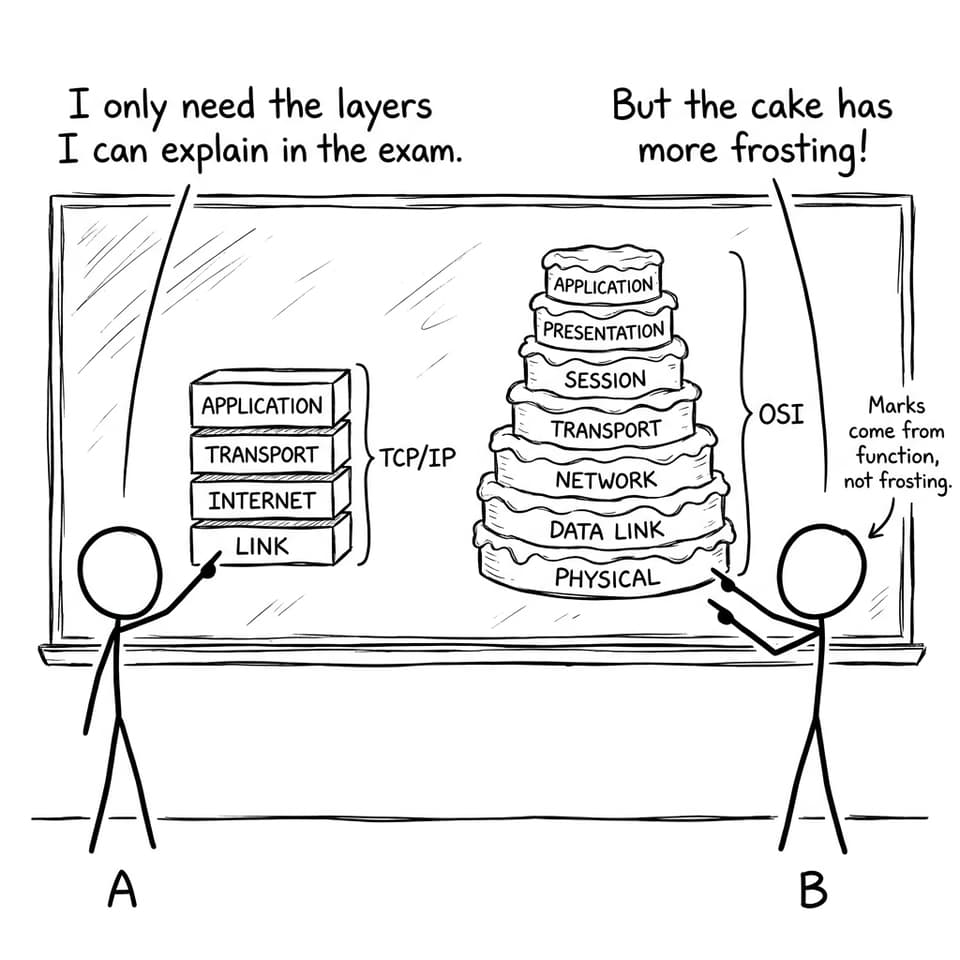
The TCP/IP model is a layered way to explain network communication. Each layer solves a specific problem, then hands the data to the next layer.
This matters in IB Computer Science because exam questions often reward explanations like: “The transport layer segments data and may ensure reliability using TCP acknowledgements.” That is function. That is marks.
For the HL-only angle, see A2.1.5 Function of the TCP/IP model (HL only).
Application layer (what the user is actually doing)
The Application layer is closest to the user and the software they touch. It provides services that applications use to communicate.
In IB Computer Science, say what it enables, not just what it is:
-
Formats data for a service (web, email, file transfer)
-
Uses user-level protocols like HTTP/HTTPS, SMTP, FTP
If you want a concrete story for this layer, the step-by-step flow in What happens when you type a URL into a browser? is a great way to phrase it in exam language.
Transport layer (reliability vs speed)
The Transport layer handles end-to-end delivery between devices. Its job is to manage communication between applications, often by:
-
Segmenting data
-
Controlling flow
-
Detecting errors
-
(Sometimes) ensuring reliable delivery
The key IB Computer Science comparison is TCP vs UDP:
-
TCP: reliable, ordered, acknowledgements and retransmission
-
UDP: faster, minimal overhead, no delivery guarantee
Revision support:
Internet layer (addressing and routing)
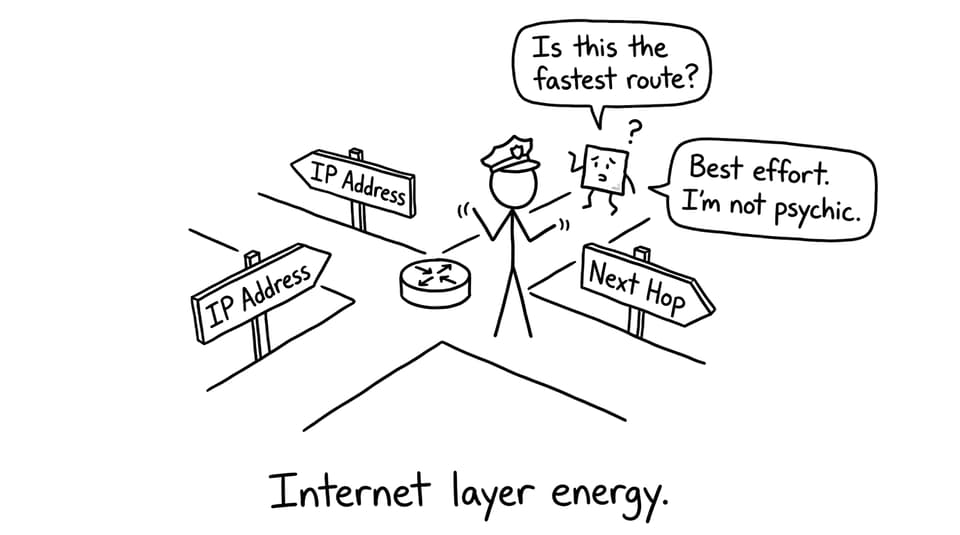
The Internet layer is where IP addressing and routing live. It decides how packets move across networks to reach the destination.
Strong IB Computer Science phrases include:
-
“Adds source and destination IP addresses”
-
“Routers forward packets to the next hop based on routing decisions”
-
“IP is best-effort: it does not guarantee delivery or order”
To tighten your terminology, use C.1.7 Internet protocols notes.
Network access layer (sending bits on the local link)
The Network Access layer handles how data is transmitted over the physical or wireless medium on the local network.
In IB Computer Science, mention:
-
Frames and local delivery
-
MAC addresses on a LAN
-
Technologies like Ethernet and Wi-Fi
If you need extra context on networks in general, What is a computer network? LAN, WAN, and PAN explained pairs well with TCP/IP.
How data moves through TCP/IP (the story examiners like)
When sending data:
-
Application prepares it (e.g., HTTP request)
-
Transport segments it and may add TCP/UDP info
-
Internet adds IP addresses and creates packets
-
Network Access frames it and transmits it on the link
When receiving, the device decapsulates in reverse, removing headers layer by layer.
For students who confuse models, the comparison topic is in A2.2.3 Compare and contrast networking models notes.
Conclusion: turn layers into marks with RevisionDojo
The TCP/IP model is not four boxes to memorise. In IB Computer Science, it is a story about responsibility: applications ask, transport manages delivery, internet routes, and network access transmits.
If you want to turn that story into exam performance, use RevisionDojo to practise it the way examiners expect: Study Notes for clean definitions, Flashcards for fast recall, AI Chat to refine explanations, and the Questionbank plus Mock Exams to pressure-test your wording. Add Predicted Papers, Grading tools, the Coursework Library, and Tutors when you need a structured push toward a level 7.
For more targeted networking revision in IB Computer Science, start at the IB Computer Science tag archive and keep your layer explanations functional, not fictional.