
DNA is one of those IB Biology topics that feels “obvious” right up until you have to explain it under exam pressure. In class, the double helix looks like a neat spiral staircase. In the exam, it becomes a question like: “Explain how structure enables function.” Suddenly you’re not recalling a picture; you’re building a chain of logic.
This post breaks the IB Biology structure of DNA into the parts that actually earn marks: the double helix, the bases, and why the shape is perfect for storing and copying information.
IB Biology DNA structure checklist (learn this first)
If you can say these points clearly, you can answer most short questions on DNA in IB Biology:
-
DNA is a polymer of nucleotides
-
Each nucleotide = phosphate + deoxyribose sugar + nitrogenous base
-
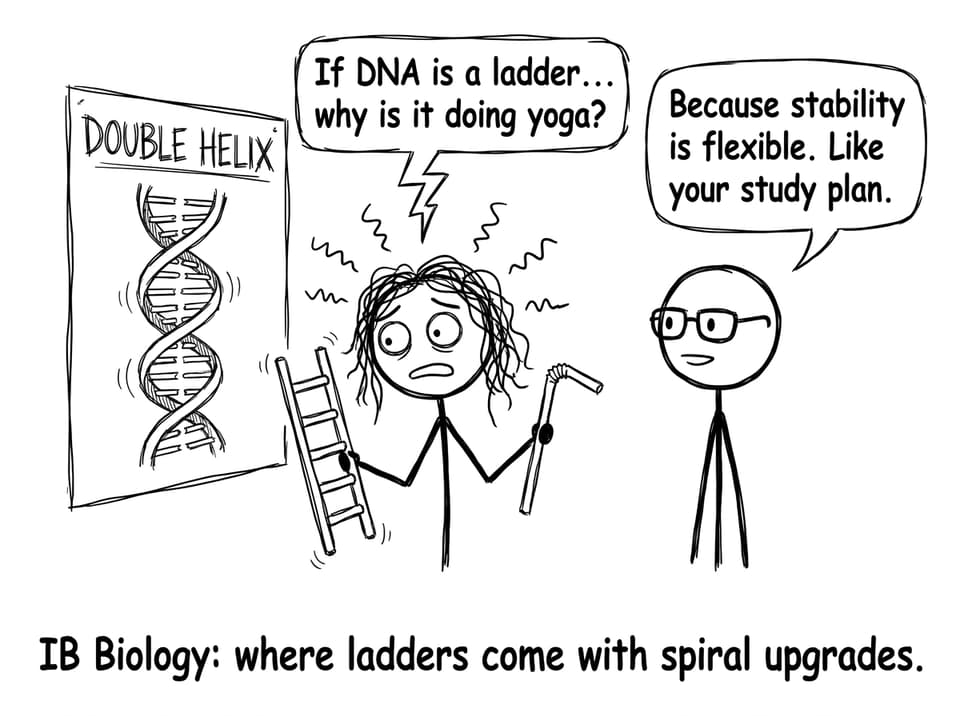
Two strands form a double helix
-
The sides are a sugar-phosphate backbone (strong covalent bonds)
-
The rungs are complementary base pairs held by hydrogen bonds
-
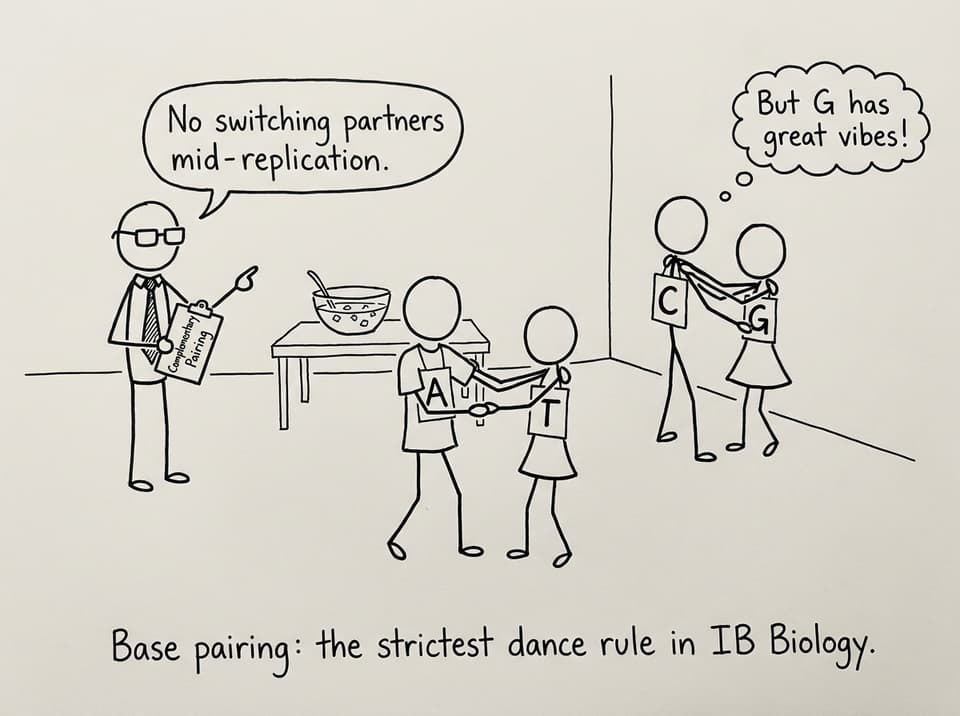
Base pairing rule: A-T and C-G
-
The sequence of bases stores genetic information
For syllabus-aligned notes, anchor your revision in 2.6 Structure of DNA and RNA and the deeper breakdown in Notes for 2.6 Structure of DNA and RNA.
Double helix: the shape that makes copying possible
In IB Biology, “double helix” is not just a label. It’s a design solution.
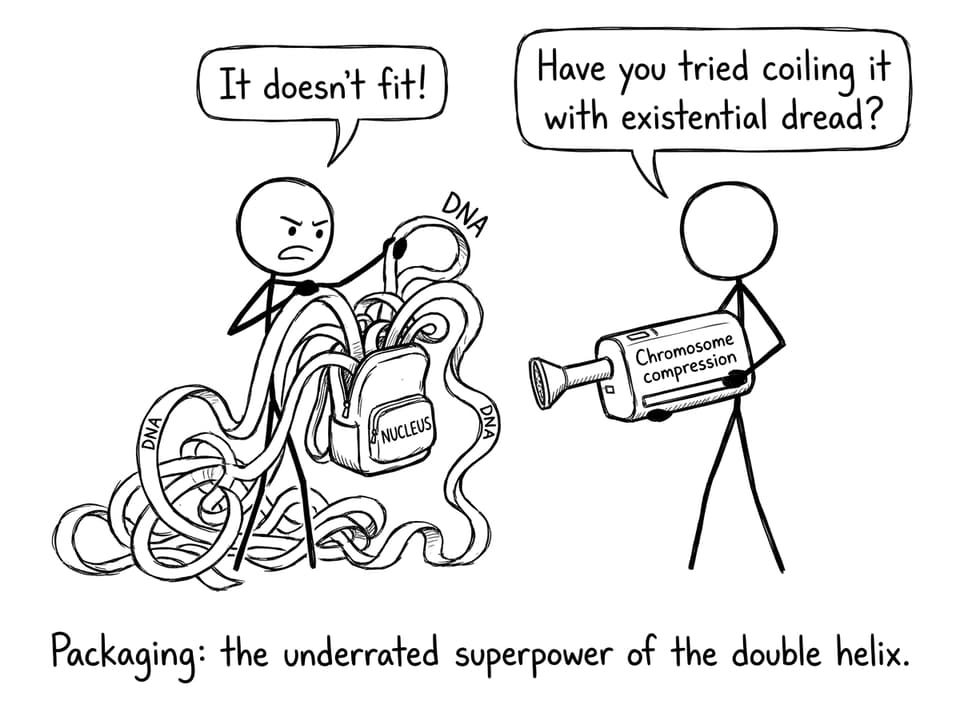
The helix is built from two antiparallel strands twisted together. That twisting helps DNA stay compact and stable, while still being able to open locally when needed. Think of it as a book that stays closed on the shelf, but can be opened to one page without the whole thing falling apart.
When the cell needs to copy information (before cell division), the strands separate and each becomes a template. If you want to connect structure directly to copying, pair this post with How Antiparallel DNA Ensures Accurate Replication and the syllabus hub IB Biology Topic D1.1: DNA Replication.
IB Biology bases: four letters, one strict pairing rule
DNA uses four nitrogenous bases: A, T, C, G. In IB Biology, your job is to link that fact to two consequences: stability and accurate information transfer.
-
A pairs with T
-
C pairs with G
That pairing isn’t picky for no reason; it’s how the molecule protects its own meaning.
To revise the why behind the rule (not just the rule itself), use IB Biology: Why Complementary Base Pairing Stabilizes DNA.
How DNA stores genetic function (sequence becomes instructions)
The sugar-phosphate backbone is like the paper in a book: necessary, strong, and mostly the same on every page. The bases are the ink.
Genetic information is stored in the order of bases along a strand. A gene is a specific sequence that can be used to produce RNA and, ultimately, a protein. In IB Biology, this is the key functional link:
-
Sequence of bases = information
-
Information can be replicated (copied accurately)
-
Information can be expressed (used to build proteins)
To extend from structure into function across DNA vs RNA, see IB Biology: How RNA and DNA Structure Drives Function and the broader hub IB Biology Resources.
Exam practice: turn knowledge into marks with RevisionDojo
Knowing DNA structure is one thing. Producing it in exam wording is another.
On RevisionDojo, you can:
-
Drill DNA questions in the 2.6 Structure of DNA and RNA Questionbank
-
Build rapid recall with Flashcards for A1.2 Nucleic acids and the full IB Biology Flashcards
-
Use AI Chat to re-explain base pairing, hydrogen bonding, or nucleotide structure in a new way when you get stuck
-
Use Grading tools to tighten explanations into mark-friendly language
-
Add timed pressure with Mock Exams and Predicted Papers when you’re ready
Closing: make IB Biology DNA questions feel inevitable
When DNA clicks, it feels less like memorising and more like recognising good design: a stable backbone, specific base pairing, and a double helix that can open, copy, and close again. That’s the heart of IB Biology: structure creating function.
If you want to turn this understanding into exam marks, use RevisionDojo’s Study Notes, Questionbank, Flashcards, AI Chat, Grading tools, Predicted Papers, Mock Exams, plus the Coursework Library and Tutors when you need extra support. Start with IB Biology Topic A1.2: Nucleic Acids and keep practicing until the double helix becomes something you can explain calmly, not just recognise.