


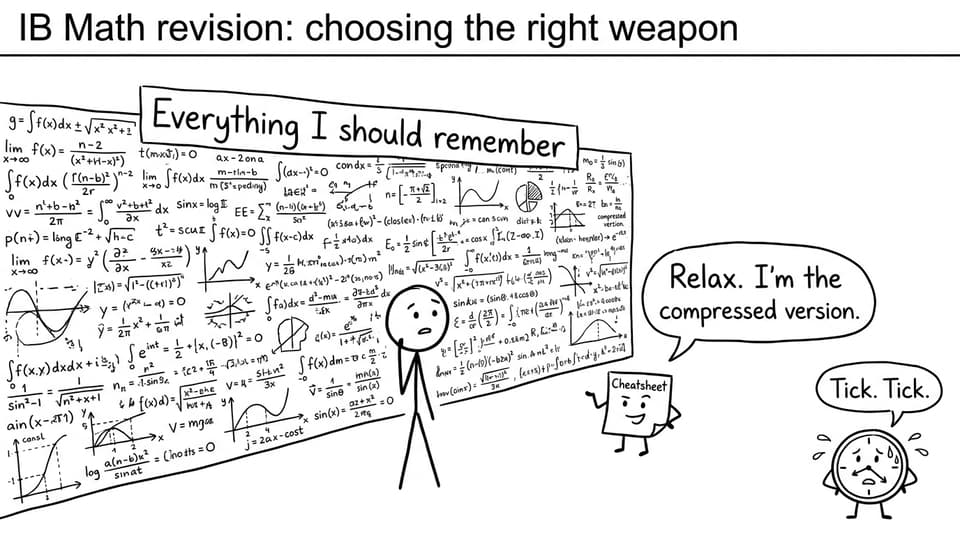
If you have ever stared at an IB Math question and felt your brain reach for a formula that is definitely in there somewhere, you already understand the real problem. It is not only difficulty. It is retrieval.
IB Math is full of moments where you know the idea, but the exam clock turns your memory into fog. A cheatsheet does not magically give you new skills. It gives you something quieter and more useful: a reliable path back to what you already learned.
That is why RevisionDojo’s IB Math cheatsheets are so effective. They are built to help you recall the right method fast, apply it cleanly, and keep your confidence intact under pressure.
IB Math cheatsheets: a quick setup checklist
Use this short checklist to make IB Math cheatsheets work like a system, not a one-time download:
-
Choose your course and level (AA or AI, SL or HL) so your IB Math revision matches your syllabus.
-
Download the core set from RevisionDojo Cheatsheets.
-
Pick one weak area and one strong area per week (this keeps IB Math momentum steady).
-
Study the cheatsheet for 8-12 minutes, then immediately do practice questions.
-
End each session by rewriting 3-5 key formulas from memory.
If you want a reliable map of your strand, start with the IB Mathematics Analysis and Approaches resources hub and build outward from there.
Why IB Math rewards memory that stays calm
The hidden challenge of IB Math is that marks go to the student who can do three things in the right order:
-
Recognize the question type.
-
Select the correct method.
-
Execute with accurate notation.
Under stress, even strong students lose time between step one and step two. You reread. You doubt. You try a different approach. And suddenly your confidence is gone.
Cheatsheets reduce that decision fatigue. Instead of asking, “What am I supposed to do here?”, your brain starts asking the better question: “Which familiar structure is this closest to?”
If you want the deeper learning science behind this, pair this article with The Science Behind Effective IB Cheatsheets. It explains why chunking and retrieval practice matter so much for IB Math performance.
What makes RevisionDojo IB Math cheatsheets different
Many IB Math formula sheets become cluttered collections of symbols. RevisionDojo’s approach is closer to how examiners think: clustered methods, clear triggers, and practical organization.
Here is what students tend to notice quickly:
-
Syllabus-aligned coverage across IB Math AA and AI.
-
Method-first layout so formulas come with their conditions and typical use.
-
Visual structure that helps you scan fast in revision sessions.
-
Exam-language clarity that matches how steps are awarded.
And importantly, cheatsheets do not live alone. They plug into a full RevisionDojo workflow: Study Notes for understanding, Flashcards for daily recall, AI Chat for stuck moments, and the Questionbank plus Grading tools to tighten your accuracy. When you are closer to exams, Mock Exams and Predicted Papers help you rehearse under time pressure, and the Coursework Library and Tutors give extra support when you need structure.
To see how RevisionDojo designs cheatsheets across subjects, this companion read helps: Why RevisionDojo’s IB Cheatsheets Are the Best for 2026 IB Exams.
How to use IB Math cheatsheets without fooling yourself
The easiest trap in IB Math revision is “I read it, so I know it.” Cheatsheets feel clean and satisfying to review, which can create a false sense of readiness.
Instead, use this loop. It is simple on purpose:
Read, then retrieve
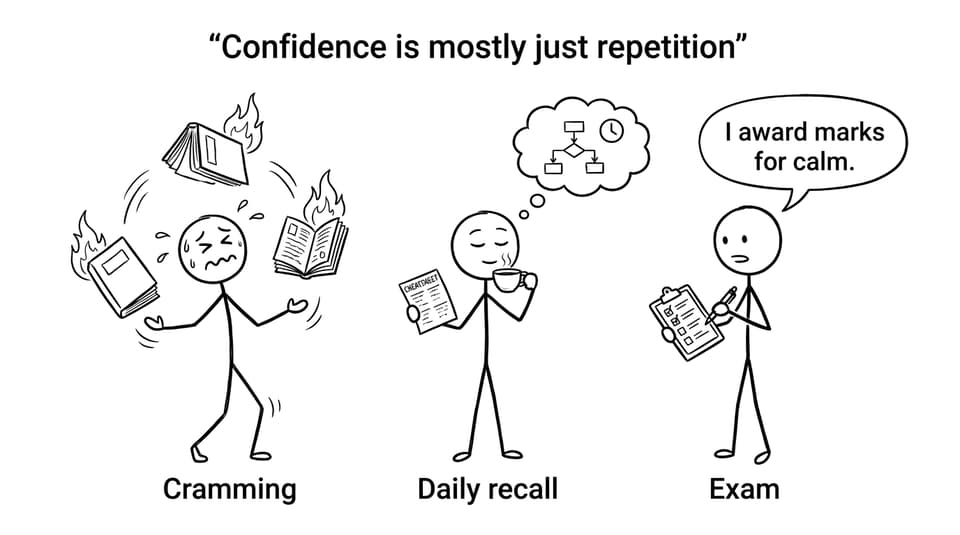
Look at one section of your IB Math cheatsheet (for example, derivative rules or normal distribution steps). Close it. Write the key relationships from memory. Then reopen and correct.
Apply immediately
Go straight into targeted practice so the formula becomes a decision you can execute, not a fact you recognize.
A strong place to do this is RevisionDojo’s Questionbank-focused strategy guide: IB Math: Targeted Revision Using the Questionbank. For many students, this is where IB Math stops feeling random and starts feeling trainable.
Log the mistake, not just the answer
In IB Math, the same mistake repeats because the same thought repeats. Keep a one-page error log: what you did, why it happened, and what cue on the cheatsheet should have stopped you.
Where IB Math cheatsheets help most (by topic)
IB Math cheatsheets are especially powerful in topics where the method is predictable but execution must be fast:
-
Algebra and functions: transformations, inverses, solving forms, domain and range.
-
Calculus: derivative rules, integration patterns, interpretation and setup.
-
Probability and statistics: distribution steps, regression interpretation, expected value structure.
-
Trigonometry and geometry: identities, unit circle relationships, radians, standard results.
-
Vectors (especially AA HL): line forms, scalar product, geometric meaning.
If calculus is a stress point, using the cheatsheets alongside targeted practice is a strong combo. You can jump straight into practice here: IB Math AA Calculus Questionbank.
And if you want a clean reference that supports consistent IB Math notation, RevisionDojo also provides a dedicated booklet: IB Mathematics Analysis and Approaches Data Booklet.
A two-week IB Math cheatsheets plan (that fits real life)
This plan works well in the final stretch because it is repetitive, measurable, and calm.
Week 1: Build speed without panic
-
Day 1-2: Cheatsheet review + short practice set (focus: accuracy).
-
Day 3-4: Cheatsheet review + timed mini-set (focus: pace).
-
Day 5: Mixed-topic set + update error log.
Week 2: Turn recall into exam readiness
-
Day 1-3: One weak topic per day (cheatsheet --> Questionbank --> correction).
-
Day 4: Mixed set under time pressure.
-
Day 5: Light review, rewrite key formulas from memory, sleep.
If you want an even more structured rhythm, these two guides pair well with cheatsheets:
FAQ
Can I bring IB Math cheatsheets into the exam?
No. IB Math exams do not allow you to bring personal IB Math cheatsheets into the room. But that is not the point of using them. Cheatsheets are training tools for recall, so the formula shows up in your head on demand, not on paper in front of you. If you use them with active recall and practice questions, you start remembering methods as routines rather than isolated facts. Over time, IB Math feels less like memorization and more like recognition. That shift is where confidence comes from.
Are RevisionDojo IB Math cheatsheets suitable for AA and AI, SL and HL?
Yes. RevisionDojo’s IB Math cheatsheets are designed to match the way AA and AI organize skills, and they are usable across SL and HL. The key is that you must choose the correct strand and level when you study, because IB Math AA HL depth is different from AI SL emphasis. If you are unsure where to start, open the relevant hub (for example IB Mathematics Analysis and Approaches resources) and follow the topic list. Then use cheatsheets as your “fast map” and the Study Notes as your “slow explanation.” This combination helps you avoid learning the wrong version of a method.
How should I combine IB Math cheatsheets with practice so they actually raise my grade?
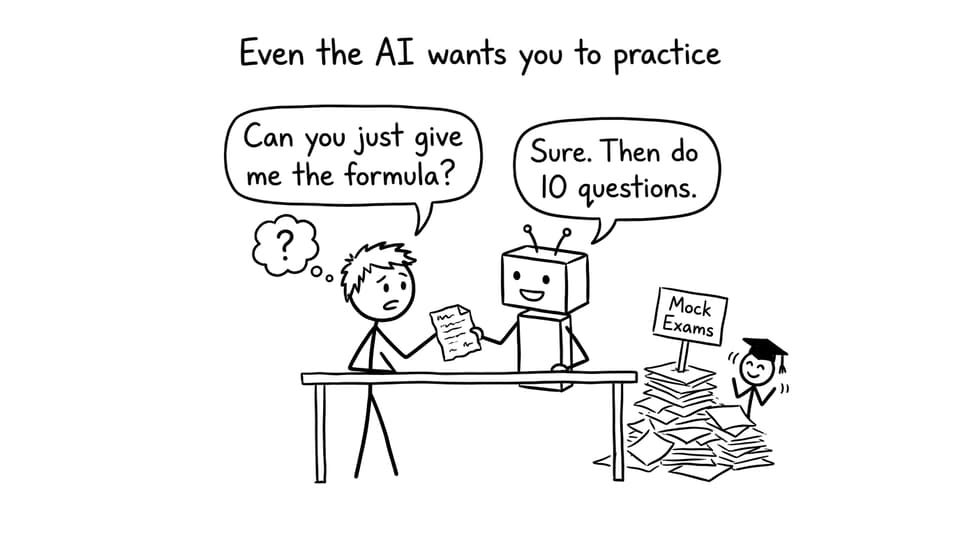
Treat your IB Math cheatsheets as a trigger for practice, not a replacement for it. Start every session with a short cheatsheet scan, then do a focused set of questions immediately after while the structure is fresh. Use the Questionbank to pick one topic and a sensible difficulty range, because random practice can hide weaknesses. After marking, write down the exact step where you lost marks and connect it back to a specific line on the cheatsheet. Finally, revisit that same cheat section two days later and redo one mistake question to lock in the correction. This is how IB Math revision becomes cumulative instead of repetitive.
Closing: the real formula for IB Math confidence
IB Math confidence is rarely about knowing everything. It is about knowing that when the exam asks, you can retrieve, choose, and execute without spiraling.
RevisionDojo’s IB Math cheatsheets help you compress the syllabus into something your brain can carry. Then the platform helps you turn that recall into performance using Study Notes, Flashcards, AI Chat, the Questionbank, Grading tools, Mock Exams, Predicted Papers, the Coursework Library, and Tutors.
If you want the simplest next step, start here: RevisionDojo Cheatsheets. Pick one sheet, pair it with targeted questions, and let consistency do what motivation never reliably can for IB Math.