
When you’re deep in exam season, time starts to feel like a currency you can’t afford to waste. You open a chess app for “just one game,” and an hour later you’ve played eight blitz matches against an AI that somehow feels smug.
Then the thought arrives: Could this count for IB CAS?
It’s a reasonable question. IB CAS is meant to recognize growth beyond exams, and chess does build discipline, pattern recognition, patience, and strategic thinking. But CAS is picky about one thing students often overlook: it’s not impressed by hours. It’s impressed by intentional experiences with evidence, reflection, and (often) other people.
This guide breaks down whether playing chess against AI can count toward IB CAS, what usually gets rejected, and how to reshape chess into a CAS experience that actually strengthens your portfolio without wrecking your revision schedule.
IB CAS in one minute: the filter that decides everything
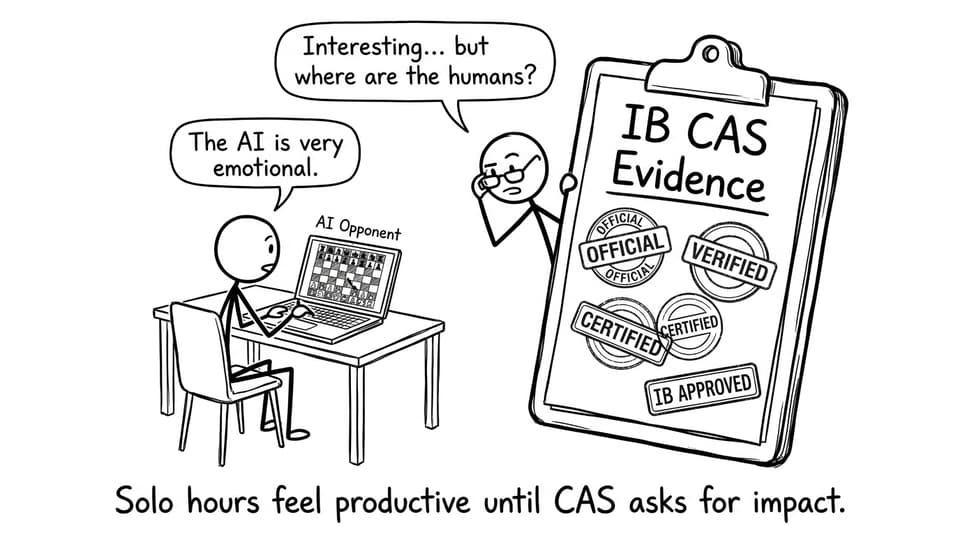
Before you log anything in IB CAS, run this quick checklist:
-
Does it clearly fit Creativity, Activity, or Service?
-
Is it intentional (planned, not just scrolling or routine)?
-
Is there evidence (photos, planning notes, feedback, product, supervisor confirmation)?
-
Is there meaningful reflection (what changed in you, not just what happened)?
-
Does it connect to CAS learning outcomes over time?
If you want the bigger picture behind this filter, read What is CAS? Unveiling the IBDP Creativity, Activity, Service and keep it bookmarked for coordinator conversations.
IB CAS and the point of the program (it’s not the hours)
A lot of students approach IB CAS like a spreadsheet problem: “If I log enough time, I’m safe.” That instinct makes sense, because exams train you to measure everything.
But CAS is built on a different logic. It’s closer to training than testing. The goal is to show you can:
-
challenge yourself and develop new skills
-
plan, act, and adapt (not just participate)
-
engage with others and the community
-
reflect honestly on growth
Hours can be part of how schools track consistency, but the heart of IB CAS is the learning outcomes and reflection trail. If you want a practical system for documenting that trail, IB CAS Reflections: Strengthen Documentation With Dojo is a strong template.
IB CAS: can playing chess against AI count toward CAS hours?
Most of the time, playing chess against AI by itself will not count for IB CAS.
Not because chess is “bad,” or because AI is automatically banned, but because AI-only chess usually fails the CAS filter in predictable ways:
It’s often too solitary for IB CAS
CAS is not allergic to solo work, but it heavily values interaction, collaboration, and shared impact. Playing an AI opponent is typically private and repetitive, which makes it hard to demonstrate engagement beyond yourself.
It’s difficult to prove growth in a CAS-style way
Yes, your rating might improve. But IB CAS reflection expects you to articulate process and personal change: decisions you made, challenges you faced, how you adapted, and what you’ll do differently next time. “I played another 20 games” rarely produces strong reflection without a larger structure.
It doesn’t naturally create service or community impact
Service is not required in every single experience, but your overall IB CAS journey must show that you contributed beyond yourself at least sometimes. AI chess has no built-in community element unless you add one.
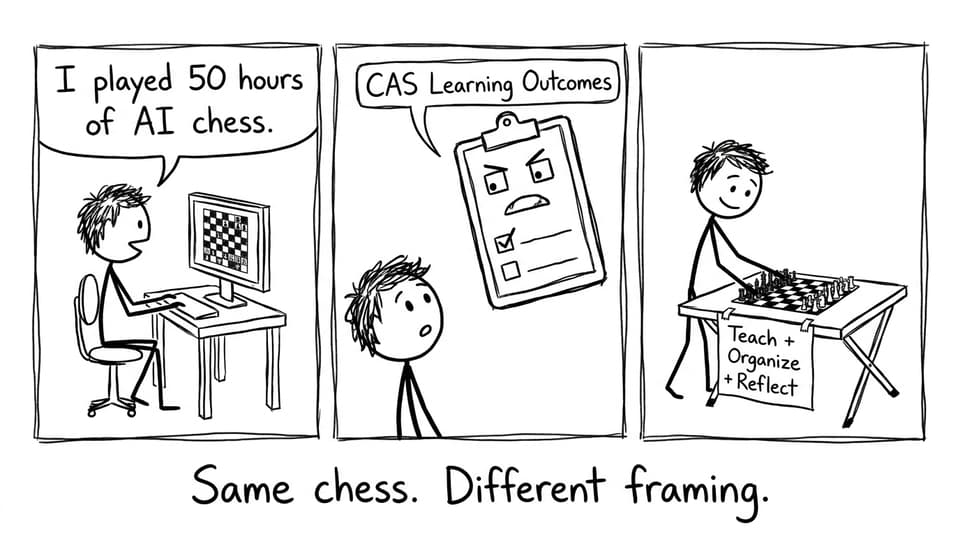
So if you log “50 hours of AI chess” as a standalone IB CAS experience, your coordinator will likely reject it or ask you to reframe it.
How chess can count for IB CAS (the framing that works)
Chess can absolutely support IB CAS when the real experience becomes learning, collaboration, creativity, or service, and AI becomes just one tool.
Chess for IB CAS Creativity
Creativity isn’t limited to art. It’s about creating something, designing something, or developing a skill in a structured way.
Ideas that often work well:
-
designing a beginner chess lesson series with handouts or slides
-
creating weekly “opening of the week” posts for your school community
-
organizing a chess puzzle newsletter or small content project
You can train with AI to sharpen your examples, but your CAS evidence should show your output and your planning.
Chess for IB CAS Activity (yes, sometimes)
CAS “Activity” is about physical exertion, but schools sometimes accept mentally demanding competitive disciplines when they’re structured, coached, and goal-driven. This varies by coordinator.
If you want to try this route, you’ll need:
-
a defined training plan (frequency, goals, progression)
-
evidence of participation (club sessions, tournaments, practice logs)
-
reflection focused on challenge, resilience, and skill development
When in doubt, ask your coordinator early and document their guidance.
Chess for IB CAS Service (the strongest option)
Service is where chess becomes clearly CAS-friendly.
High-approval options:
-
volunteering to teach chess to younger students
-
supporting an after-school club as a mentor
-
running a small tournament and donating entry fees to a cause
-
creating inclusive chess sessions for beginners who feel intimidated
Here, AI chess can be your practice tool, but the CAS experience is the teaching, organizing, and community impact.
For a clean way to distinguish experiences vs longer projects, read What Counts as a CAS Project vs. a CAS Experience?.
Turning AI chess into IB CAS: a simple “tool, not the whole activity” plan
If you love chess and you genuinely spend time training against AI, you can still use it inside a valid IB CAS structure. Try this:
Use AI chess as training input
-
Play 2-4 focused games per week against AI with a specific theme (endgames, tactics, one opening)
-
Save screenshots of key positions
-
Write 3 bullet points on what you learned
Convert it into a human-facing output
-
teach that theme to two classmates
-
run a short lunch session for beginners
-
create a mini-guide or puzzle sheet for your club
Reflect in CAS language
Reflection should explain:
-
what was challenging
-
what changed in your thinking
-
what you’ll do next
-
which learning outcome you’re showing
If you need a reflection structure that’s fast enough to survive exam season, IB CAS: 10 Tips for a Standout Reflection in 2026 is built for exactly that.
Keeping IB CAS from stealing your exam prep
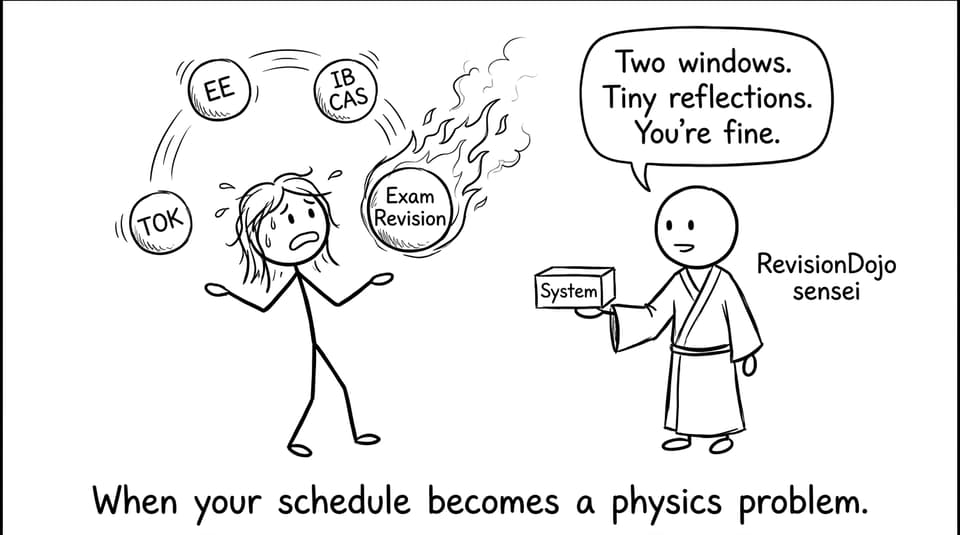
The quiet danger of IB CAS is not the experience itself. It’s the admin spiral: proof gathering, reflection backlogs, and the mental noise of feeling behind.
A sustainable approach:
-
two fixed weekly CAS windows (one weekday, one weekend)
-
one 15-minute reflection window right after the experience
-
tiny evidence captured immediately
If CAS is currently colliding with revision, Balancing CAS With Real Life (Without Burning Out) gives a realistic structure.
And while CAS is not an exam paper, your time is still finite. This is where RevisionDojo helps you keep the rest of the Diploma tight: use the RevisionDojo App: The Smarter Way to Prep for IB Exams workflow to protect revision blocks with Study Notes, Flashcards, and targeted Questionbank practice.
Conclusion: the IB CAS answer (and the chess answer)
Playing chess against AI can make you better at chess. But IB CAS is asking a different question: Did you grow through intentional experience, and can you prove it through reflection and impact?
So the practical rule is this: AI chess alone usually doesn’t count for IB CAS, but chess absolutely can, ifif you turn it into teaching, organizing, collaborating, or creating something others can benefit from.
If you want your CAS portfolio to feel calm during exam season, build a small system: consistent evidence, short reflections, and experiences that naturally create impact. Then keep your academics moving with RevisionDojo’s Study Notes, Flashcards, AI Chat, Grading tools, Mock Exams, Predicted Papers, Coursework Library, and Tutors, so CAS stays meaningful, and revision stays ruthless.
For more CAS planning ideas, explore How to Excel in IB CAS: Creativity, Activity, Service and the IB CAS tag hub.