

If you’ve ever stared at a formula sheet and felt your mind go politely blank, you’re not alone. The strange thing about IB Math is that the formulas can look familiar for weeks, right up until the moment you actually need them. Then, under exam pressure, the symbols scatter.
Flashcards fix that problem not because they’re magical, but because they’re honest. They ask one question: Can you retrieve this right now? In IB Math, that single skill is the difference between “I understand the chapter” and “I can finish the question in time.”
RevisionDojo makes this easier because the tools connect: learn with Notes, remember with Flashcards, apply with the Questionbank, and test your stamina with Mock Exams and Predicted Papers. The workflow is simple. And when the workflow is simple, you actually repeat it.
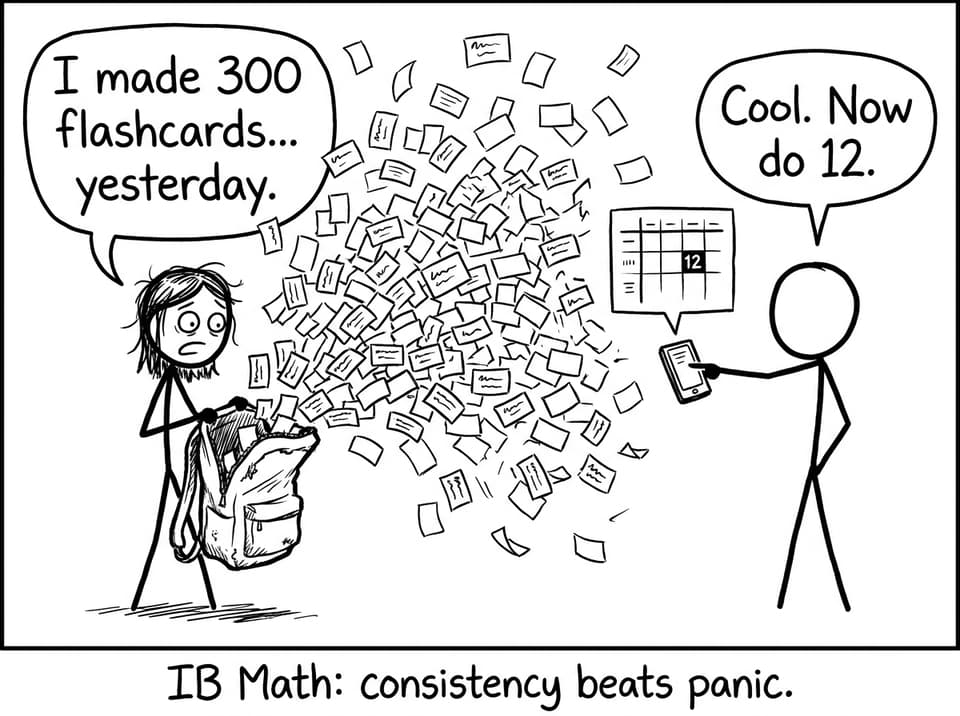
Quick checklist: the 15-minute IB Math formula system
Use this as your default routine for IB Math formulas.
-
Pick one topic (derivatives, normal distribution, trig identities).
-
Review 10-15 flashcards only.
-
Say the answer out loud (or write it) before flipping.
-
Mark cards as easy/medium/hard.
-
Do 3-5 related questions immediately after.
If you want a ready-made place to start, open RevisionDojo Flashcards and select your course (AA or AI, SL or HL). If you’re building a broader routine, borrow the structure from The Ultimate IB Math Study Routine for Busy Students.
Why flashcards work for IB Math (and rereading doesn’t)
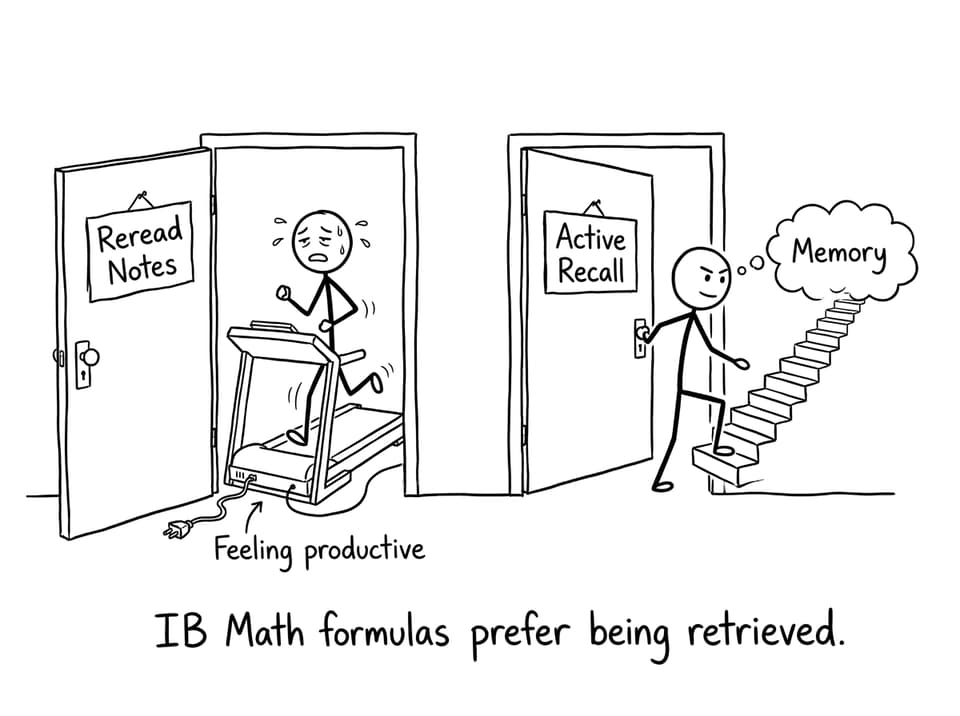
Rereading feels productive because your brain recognizes the page. But recognition is a weak signal. IB Math exams don’t reward recognition; they reward retrieval.
Flashcards force active recall: you see a prompt, you attempt the formula, and only then do you check. That tiny moment of struggle is where memory forms.
If you want to understand the broader method, the feature page Flashcards lays out how active recall and spaced repetition are built into the tool.
Build IB Math flashcards that actually work
Most flashcards fail because they try to hold too much. In IB Math, the best card is small, sharp, and testable.
Use “one card, one retrieval”
Good cards ask for one thing:
-
“Derivative of (\sin x)?”
-
“Binomial coefficient general term?”
-
“Standardization for (X \sim N(\mu,\sigma^2))?”
Bad cards ask for a paragraph of steps. If a process matters, split it into steps across multiple cards.
Add meaning, not extra words
For formulas like (A=\pi r^2), don’t just memorize symbols. Attach a one-line meaning: “Area scales with (r^2).” That gives your brain a hook.
When you’re learning a concept for the first time, use Study Notes before flashcards. Notes make sure your recall is connected to understanding, not just pattern-matching.
Spaced repetition: the fast way to stop forgetting
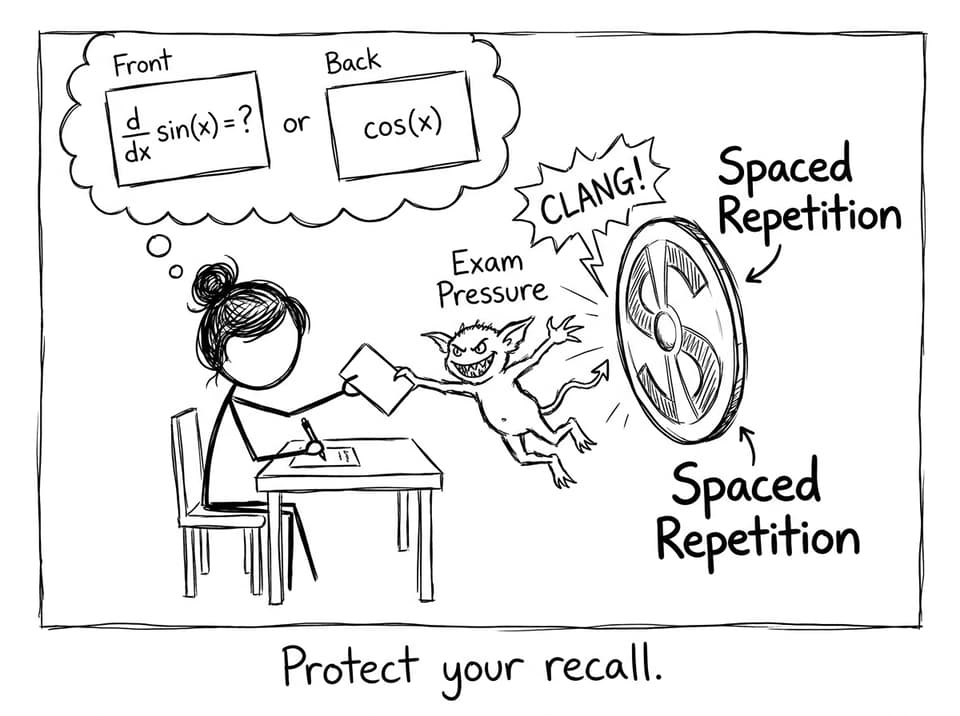
Spaced repetition is the quiet secret behind fast memorization in IB Math. You review a card right before you’re likely to forget it, which keeps the memory alive with minimal time.
That’s why short daily sessions beat weekend marathons. A 7-12 minute flashcard habit can outperform an hour of rewriting formulas, because it targets forgetting instead of feeding familiarity.
To see how the method fits into a wider system, the post How to Use RevisionDojo Flashcards for Formula Mastery is a useful companion.
The missing piece: pair flashcards with Questionbank practice
Flashcards help you retrieve formulas. But IB Math also tests whether you can select the right formula and apply it cleanly.
Right after a flashcard session, open a short practice set in the Questionbank:
-
3 questions if you’re tired
-
5 questions if you’re steady
-
8 questions if you’re confident and timing matters
RevisionDojo makes this loop natural: use How to Use the Questionbank for Targeted Math Revision as your blueprint, then drill a specific area like Math AA Calculus Questionbank when you want topic focus.
If you’re in AI and want a clean entry point, use the subject hub IB Mathematics Applications & Interpretation Resources. For AA students, start at IB Mathematics Analysis and Approaches Resources.
A simple 7-day plan to memorize formulas fast
This is designed for IB Math students who want speed without chaos.
Days 1-2: Build the “high-frequency” deck
Choose 25-35 formulas you use constantly (derivative rules, integrals, trig identities, normal distribution, common algebra forms). Keep it small.
Days 3-4: Add reverse cards
For every key formula, add a reverse prompt:
-
“Which identity equals 1 with (\sin^2) and (\cos^2)?”
-
“Which method uses (u)-substitution here?”
Reverse cards train flexibility, which is exactly what exam questions demand.
Days 5-6: Timed mini-sets
Do flashcards for 8 minutes, then do 10 minutes of questions. Keep moving. You’re training retrieval under mild pressure.
Day 7: Simulate and diagnose
Use a timed set (Mock Exams or a section of a full paper) to see what disappears under stress. Then turn those mistakes into new flashcards.
If you’re building full exam rhythm, add Mathematics Analysis and Approaches Predicted Papers as your weekly rehearsal tool.
Closing: make IB Math formulas feel automatic
The goal isn’t to collect formulas. It’s to reach a point where IB Math formulas come back quickly enough that you can spend your time thinking, not searching your memory.
RevisionDojo is built for that compounding loop: Study Notes to understand, Flashcards to remember, Questionbank to apply, AI Chat to unblock confusion, Grading tools to see what earns marks, Predicted Papers and Mock Exams to rehearse timing, plus a Coursework Library and Tutors when you need deeper support.
Open your flashcards today, pick one topic, and do 12 cards. In a week, you won’t just “know” more formulas. You’ll trust that they’ll show up when you ask for them. That’s the feeling IB Math students are really chasing.