This site uses cookie tracking technologies. Learn more in our Cookie Policy.
IB Extended Essay: Balance EE, Coursework, and Exams | RevisionDojo
Join 600k+ Students Already Crushing Their Exams
If you have ever looked at your to-do list and felt it looking back, you are not alone. The IB Extended Essay has a special talent: it never feels urgent until it is suddenly the most urgent thing in your life. Meanwhile, your IAs, TOK, and exam revision keep arriving on schedule, like trains that do not care you are tired.
The good news is that balancing the IB Extended Essay with coursework and exams is less about working harder and more about working in smaller, smarter units.
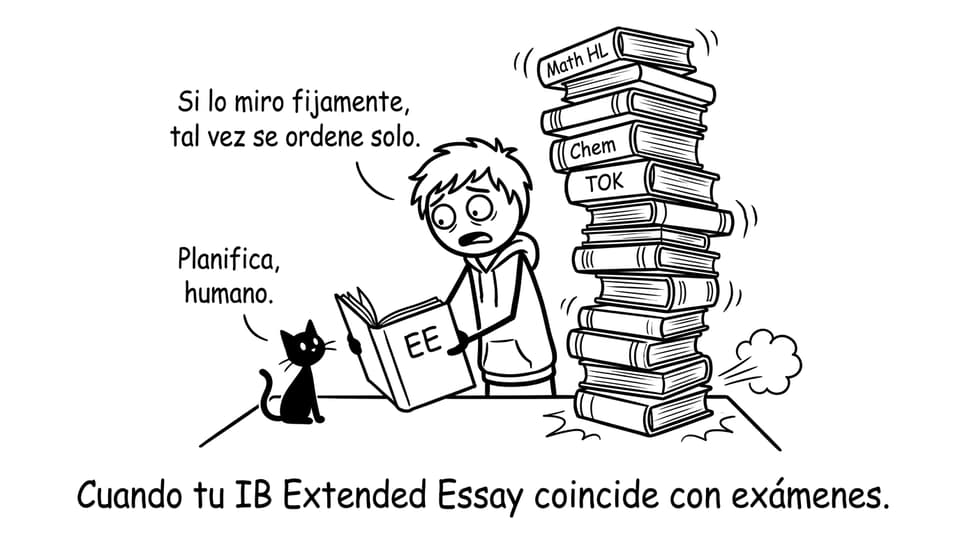
Comic: el torreón de tareas del IB
A quick balancing checklist (read this before you plan)
One master calendar for everything (EE, IAs, TOK, CAS, exams)
Weekly EE minimum (so the IB Extended Essay never “restarts” in your brain)
Short focused blocks, not marathon sessions
Fast feedback loops (so you do not overwork the wrong thing)
10 time-saving tips to balance your IB Extended Essay
Treat the IB Extended Essay like a subscription, not a crisis
Set a non-negotiable weekly baseline (even 60--90 minutes). When exams spike, reduce the dose, but do not stop. Consistency prevents the “starting from zero” feeling.
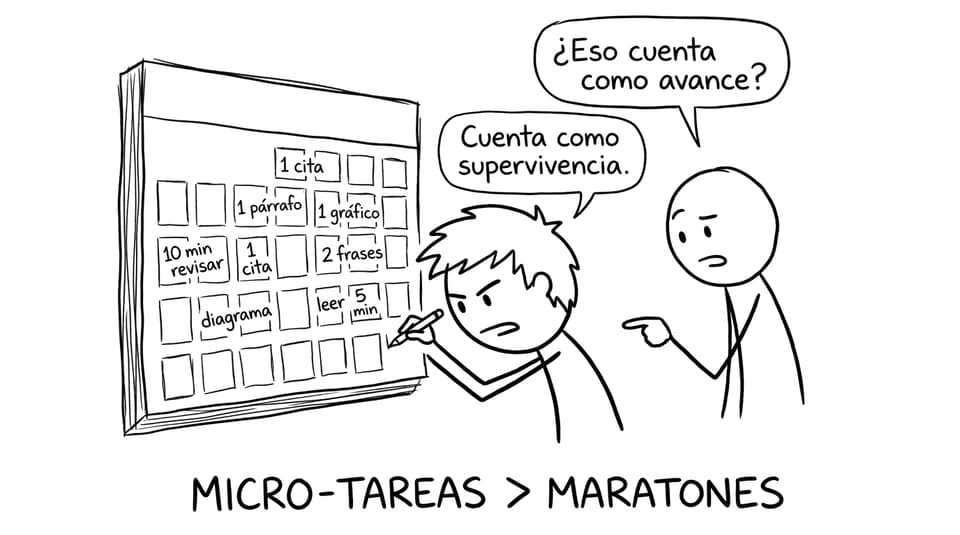
“Work on EE” is vague. “Fix one paragraph’s analysis” is finishable. Micro-tasks keep the IB Extended Essay moving during exam weeks.
Comic: micro-tareas
Separate research from writing days
Research days: collect sources, quotes, and citations. Writing days: draft without opening new tabs. This stops the “research spiral” that steals hours.
Use short sprints (25 minutes) for high-friction tasks
A timer turns dread into a game. One sprint can be: outline one section, rewrite one claim, or clean citations.
Decide your “exam season rule” in advance
Example: “During mocks, I only do IB Extended Essay tasks that reduce future pain: citations, outline tightening, supervisor questions.” Your future self will thank you.
Stop multitasking (it feels smart, then it breaks you)
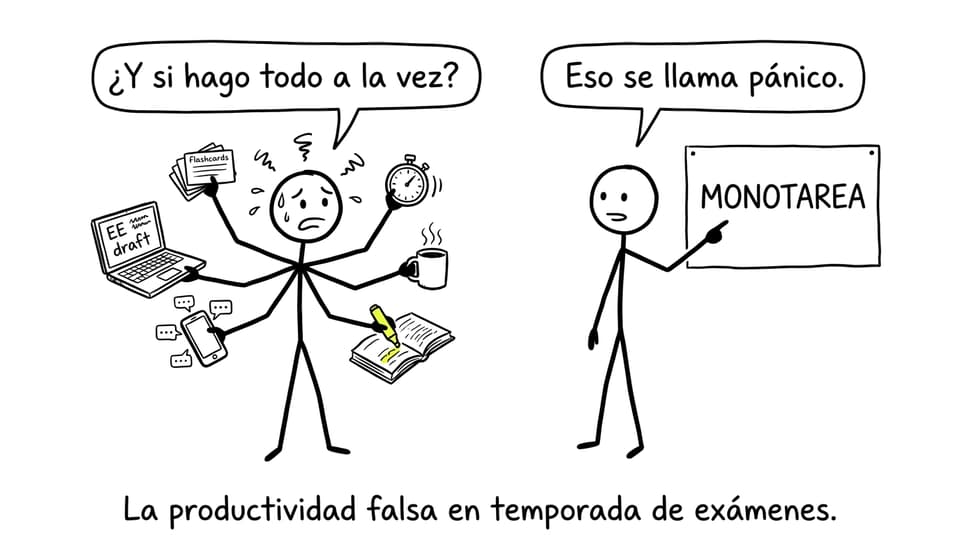
If you keep toggling between EE, Math, and TOK every five minutes, you pay a switching tax. Finish a small unit, then switch.
Comic: multitarea = pánico
Build one feedback loop per week
Use RevisionDojo’s AI Chat to clarify an argument, then run your draft through Grading tools to spot rubric gaps early. Fast feedback prevents “perfecting the wrong draft.”
Make your study tools do double duty
When you revise content, use RevisionDojo Study Notes to patch gaps, then lock it in with Flashcards. For exam readiness, use Questionbank, Predicted Papers, and Mock Exams so your revision time produces marks, not just comfort.
Conclusion: the goal is steady progress, not heroic weekends
Balancing the IB Extended Essay with coursework and exams is doable when you stop relying on motivation and start relying on structure. Keep the weekly minimum, break work into micro-tasks, and use tools that compress effort into results.
If you want one place to run the whole system, RevisionDojo brings it together: Questionbank, Study Notes, Flashcards, AI Chat, Grading tools, Predicted Papers, Mock Exams, a Coursework Library, and Tutors for when you need a human checkpoint. Make your plan smaller, make it consistent, and let the IB Extended Essay become just another routine win.
IB Extended Essay (EE) : guide complet pour débutants
IB Extended Essay : guide débutant pour choisir un sujet, formuler une question, structurer 4000 mots, réussir le RPPF et viser les meilleurs critères.