


IB Math SL Exam Mistakes: 10 Smart Fixes to Score Higher
The most painful IB Math moments aren’t the hard questions. They’re the easy marks that slip away quietly.
You’ll feel it when you flip to the next page and realize you answered a “state” question like it asked for an essay. Or when you spot the correct method… applied to the wrong value because you skimmed one word. In IB Math, the difference between “I understand this” and “I scored well on this” is often a set of small habits.
This guide gives you 10 smart fixes to avoid the most common IB Math SL exam mistakes. Not theoretical advice: practical moves you can repeat under pressure.
Quick checklist: the 60-second IB Math safety scan
Before you hand in any IB Math paper, run this fast scan:
-
Did I answer what the question actually asked (value vs method vs explanation)?
-
Did I include units, labels, and correct rounding?
-
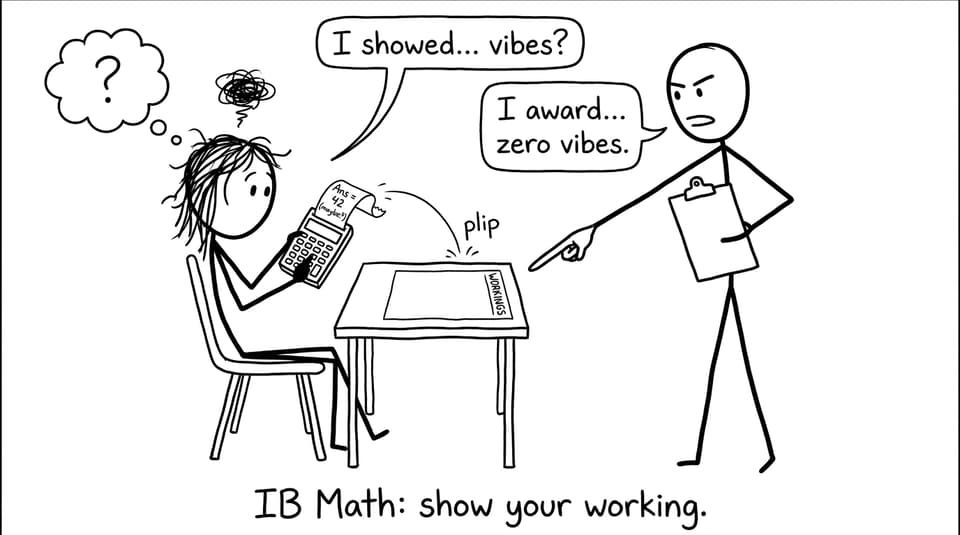
Did I show enough working for method marks?
-
Did I use degrees vs radians correctly?
-
Did I check domain/constraints and context?
-
Did I attempt every question, even briefly?
If you want a structured place to practise these habits, start from the IB Mathematics Analysis and Approaches Resources hub and revise by topic, not by mood.
10 common IB Math SL mistakes (and the smart fixes)
Misreading the question under time pressure
In IB Math, one misread word can turn a perfect method into the wrong product.
Smart fix: Read twice, write once.
-
Circle the target: “find”, “show”, “solve”, “write down”, “hence”, “interpret”.
-
Rewrite the task in five words at the margin: “Need equation of tangent” or “Need probability, not mean”.
-
When finished, match your final line to the command term.
This is especially important in functions and calculus, where a question can shift from “solve” to “solve and interpret.” If calculus is a weak spot, build confidence with targeted practice in IB Math AA Calculus.
Dropping units and labels (and donating marks)
IB Math is full of answers that are numerically right but incomplete.
Smart fix: Treat units as part of the number.
-
Write units on every intermediate answer when context is present.
-
Label axes and key points when sketching graphs.
-
For trig and calculus, be explicit about radians vs degrees.
A surprisingly effective habit is to write a small “U?” next to any final answer space while you work. It reminds you to finish cleanly.
Over-trusting the calculator output
The calculator can be correct and still cost you marks if your reasoning is invisible.
Smart fix: Show the setup, then the tech.
-
Write the equation or expression you are solving before you press buttons.
-
Record what you did: “solve f(x)=0 on ” or “use regression to find a and b”.
-
Do a quick estimate to catch nonsense answers.
On RevisionDojo, students often pair the Questionbank with AI Chat to ask: “What would an examiner need to see for method marks here?” That single question can change how you present solutions.
For systematic practice, use the strategy in How to Use the Questionbank for Targeted Math Revision.
Forgetting domain, constraints, and conditions
You can solve an equation correctly and still lose marks if your solution doesn’t fit the allowed domain.
Smart fix: Add a “reality line” after solving.
-
State restrictions (e.g., (x>0), (n\in\mathbb{N})).
-
Reject extraneous solutions explicitly.
-
In modelling questions, check whether your answer makes sense in context.
This shows mathematical maturity, and it’s exactly the kind of clarity IB Math rewards.
Ignoring command terms (and writing the wrong kind of answer)
Command terms are not decoration. They’re instructions.
Smart fix: Build a mini translation habit.
-
State = short and exact.
-
Show = enough steps that someone else could follow.
-
Hence = use your previous result.
-
Explain/justify = a sentence of reasoning, not extra calculations.
If you want a broader look at how IB papers are structured and why command terms matter, see Effective Study Strategies for the IB Math SL Exam.
Not showing enough working to earn method marks
IB Math marking is often generous, but only if the examiner can see your thinking.
Smart fix: Write for the marker, not for your future self.
-
Show algebraic rearrangements clearly.
-
When substituting numbers, write the substitution step.
-
Box final answers and keep working readable.
RevisionDojo’s Grading tools and AI Chat are useful here: you can submit a solution and ask, “Where would I lose method marks?” That’s the feedback loop most students never get until it’s too late.
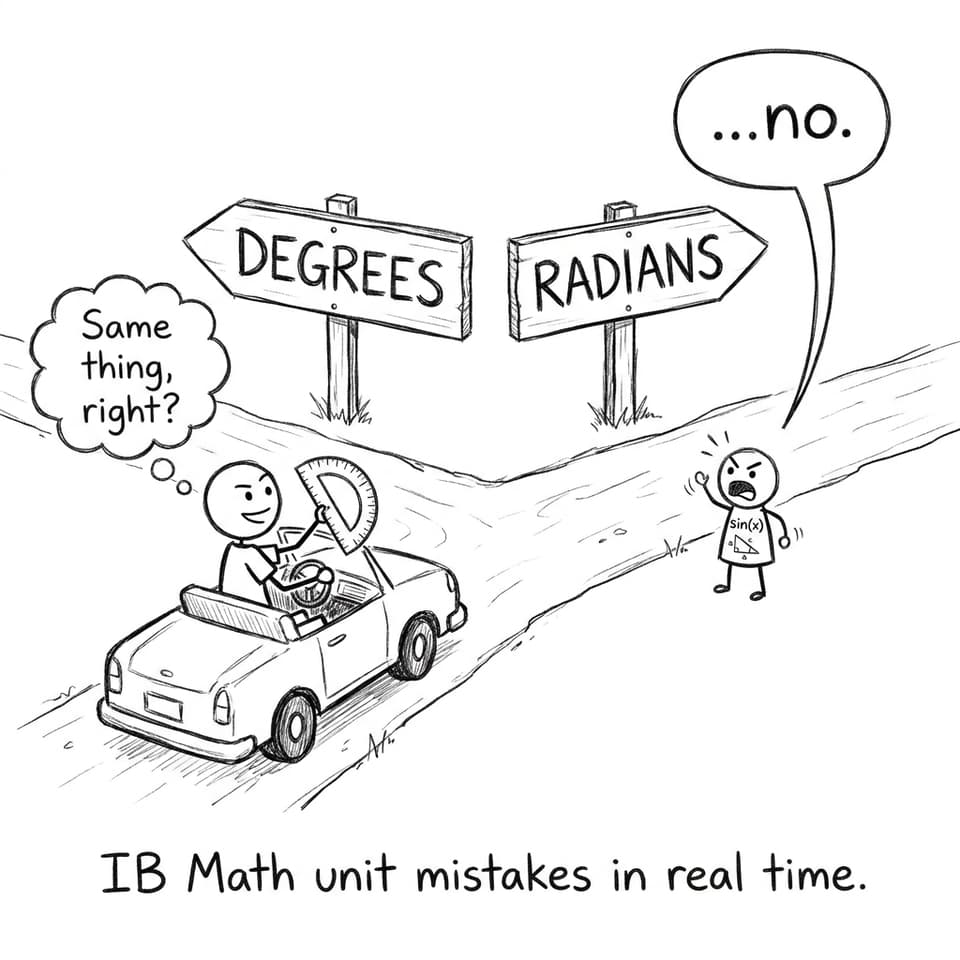
Degree/radian confusion in trig and calculus
This mistake is small, common, and brutally expensive.
Smart fix: Set a default, then verify.
-
Decide your calculator default (usually radians for calculus-heavy work).
-
Before any trig calculation, write “RAD” or “DEG” next to the question number.
-
If the question involves (\pi), assume radians unless clearly told otherwise.
Rounding too early (or to the wrong precision)
In IB Math, rounding is often a last step. Do it early and error spreads.
Smart fix: Keep exact values until the end.
-
Store values in the calculator memory.
-
Use fractions and surds when appropriate.
-
Round only in the final line, and match the question’s requested accuracy.
This becomes critical in statistics and probability. If that’s an area you’re revising, the Statistics and Probability topic hub is a clean way to practise question styles repeatedly.
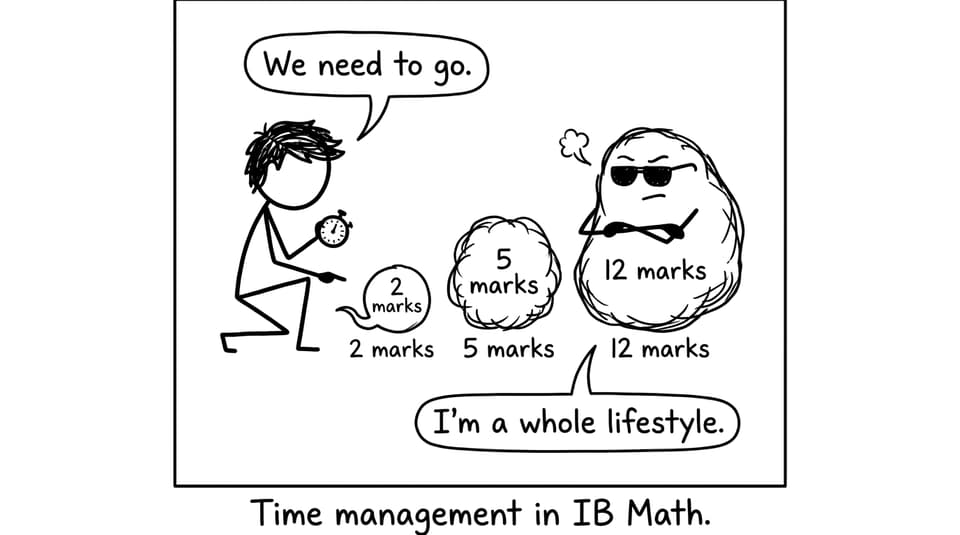
Poor time management: spending 12 minutes to win 3 marks
The exam is not just a test of math. It’s a test of decisions.
Smart fix: Use mark-based pacing.
-
Rough rule: 1 mark ~= 1 minute (adjust for your paper timing).
-
If you’re stuck, leave a “bridge step” (a formula, a diagram, a setup) and move on.
-
Return later with fresh eyes.
To train this, run timed practice using RevisionDojo Mock Exams and Predicted Papers. Start here: IB Predicted Papers and (for format clarity) IB Predicted vs Specimen Papers: What They Mean.
Leaving questions blank (even when partial credit exists)
Blank answers are guaranteed zeros. Even messy attempts can earn method marks.
Smart fix: Always leave a footprint.
-
Write the relevant formula.
-
Substitute what you can.
-
Draw a diagram or define variables.
A good rule in IB Math: if you can write something correct in 30 seconds, do it before you move on.
Build your “no silly mistakes” system (the RevisionDojo loop)
Avoiding IB Math mistakes isn’t about being naturally careful. It’s about making care automatic.
A simple loop that works:
-
Learn: Use RevisionDojo Study Notes and Flashcards for quick recall.
-
Drill: Use the Questionbank to practise one weakness at a time.
-
Simulate: Use Mock Exams and Predicted Papers to train pacing and stamina.
-
Reflect: Use AI Chat and Grading tools to spot presentation and method-mark gaps.
If formulas are where you panic, keep the official layout close using the IB Mathematics AA Data Booklet and practise locating what you need quickly.
Final thought: higher IB Math scores are often “error control”
A strong IB Math student isn’t someone who never makes mistakes. It’s someone who makes fewer of the expensive ones.
Pick three fixes from this list and practise them deliberately this week. Then practise them again under time pressure. When you want a full system, including Questionbank drills, Study Notes, Flashcards, AI Chat feedback, Grading tools, Predicted Papers, Mock Exams, plus extra support from the Coursework Library and Tutors, RevisionDojo is built to turn “I knew that” into “I got the marks.”
If you’re ready, start with the IB Mathematics Analysis and Approaches Resources page, choose your weakest topic, and run your first focused set today.