

When your revision notes are neat, you feel smart. When your data is neat, systems stay alive.
That’s the real story behind IB Computer Science questions on flat files vs databases: not definitions, but why structure matters when life gets messy. A single spreadsheet looks harmless… right up until a teacher changes their email, three clubs update the same student record, and suddenly your “simple system” becomes a disagreement factory.
In IB Computer Science, examiners reward students who can explain why databases were invented by comparing them to flat files with clear, scenario-based justification.
Quick exam checklist (what to say fast)
Use this mini-checklist in IB Computer Science long-answer questions:
-
Define flat file as one file/table (CSV/text/spreadsheet).
-
State typical issues: redundancy, inconsistency, weak querying, poor multi-user support.
-
Define database as structured related data managed by a DBMS.
-
Explain how a DBMS reduces redundancy, improves integrity, supports queries, security, and concurrency.
-
Finish with a scenario sentence: “Therefore, a database is more suitable because…”
For extra practice on the syllabus area, see RevisionDojo’s Databases hub.
What is a flat file in IB Computer Science?
A flat file stores all data in a single file or single table. In IB Computer Science, the most common examples are CSV files, text files, and spreadsheets.
Flat files work well when the world is small:
-
One user
-
A small dataset
-
Few relationships between data items
The strength is simplicity. There’s little setup, and anyone can open a CSV. The weakness is that simplicity has no built-in protection when data grows or multiple people touch the system.
Why flat files break down (the problems examiners want)
Flat file limitations are where IB Computer Science marks live. The core problems are:
-
Data duplication: the same piece of data appears in many rows (e.g., a student’s tutor name copied everywhere).
-
Data inconsistency: duplication makes errors likely (one copy updated, another forgotten).
-
Harder searching and reporting: complex questions become awkward without a query language.
-
Poor scalability: performance and maintenance degrade as the file grows.
-
Weak multi-user support: simultaneous edits can overwrite changes.
A strong way to revise these is to pair each problem with an example. You can deepen your DBMS vocabulary using DBMS and RDBMS notes.

What is a database (and what does a DBMS do)?
A database is an organized collection of related data, usually stored across multiple related tables. In IB Computer Science, the key is that a database is managed by a Database Management System (DBMS).
A DBMS helps by:
-
enforcing rules (data types, keys, constraints)
-
controlling access (permissions)
-
handling multi-user edits (concurrency control)
-
supporting efficient queries
If you need a crisp definition for exam wording, read What is a database? IB Computer Science definition.
Flat files vs databases (direct comparison for exam answers)
In IB Computer Science, comparisons score higher than separate descriptions. Try this framing:
Flat files
-
Fast to set up, minimal structure
-
Suitable for small, simple datasets
-
Prone to redundancy and inconsistency
-
Limited support for complex queries and multi-user editing
Databases
-
Structured data with relationships (tables linked by keys)
-
Reduces redundancy and improves integrity
-
Supports fast searching, filtering, and joining
-
Better security and concurrent access
A helpful next step is learning how databases are “asked questions” using SQL. See Introduction to SQL for IB Computer Science.

When a flat file is still the right choice
Databases aren’t mandatory for every scenario (and IB Computer Science sometimes tests this nuance). A flat file can be appropriate when:
-
the dataset is small
-
there’s only one editor
-
relationships are minimal
-
portability matters more than control (e.g., exporting data)
The best students don’t say “databases are always better.” They say “databases are better when redundancy, integrity, and concurrent access matter.”
Final takeaway
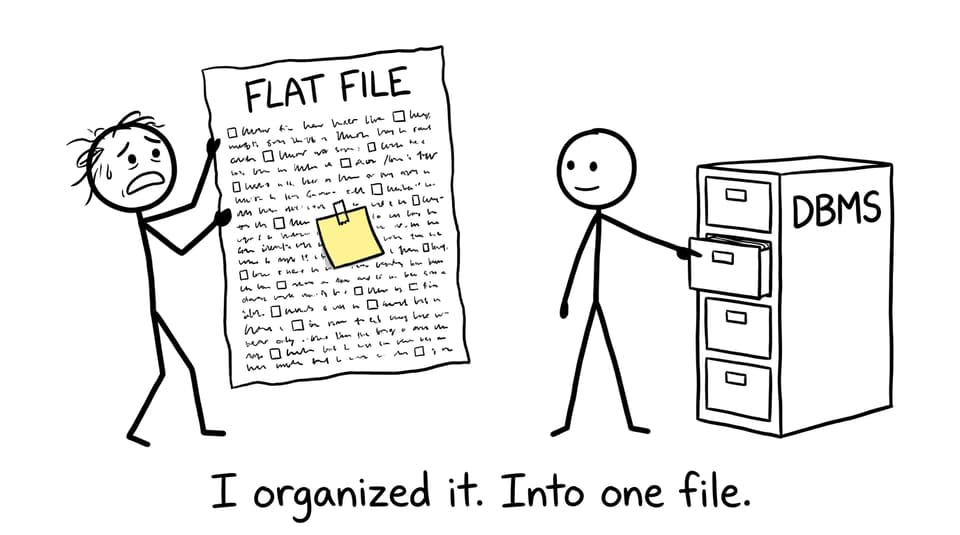
Flat files store data. Databases manage data.
That difference is the heart of IB Computer Science: once information gets bigger, shared, and connected, structure stops being optional. If you want to turn this topic into easy marks, practice direct comparisons, use scenario justification, and revise with RevisionDojo’s Study Notes, Flashcards, Questionbank, AI Chat, Predicted Papers, Mock Exams, Coursework Library, and Tutors inside the IB Computer Science resources page.