



In IB Computer Science, network questions often feel simple right up until the prompt adds one sentence: “Justify your choice.” Suddenly, it’s not enough to know definitions. You need to explain who controls what, where data lives, and what breaks first when things go wrong.
That’s why IB Computer Science keeps returning to two classic models: client-server and peer-to-peer (P2P). They’re not just diagrams. They’re two philosophies of responsibility.
Quick exam checklist (what to mention fast)
When comparing models in IB Computer Science, hit these points:
-
Control: centralized (client-server) vs distributed (P2P)
-
Security: managed policies vs inconsistent device-by-device rules
-
Cost: dedicated server/admin vs low setup cost
-
Reliability: single point of failure vs failure is spread out
-
Scalability: designed to grow vs gets messy as nodes increase
For deeper networking foundations, use IB Computer Science Networks hub alongside 3.1 Networks notes.
Client-server networks in IB Computer Science
A client-server network splits roles clearly:
-
Clients request a service (files, web pages, printing, authentication)
-
Servers provide that service and manage access
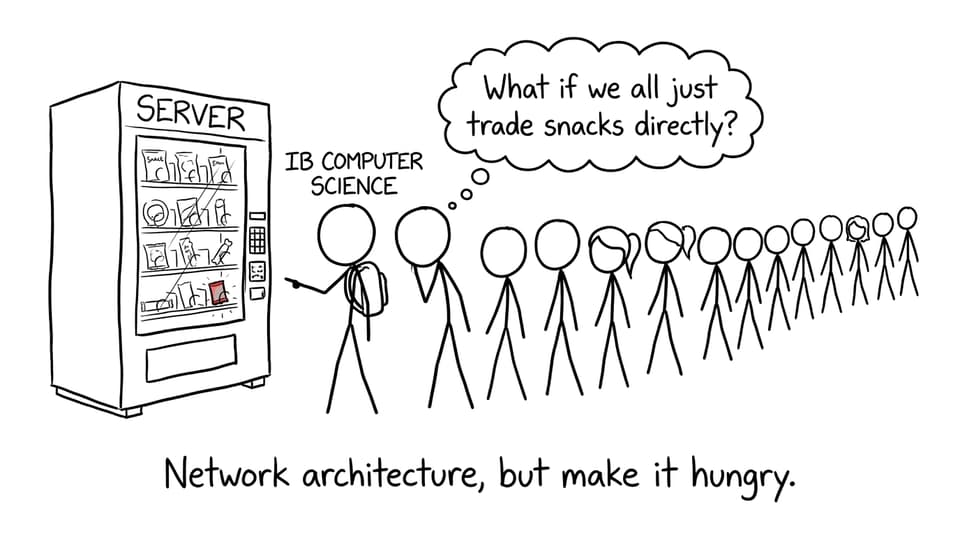
Think of it like a library. Students (clients) ask for books. The librarian system (server) decides what you can borrow, records it, and keeps the master catalog.
In practice, a client-server network typically follows this flow:
-
Client sends a request
-
Server processes it (checks permissions, finds data)
-
Server sends a response
Central control is the main reason client-server dominates larger environments like schools, email systems, and hosted websites.
To lock down the vocabulary examiners love, review Roles of computers in a networked world notes.
Client-server advantages (write these as “because” points)
Strong IB Computer Science answers don’t list benefits; they connect them to outcomes:
-
Centralized data: easier to keep versions consistent
-
Central security policies: access control is easier to enforce
-
Backups are simpler: one main place to protect
-
Performance is more predictable: dedicated server hardware can handle load
Client-server disadvantages (the “single point of failure” story)
The tradeoff is dependency:
-
Higher cost (server hardware, licensing, maintenance)
-
Needs administration (skilled management)
-
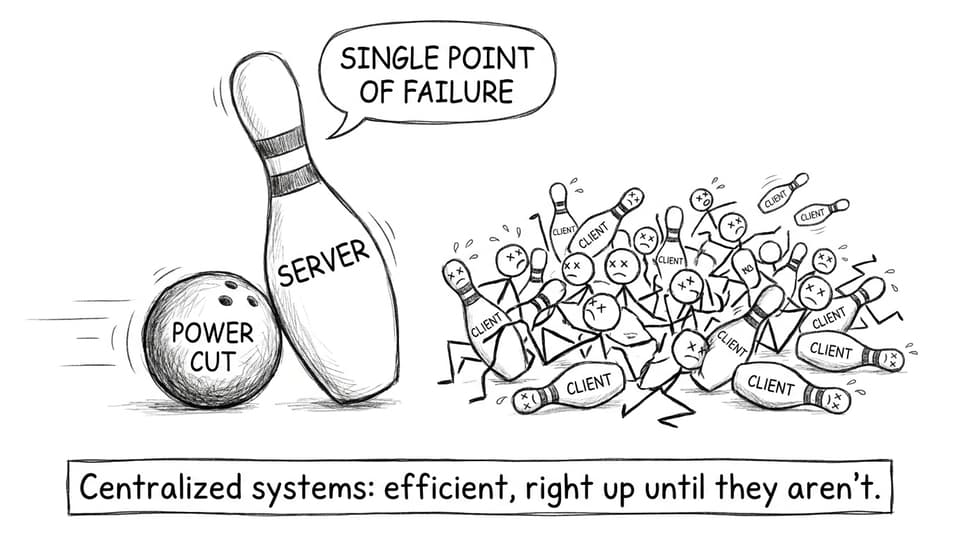
Server failure disrupts everything: classic single point of failure
Peer-to-peer (P2P) networks in IB Computer Science
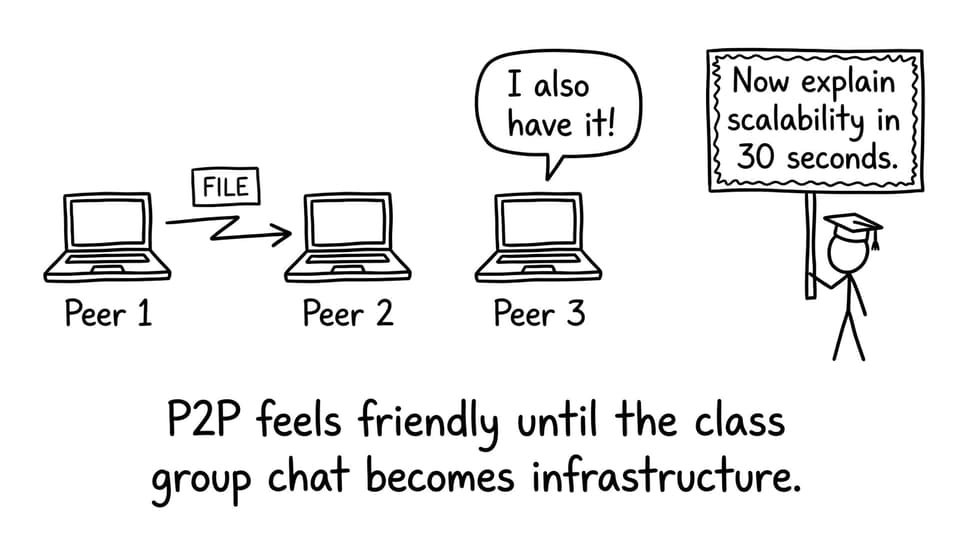
A peer-to-peer network is flatter. Every device can be both:
-
a requester (client-like)
-
a provider (server-like)
There’s no dedicated central server coordinating everything. Peers share resources directly. That simplicity is why P2P often appears in small home networks, temporary setups, or distributed sharing systems.
P2P advantages
In IB Computer Science, these are easy marks when linked to scenarios:
-
Low cost: no dedicated server needed
-
Quick to set up: minimal configuration
-
No single point of failure: if one peer goes down, others can still share
P2P disadvantages
Where P2P struggles is governance:
-
Weaker security: rules depend on each device
-
No central control: harder to enforce policies
-
Hard to scale: management and performance degrade as peers grow
-
Data inconsistency: multiple versions of files can spread
Client-server vs P2P networks compared (how to write the 6-marker)
A clean IB Computer Science comparison usually sounds like this:
-
Client-server is centralized, more secure and manageable, but costs more and has a single point of failure.
-
P2P is decentralized, cheap and resilient to one node failing, but becomes difficult to secure and manage as the network grows.
If you want to practice these exact “compare/justify” prompts, use Networks Questionbank practice and then reinforce with A2.2.3 Compare and Contrast Networking Models notes.
Common mistakes examiners punish
-
Saying P2P has a central server (it doesn’t)
-
Listing pros without linking to a scenario
-
Forgetting scalability in P2P discussions
-
Ignoring security as an explicit evaluation point
For overall exam technique in IB Computer Science, bookmark How to Avoid Common Mistakes on IB Computer Science Exams.
Closing: turn models into marks
Client-server and peer-to-peer networks aren’t competing trivia facts. In IB Computer Science, they’re reusable lenses for thinking about control, risk, and growth.
If you want to make this topic feel effortless under exam pressure, use RevisionDojo’s Study Notes, Flashcards, and Questionbank to drill comparisons, then level up with AI Chat feedback and Mock Exams for timing. When you can justify the model in one calm paragraph, you’re not just revising networks: you’re practicing how examiners award marks in IB Computer Science.