


A good TOK essay introduction feels like the moment a blurry camera finally locks focus. One second you are staring at a prescribed title that looks philosophical and vague. The next, you have a real-life situation you can point to, a knowledge question you can argue, and a clear promise to the examiner: this will be structured, specific, and evaluative.
Most IB students think the introduction is where you “warm up.” In TOK, it is where you prove you belong in the conversation. It is also where a rushed examiner decides whether your essay is likely to be sharp or foggy. You do not need theatrics. You need clarity that lands fast.
The TOK introduction checklist (use it every time)
If you only remember one thing, remember this: a strong TOK introduction is a roadmap, not a trailer.
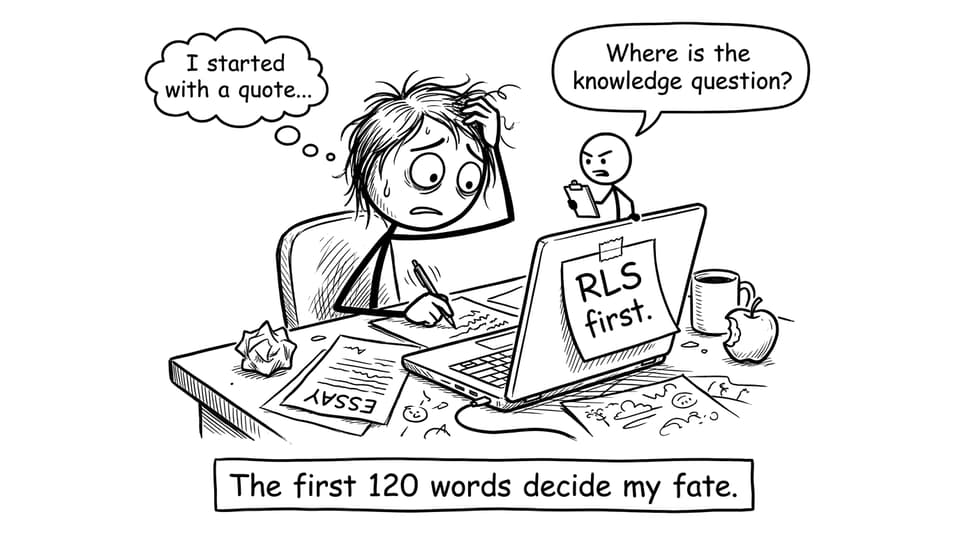
Aim for roughly 120-150 words and hit these points:
-
Real-life situation (RLS): a concrete event, practice, or controversy
-
Knowledge question (KQ): open-ended, debatable, and clearly about knowledge
-
Link to the prescribed title: show you are answering this prompt, not any prompt
-
Scope preview: name the AOKs and (if relevant) WOKs you will actually use
-
Thesis direction: a stance with conditions (not fence-sitting)
If you want a broader structure check, pair this with Comprehensive Guide to IB TOK Essay Structure.
Why TOK introductions win or lose on specificity
There is a common intro that sounds intelligent but collapses under marking:
“Knowledge has always been important, and different people see truth differently…”
It is not wrong. It is just unmarkable. In TOK, examiners reward controlled thinking: a specific RLS, a focused KQ, and a clear plan for evaluation.
Specificity also protects you from the biggest time-waster in TOK writing: drifting into a mini-essay about the topic instead of an argument about knowledge. When you anchor your opening in a real situation, your analysis naturally turns toward justification, evidence, bias, and limits.
For examples of tight, evaluative KQs, see Examples and Tips for Writing IB TOK Knowledge Questions and TOK Essay Titles: What Are Knowledge Questions?.
How to write a hook without sounding like a TED talk
A hook in TOK is not a motivational quote. It is a situation that quietly forces a knowledge problem.
Here are three hooks that actually help your marks.
Start with an RLS that already contains tension
Pick a case where reasonable people disagree because their standards of evidence differ.
Examples of strong TOK-ready RLS types:
-
A museum debating whether AI-generated art counts as “authorship”
-
A medical guideline changing after new evidence emerges
-
A historical narrative shifting as archives open and new perspectives appear
Your RLS should be described in one or two sentences. No backstory. Just enough for the reader to see the knowledge tension.
Use a provocative claim (but make it examinable)
A claim works when it is not just dramatic, but arguable across AOKs.
For instance: “In the Natural Sciences, trust is earned through method; in History, trust is negotiated through interpretation.” Now you have something to test.
If you need content-grade clarity on trust and methods, RevisionDojo’s notes like How Science Builds Trustworthy Knowledge Notes can give you clean language to adapt into TOK evaluation.
Ask a layered question that leads directly to your KQ
A rhetorical question is useful only if it becomes a precise KQ immediately after.
Bad: “What is truth?”
Better: “If two communities use different standards of evidence, under what conditions can we call one account more reliable?” That is already TOK.
Put the TOK knowledge question early (and phrase it like an examiner)
A strong rule: write the KQ in the first 2-3 sentences. In TOK, delay creates confusion.
Your KQ should be:
-
Open-ended: “to what extent,” “how,” “under what conditions,” “why”
-
About knowledge: reliability, justification, interpretation, authority, perspective
-
Transferable: you can explore it in at least two AOKs
Then show the examiner you have control:
-
define one key term from the title (briefly)
-
state a conditional thesis (yes, but…)
If you want a rubric-aligned overview of planning and argument flow, keep Structuring for Success in IB TOK Essays nearby while drafting.
Preview AOKs and WOKs like you mean it
Examiners can tell when AOKs/WOKs are name-dropped. Your intro should signal why those lenses are the right tools.
Strong preview language looks like:
-
“This essay tests the title through the Natural Sciences and History to compare method-based reliability with interpretation-based reliability.”
-
“The discussion uses language and reason to evaluate how claims become persuasive in different knowledge communities.”
If you want a quick refresher of TOK essay expectations, RevisionDojo’s Mastering the TOK Essay and Exhibition pairs well with this introduction-focused guide.
A simple template for a high-scoring TOK introduction
Use this as a drafting scaffold, then rewrite into your own voice:
-
RLS (1-2 sentences): Describe the case and the disagreement.
-
KQ (1 sentence): Turn the disagreement into a knowledge question.
-
Link to title + definition (1-2 sentences): Show alignment and define one key term.
-
Scope + thesis direction (1-2 sentences): Name AOKs/WOKs and state your conditional stance.
If you want examples across a specific session, see TOK May 2026 Essay Introduction Examples: How to Start Strong and the broader RevisionDojo Ultimate TOK May 2026 Essay Guide.
Common TOK intro mistakes (and the quick fixes)
-
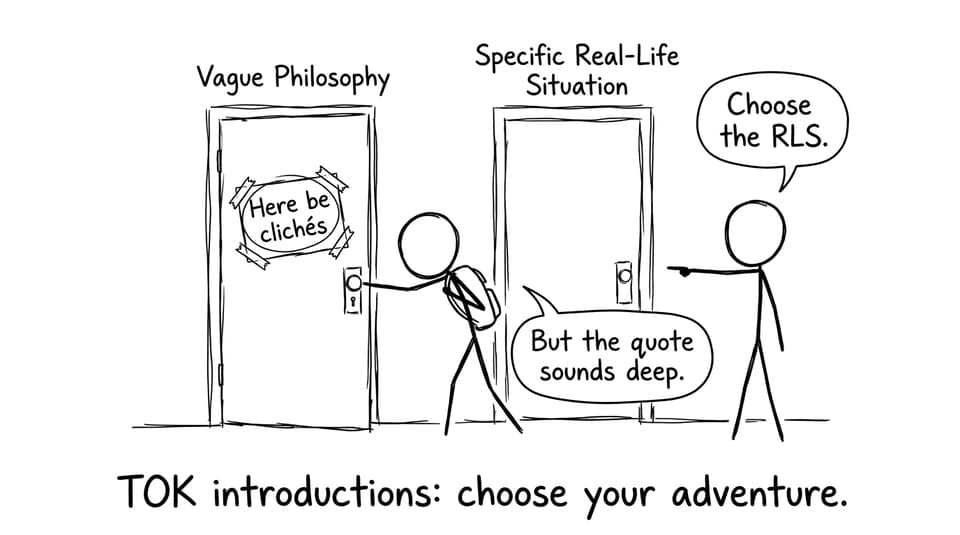
Mistake: Starting with a quote.
- Fix: Start with an RLS, then earn the “deep” tone through analysis.
-
Mistake: Writing a KQ that is actually a subject question.
- Fix: Add knowledge language: “reliable,” “justified,” “interpreted,” “validated.”
-
Mistake: No scope.
- Fix: Name the two AOKs you will truly use, not the ones that sound impressive.
-
Mistake: Vague thesis.
- Fix: Use conditions: “Yes in X contexts, but not when Y happens, because Z.”
For mark-band thinking, RevisionDojo’s How to Hit the Top Mark Bands notes are a strong companion.
Closing: make your TOK first paragraph earn trust
The best TOK introductions do not “sound smart.” They make smart thinking visible. A concrete RLS, a precise KQ, and a scoped plan across AOKs tell the examiner you are here to evaluate knowledge, not decorate it.
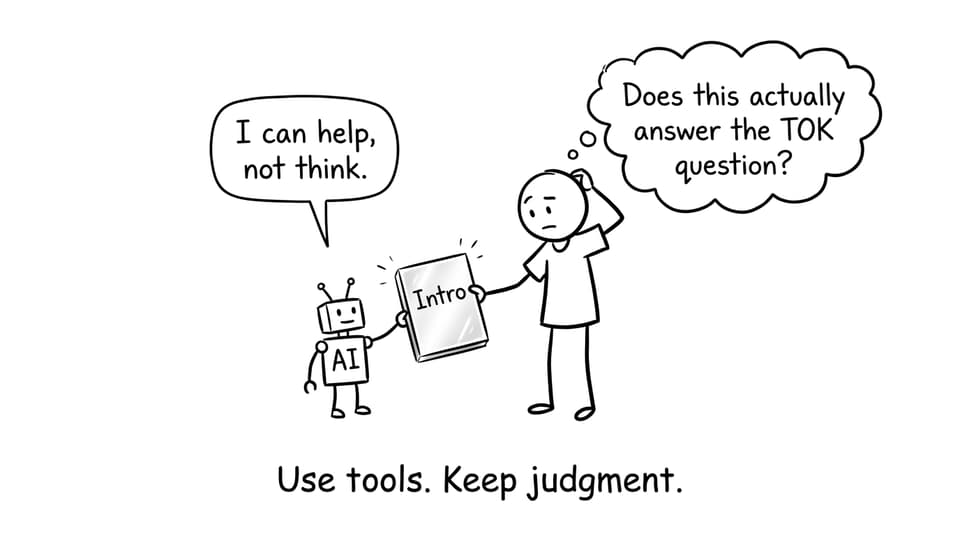
If you want your TOK essay process to feel less mysterious, build it inside RevisionDojo: use the Study Notes to sharpen concepts, Flashcards to keep key vocabulary active, AI Chat to stress-test your KQ, and the Grading tools to check alignment with the rubric. When you are ready to practise under pressure, the Questionbank, Predicted Papers, and Mock Exams keep your exam skills moving while your core work stays strong. And if you want human feedback that pushes your thinking, the Coursework Library plus Tutors gives you models and coaching that make “good” feel concrete.
Start with the first 120 words. In TOK, they are not a warm-up. They are your opening argument.