



Momentum conservation feels like one of those rules that was always there, even before you learned the equation. You watch two carts collide, or a rocket fire its engine, and the story stays strangely consistent: motion gets traded, not invented. In IB Physics, that reliability matters because exam questions often hide messy forces inside short interactions and dare you to still make a clean argument.
Momentum conservation is considered fundamental for a simple reason: it isn’t picky. It works across objects, scales, and interaction types, as long as your system is isolated. That universality is what makes it a pillar of physics rather than just another handy trick.
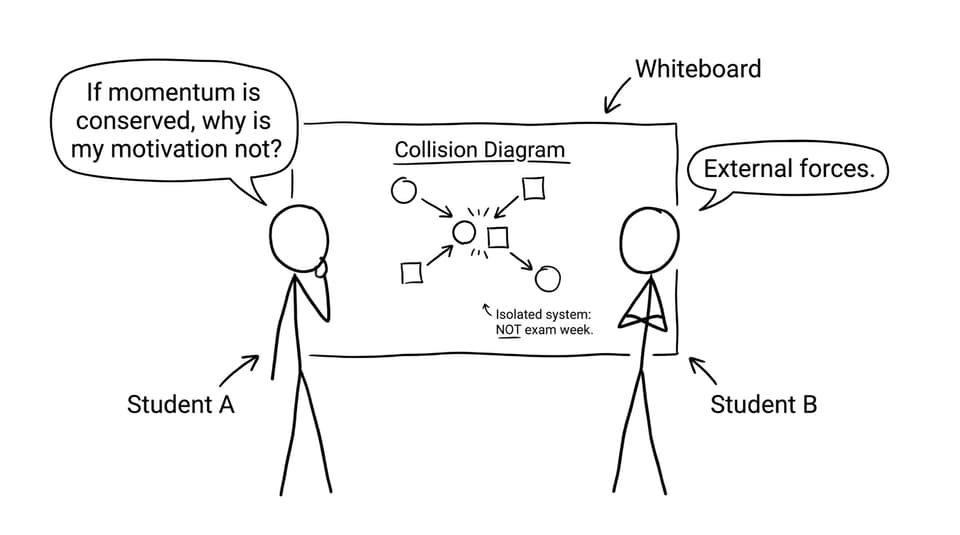
IB Physics momentum conservation: a quick checklist
Before you write a single equation, run this quick IB-style check:
-
Define the system (what objects are included?)
-
Decide if the system is isolated (are external forces negligible over the interaction time?)
-
Write momentum as a vector: direction matters
-
Use: (\sum \vec p_{\text{before}} = \sum \vec p_{\text{after}})
-
If needed, connect to impulse: (\vec F\Delta t = \Delta \vec p)
For targeted practice, the RevisionDojo resources under A.2 Forces and momentum make this checklist feel automatic through Study Notes, Flashcards, and exam-style Questionbank drills.
Why momentum conservation is so fundamental in physics
Momentum conservation is fundamental because it reflects a deep regularity in nature: in an isolated system, total momentum doesn’t change. The interaction can be complicated, but the bookkeeping stays simple. That’s the appeal for physicists and for IB Physics students: it lets you analyze events without knowing every detail of the forces involved.
At a deeper level, momentum conservation is tied to the idea that space is uniform. If the laws of physics work the same “here” as they do “over there,” then there’s no special location that can mysteriously create extra motion. That symmetry shows up in the mathematics of physics, but you can feel it in everyday examples too: skaters pushing off, recoil, explosions, collisions.
If you want an exam-friendly explanation with the key steps laid out clearly, RevisionDojo’s Linear momentum and impulse notes (A.2.2) walk through the logic from Newton’s second law to conservation in a way that mirrors mark schemes.
Collisions: where IB Physics tests momentum conservation hardest
Collisions are where the principle earns its reputation. During impact, forces can be enormous and hard to model. But if external forces are negligible for the short collision time, internal forces come in action-reaction pairs, and the total momentum stays constant.
This is why collision questions are so efficient: with one conservation law, you can relate speeds before and after even when the contact force is unknown.
To sharpen this skill, use:
-
Collisions and explosions notes (A.2.3) for elastic vs inelastic structure
-
Momentum and impulse questionbank (2.4) for timed exam-style practice
RevisionDojo’s AI Chat and Grading tools are especially helpful here: you can submit your setup (system definition, sign convention, conservation statement) and get feedback on the exact step where students usually lose marks.
The “missing momentum” illusion (and how examiners trap you)
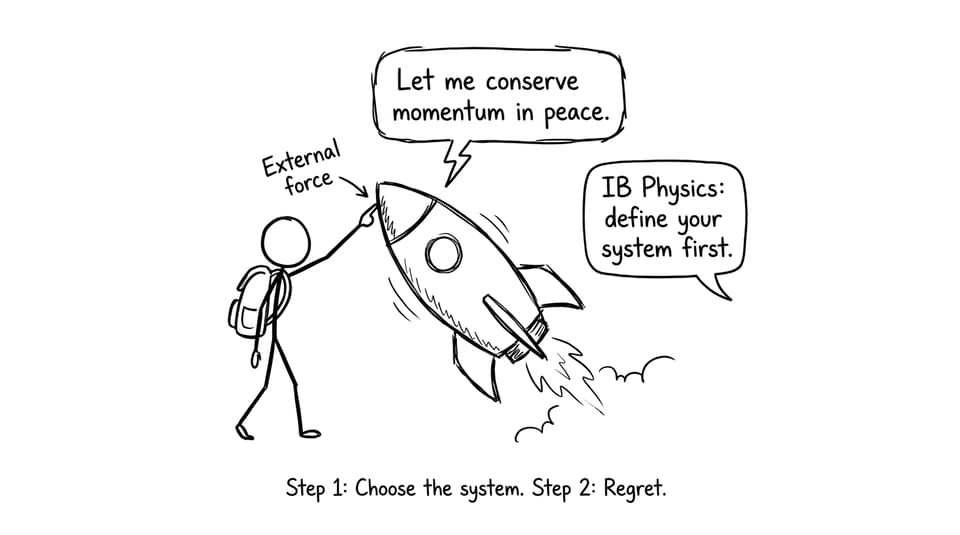
Momentum doesn’t usually vanish. It gets transferred into something you didn’t include.
Classic examples:
-
A person jumps off a boat: momentum is shared between person and boat
-
A bouncing ball: momentum changes direction, but the Earth-ball system accounts for the exchange
-
A crash with friction: momentum can leave your chosen system via external impulses from the ground
In IB Physics, the mark-winning move is to state this explicitly: “Momentum is conserved in the isolated system of X and Y” or “Momentum is not conserved for the object alone due to an external impulse.” If you want a strong foundation for these definitions, keep the Momentum and impulse notes (2.4) nearby during revision.
Final takeaway for IB Physics revision
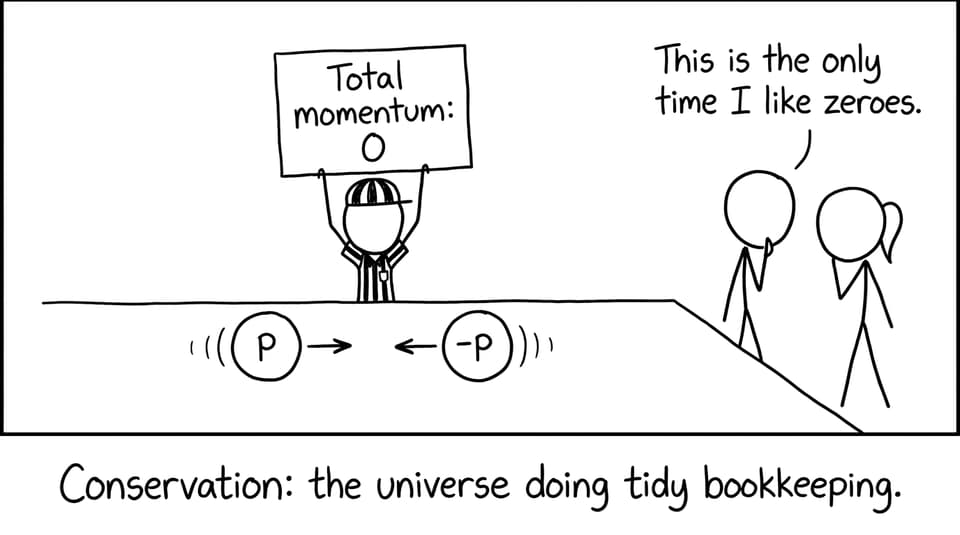
Momentum conservation is fundamental because it’s universal, symmetry-rooted, and powerful enough to survive the chaos of real interactions. In IB Physics, it’s also a scoring opportunity: define the system, justify isolation, conserve momentum, and only then chase algebra.
If you want this to feel effortless under timed conditions, use RevisionDojo’s IB Physics resources hub alongside the Questionbank, Study Notes, Flashcards, AI Chat, Grading tools, Predicted Papers, and Mock Exams. Momentum conservation becomes less like a topic you revise and more like a rule you trust.