



A quick hook: the same mass, two very different spins
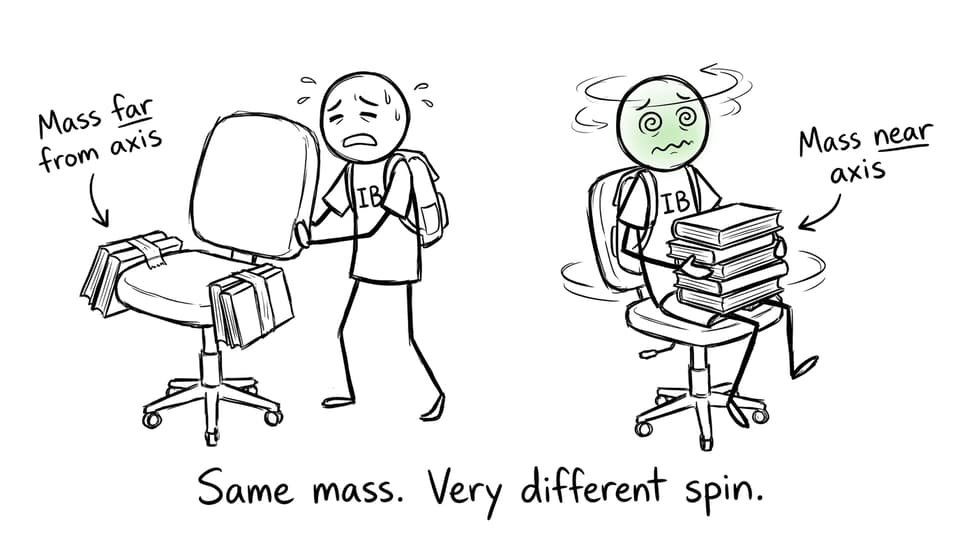
In IB Physics, one of the strangest (and most testable) feelings is realizing that mass isn’t the full story. Two objects can weigh the same, look similar, and still behave wildly differently when you try to spin them. One feels smooth. The other feels like it’s dragging through invisible mud. That difference is not “mystery friction” or “bad luck”; it’s where the mass is located compared to the axis of rotation.
That single idea powers a whole cluster of exam questions on torque, angular acceleration, and conservation of angular momentum. And it’s exactly why the distribution of mass affects how an object rotates.
The exam checklist (what to remember fast)
For IB Physics rotation questions, keep this mini-checklist in your head:
-
Rotation depends on moment of inertia (I), not just mass (m)
-
(I) depends on mass distribution: farther from the axis means larger (I)
-
Torque links to angular acceleration: (\tau = I\alpha)
-
For point masses: (I = \sum m r^2) (distance from axis is squared)
-
Changing the axis changes (r), so it changes (I)
If you want a syllabus-aligned summary, use RevisionDojo’s A.4 Rigid body mechanics notes and then drill it with the A.4 Rigid body mechanics Questionbank.
Why mass distribution matters: moment of inertia in plain language
In linear motion, inertia is basically “how hard it is to change velocity,” and in IB Physics you tie that to mass. Rotation has the same idea, but upgraded: “how hard it is to change angular velocity” depends on both mass and how far that mass sits from the axis.
That resistance is the moment of inertia (I). The key feature is the (r^2) term in (I = \sum m r^2). Squaring the distance means moving mass outward matters a lot. Double the distance from the axis and you quadruple that part of (I). So even if total mass stays constant, shifting mass toward the rim can make an object dramatically harder to spin up (or slow down).
For a clean, exam-ready definition and examples, RevisionDojo’s A.4.2 Moment of inertia notes are the quickest way to turn intuition into marks.
Torque, angular acceleration, and the hidden “price” of spinning
Once you accept that (I) can change, the most important IB Physics equation becomes almost obvious:
Same torque (\tau), bigger (I) means smaller angular acceleration (\alpha). That’s why a hollow cylinder (more mass near the outside) is tougher to start rotating than a solid one of the same mass and radius. You’re paying extra “rotational cost” because more of the mass lives far from the axis.
If torque still feels slippery, pair the notes with RevisionDojo’s A.4.1 Torque and rotational motion videos and then reinforce with targeted practice from the B.1 rotational dynamics Questionbank.
A story you can reuse in answers: the skater (and the homework)
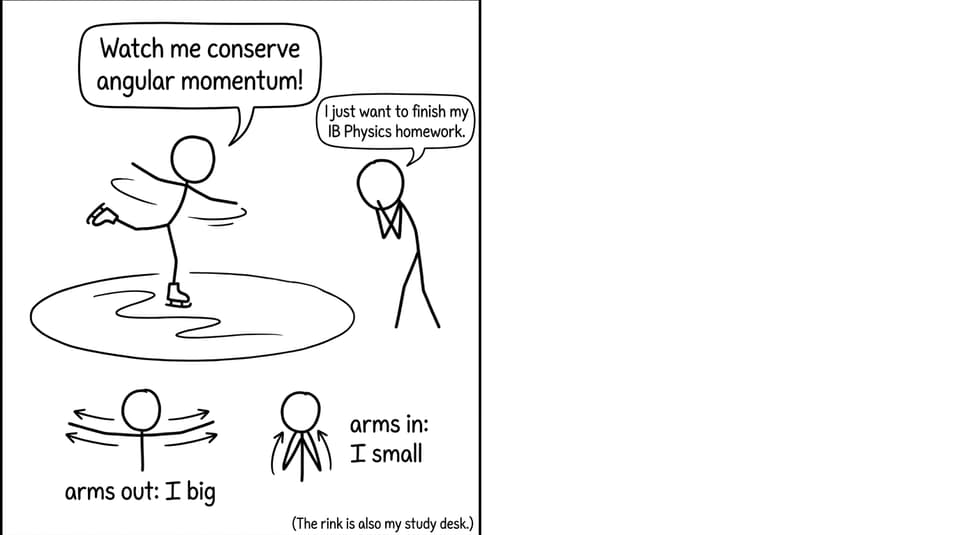
You’ve seen the classic example: a figure skater spins faster when pulling arms in. In IB Physics, the reason is that pulling arms inward reduces (r) for a lot of their mass, which reduces (I). With angular momentum (L = I\omega) conserved (no significant external torque), a smaller (I) means a larger (\omega).
That story works because it shows the full chain: mass distribution changes (I); then either (\tau = I\alpha) explains acceleration changes, or (L = I\omega) explains speed changes.
To connect this to the wider mechanics picture, RevisionDojo’s Mechanics hub helps you stitch rotation back to forces, energy, and momentum.
Where this shows up in real systems (and in exam questions)
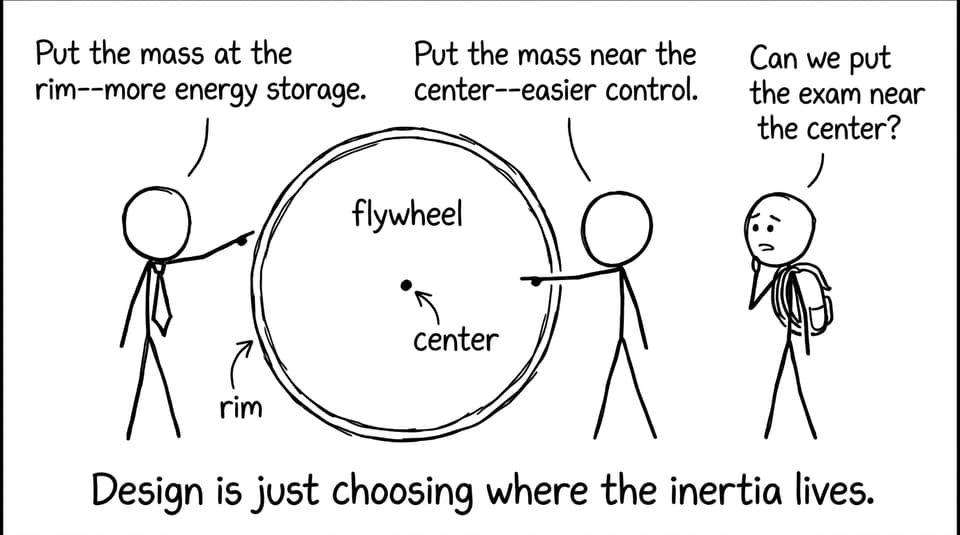
Engineers use mass distribution on purpose. Flywheels store energy efficiently by keeping more mass near the rim, boosting (I) and stabilizing rotation. Sports equipment does the same: a bat, racket, or hammer can feel “heavy to swing” because its effective rotational inertia about your hands is large.
In IB Physics questions, you’ll often be asked to compare two shapes, two axes, or two mass placements, and justify which has the larger (I) or needs more torque for the same (\alpha). For topic-by-topic navigation while revising, start from IB Physics revision notes (SL/HL).
Final takeaway (and how to turn it into marks)
Mass distribution affects rotation because IB Physics measures rotational “stubbornness” using moment of inertia (I), and (I) grows fast when mass sits farther from the axis. Once you see (\tau = I\alpha) (and, when needed, (L = I\omega)), rotation stops being a collection of tricks and starts feeling like one consistent story.
To lock this in before exams, use RevisionDojo’s A.4.2 Moment of inertia topic page for notes + Flashcards, then grind exam-style practice with the Questionbank feature. If you’re aiming for top marks, add RevisionDojo’s Predicted Papers, Mock Exams, AI Chat, and Grading tools to check your explanations under time pressure, the kind of pressure where IB Physics definitions either stick, or slip.